From clinker-built timber boats and oars to deep-vee GRP trailer boats and an amphibious flagship, the Haines Hunter story spans eight decades of New Zealand boatbuilding. It has not been a story of change for change’s sake, but of retaining what works and steadily improving the rest.
An 80th anniversary invites a little nostalgia, but the Haines Hunter story is more interesting when viewed as an account of survival, adaptation and continuous development.
To be precise, 2026 marks 80 years since SeaCraft, the New Zealand company from which today’s Haines Hunter business evolved, was established. The Haines Hunter name arrived here later, in 1980, and came fully into New Zealand ownership in 1985. That distinction matters, but so does the continuity throughout the period: boats designed and built by skilled people, for the way New Zealanders use them.
Plenty has changed since Yeoman ‘Sandy’ Sands founded SeaCraft in Auckland in 1946. Timber gave way to fibreglass, modest Seagull outboards gave way to engines producing hundreds of horsepower, electronics took over dashboards, and hardtops became almost standard equipment on larger trailer boats. Yet the basic test of a boat remains much the same. It must be safe, practical and predictable when the weather turns against you.
That is where the modern Haines Hunter motto, ‘The Ride Just Gets Better’, earns some substance. It does not suggest that every successful hull must be discarded for the next fashionable idea. Haines Hunter’s approach has generally been more measured: preserve the qualities owners value, listen to what they want improved, then apply better design tools, materials and equipment when those changes produce a genuine benefit.
THE SEACRAFT FOUNDATIONS
Sandy Sands brought an unusual depth of experience to the new company. Before the Second World War, he worked on coastal scows, in commercial fishing, and at Ship Builders in Auckland. During the war, he served with the 22nd Battalion, was captured on Crete, and spent the remainder of the conflict as a prisoner of war. While in captivity, he studied naval architecture using material supplied through the Red Cross. After liberation, he worked with respected English yacht designer Uffa Fox on the Isle of Wight and became an associate member of the Royal Institution of Naval Architects.
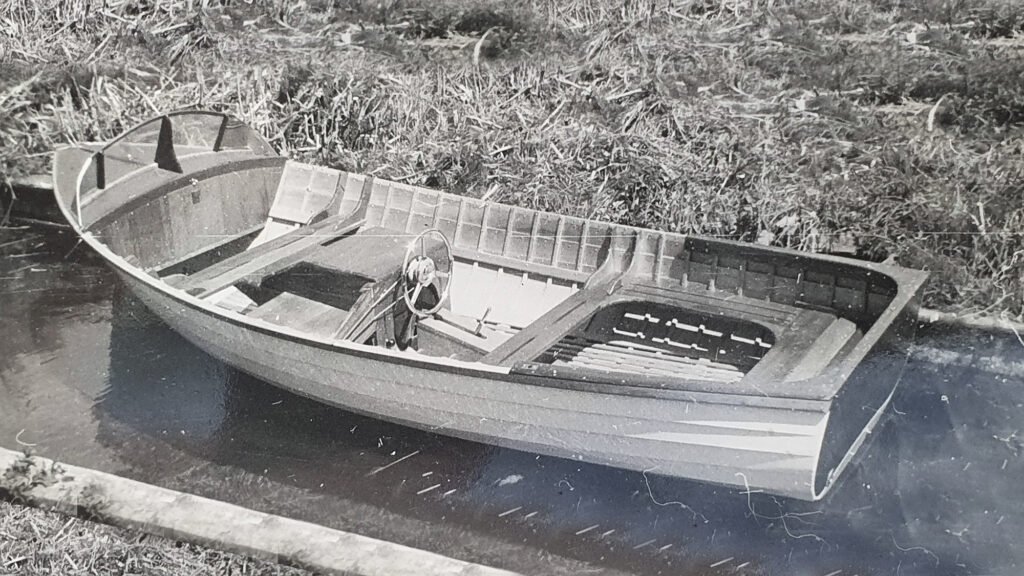
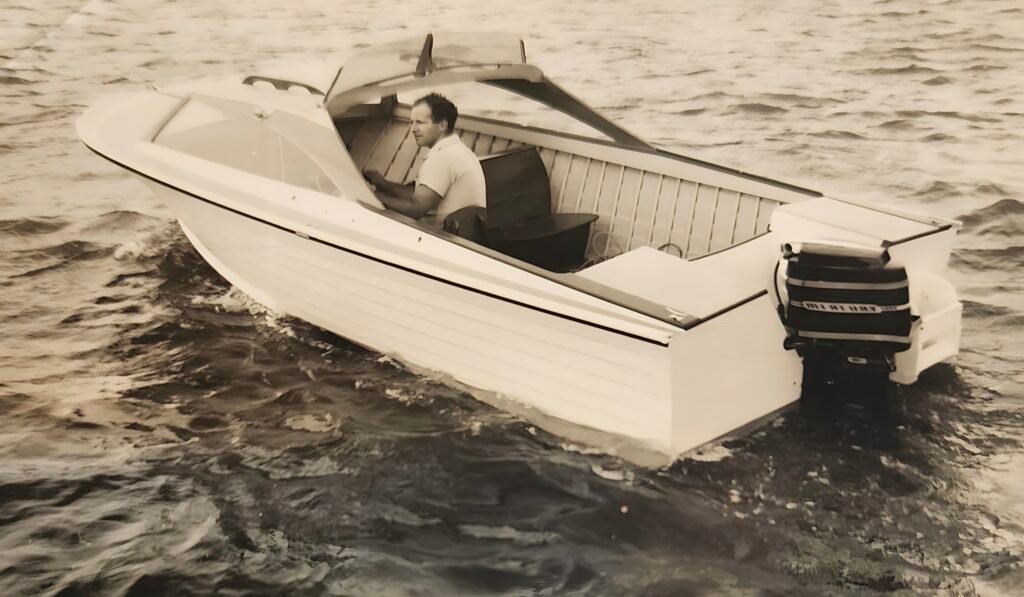
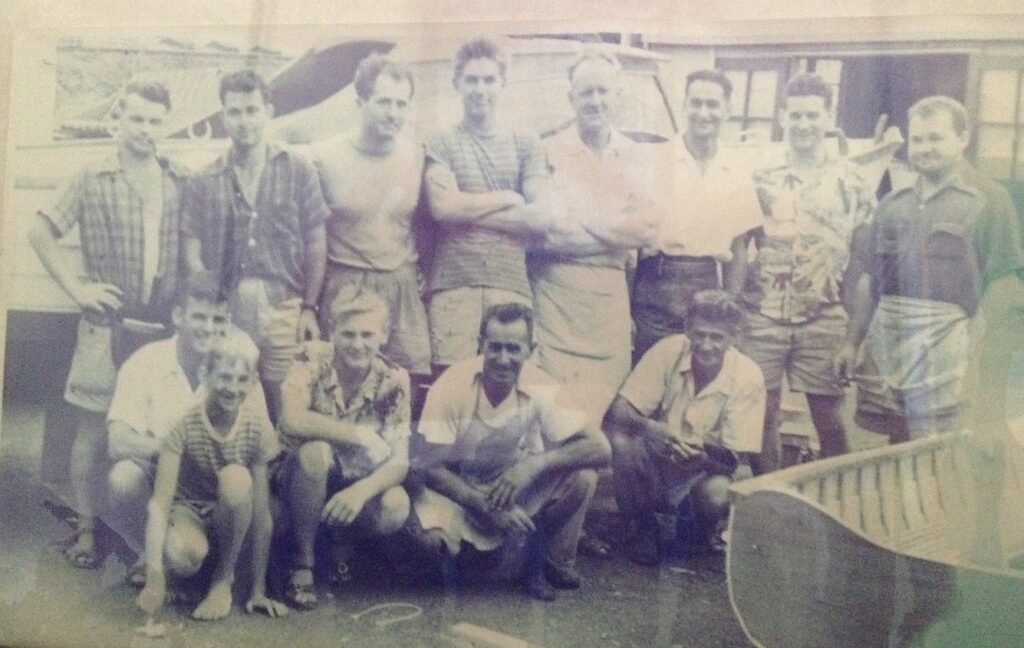
Back in New Zealand in 1946, Sands established SeaCraft in Cawley Street, Ellerslie. Its early output included clinkerbuilt timber boats and oars, powered by Seagull outboards or small inboard engines. SeaCraft became a major manufacturer of oars, reportedly the country’s largest for more than 20 years, but its greater long-term contribution was the standard it established for production boatbuilding.
Sands invested in apprenticeships, and many young tradesmen who learned their craft at SeaCraft went on to build their own careers and businesses. The formula was straightforward: sound designs, suitable materials, and properly trained boatbuilders. It is a philosophy that reads like common sense, although maintaining it consistently over decades is considerably harder.
During the 1950s, growing access to outboard motors helped expand recreational boating. Demand for well-built timber boats made SeaCraft one of New Zealand’s leading production builders. Sands also became involved in the wider industry and was elected the inaugural president of the Boating Industries Association, representing boatbuilders as the local marine sector began to find a collective voice.
FROM TIMBER TO FIBREGLASS
By the mid-1960s, fibreglass was changing boatbuilding production internationally. It promised repeatability, lower maintenance and shapes that could be reproduced accurately from moulds, but it also required different skills and tightly controlled processes.
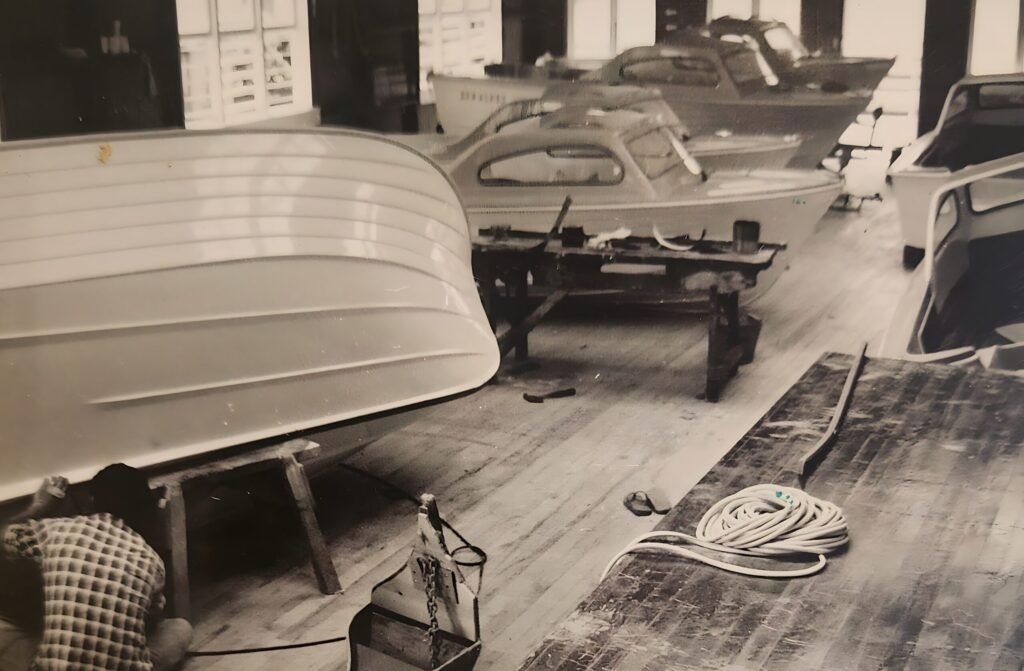
Following exposure to the emerging technology, including a visit to the Los Angeles Boat Show in 1965, SeaCraft sent staff to California to learn the methods involved. It then built a dedicated temperature and humidity-controlled laminating factory in Auckland. This was a serious investment rather than a quick conversion from one material to another, and it allowed the company to move into GRP construction while retaining control over quality.
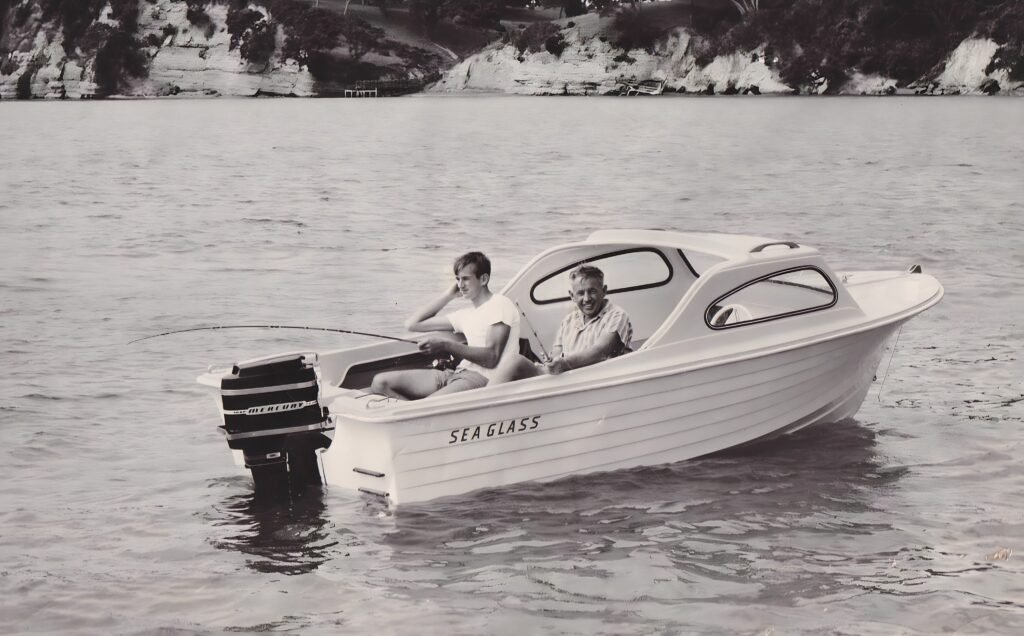
Growth followed. A Fiji factory opened in 1967 to support exports, while the expanding domestic market absorbed a range of SeaCraft fibreglass boats. By the early 1970s, more powerful outboards were widening what a trailer boat could do. SeaCraft acquired the Mercury franchise and produced boats to match engines of up to 130hp, substantial power at the time.
The SeaCraft Valencia became the flagship. An 18-footer commonly paired with a 115hp Mercury, it sold as a complete rig for about $5,000, and at the height of demand the factory was reportedly turning out two Valencia’s a week alongside other models.
Then came a reminder that boatbuilding is shaped as much by economics as design. Fuel shocks, carless days, and, in July 1979, a 20 per cent sales tax on powerboats and caravans hit the industry hard. SeaCraft’s production fell dramatically. Service and repair work, together with limited yacht construction, helped keep the business operating, but the old model was no longer sustainable.
The Haines Hunter name arrives
In 1980, SeaCraft merged with Miller Moyes, the successful Auckland marine retailer led by Les Miller. Miller Moyes was a Haines Hunter reseller. The arrangement brought manufacturing and retailing together and gave the business a stronger route to market. At about the same time, Miller Moyes SeaCraft acquired the New Zealand manufacturing rights to the established Australian Haines Hunter range and began developing a national dealer network.
The origin of the Haines Hunter name lies across the Tasman. As the company tells it, Australian boatbuilder and racer John Haines developed his reputation driving offshore boats based on C. Raymond Hunt’s influential deep-vee design concept. The combination of Haines and Hunt became Haines Hunter, a name closely associated with offshore racing and rough-water performance.
The V198 was already the best-known expression of that pedigree. When a V198 powered by a Mercury Black Max 175 was reviewed in 1975, it represented what many considered the ultimate six-metre cabin boat of its time. Built from the mid-1970s into the following decade, surviving examples still have a loyal following. That durability matters to the wider story: the brand’s reputation came not from a slogan, but from boats that stayed in use long after their first owners had moved on.
In 1985, SeaCraft purchased Haines Hunter New Zealand outright from the Australian parent company. The brand was now fully locally owned, freeing the New Zealand operation to develop models specifically for local boating and fishing.
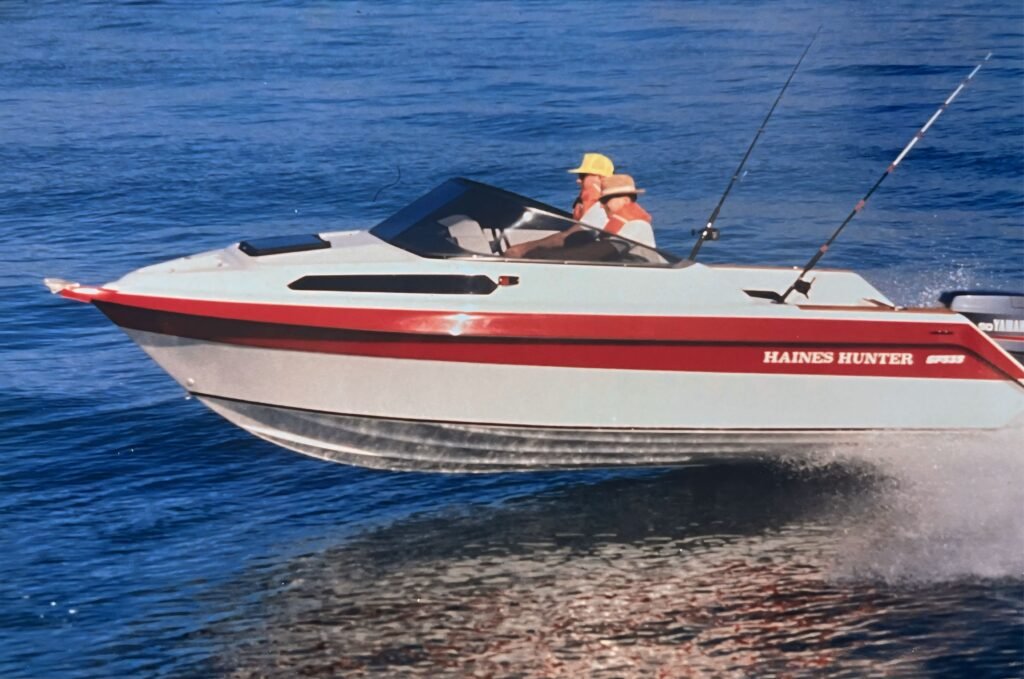
That period produced several boats that became familiar at ramps around the country. The 565L was introduced in 1984, followed in 1986 by the 1800S, SF535 and SF700. The SF535, in particular, became one of the most popular fibreglass trailer boats New Zealand has produced. Thousands of these 1980s-era Haines Hunters remain on the water, perhaps the best measure of their significance.
Building on successful hulls
The 1990 arrival of the SF600 added another long-running model to the range. It appealed to families as well as serious fishermen and, through successive updates, remained relevant for three decades. The SF650 lifted expectations for rough-water performance in its class, while the SF700 established Haines Hunter at the larger end of the trailer-boat market.
The SF700’s development also offers an honest example of continuous improvement. When a later-generation SF700 was released, designer Lionel Sands acknowledged that the company had probably relied on the original’s success for too long while it focused on the busy 535, 600, and 650 ranges.
The answer was not simply a new set of stripes. Owner feedback shaped a substantially revised boat that kept the original’s 21-degree deep-vee character but added more bow lift, a drier ride, extra freeboard, greater beam, and a more contemporary deck and cabin. Half of the first 15 boats delivered went to previous SF700 owners, people well placed to judge whether the new model represented real progress.
This willingness to refine rather than abandon a proven identity became a recurring Haines Hunter theme. Driving positions, the familiar king-and-queen seating, usable cockpits and strong rough-water manners carried forward, while layouts, storage, weather protection and construction developed around them.
The business itself changed as well. Sandy Sands died in 1990, still closely involved with the company he had created. Les Miller retired, and Denis Kendall joined the management team alongside Sandy’s son Lionel, later becoming a shareholder and ultimately owner and chief executive. Through those transitions, the company remained locally controlled and retained its commitment to trade training and hands-on boatbuilding.
Hardtops, composites and changing expectations
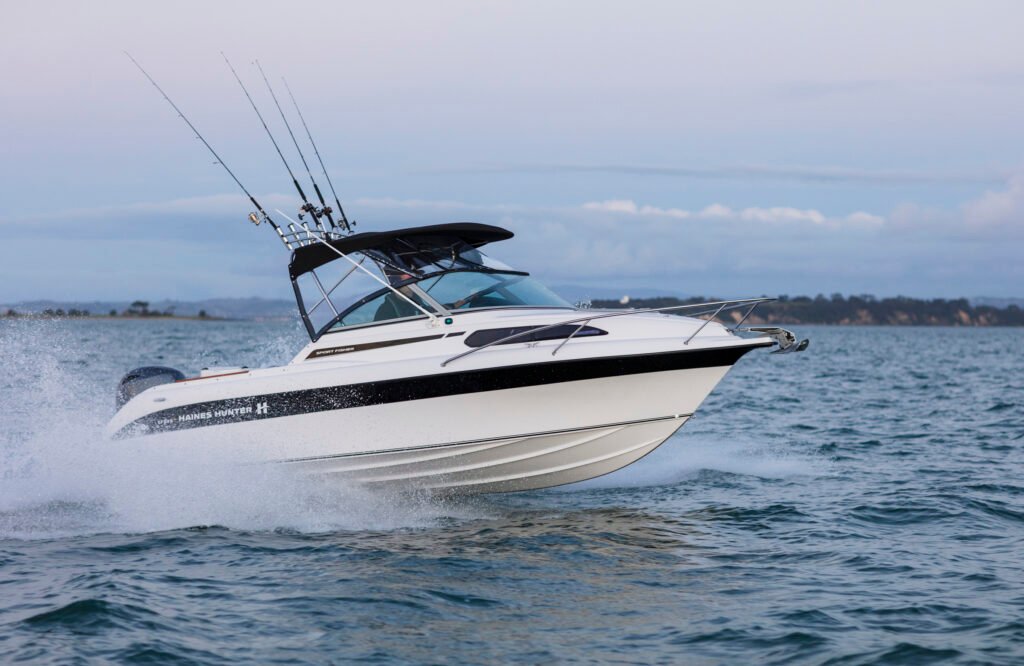
During the 2000s, models including the SF650, SS660, SFS700, and sterndrive SS720 reflected how trailer boating was changing. Fishing remained central, but buyers increasingly expected better weather protection, more comfort and equipment previously associated with larger cruisers.
Haines Hunter was among the local builders to develop moulded fibreglass hardtops paired with custom curved toughened-glass windscreens. These were not merely roofs added to existing boats. A successful hardtop affects weight distribution, sightlines, access, ventilation and the overall balance of the design. Done properly, it extends the boating season and makes family cruising or an overnight trip more practical without losing the open cockpit fishermen require.
Construction also continued to evolve. The 485, introduced in 2009, showed the company responding to a different part of the market. It was designed for 50–70hp outboards and for owners who wanted a Haines Hunter ride, finish, and fishing practicality in a smaller, easier-to-handle package. Its hull liner used resin-infusion technology and became a structural part of the boat, giving the factory a chance to gain experience with a process that offered more consistent laminate thickness and lower weight without sacrificing strength.
In the following decade, models such as the 545 and flagship 725 series arrived, while structural GRP and foam-cored floor systems made hulls stiffer, stronger and lighter. The change mattered because rigidity is not simply a factory talking point. A hull and floor working together as a structure reduce flex, contribute to durability and allow the running surface to perform as its designer intended.
What remained was the labour content. Haines Hunters are production boats, but they are hand-built. As PowerBoat Magazine documented during a recent SP635 build, once the main moulded components were assembled, one boatbuilder took responsibility for bringing an individual boat through to completion. Modern CNC-cut composite components, Thermo-Lite structural material, carbon-fibre reinforcement and digital build records now sit alongside hand laminating, upholstery, teak detailing and tools that have served the factory for decades. Even SeaCraft’s old timber steam box found a second life heating rubber fendering before installation.
A new generation of the ride
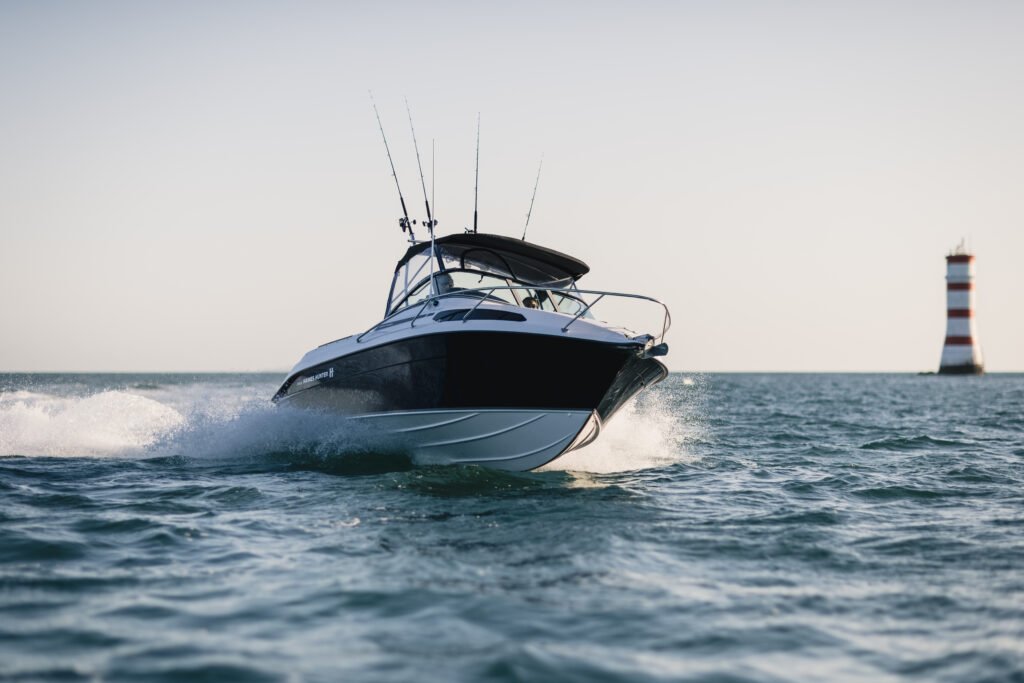
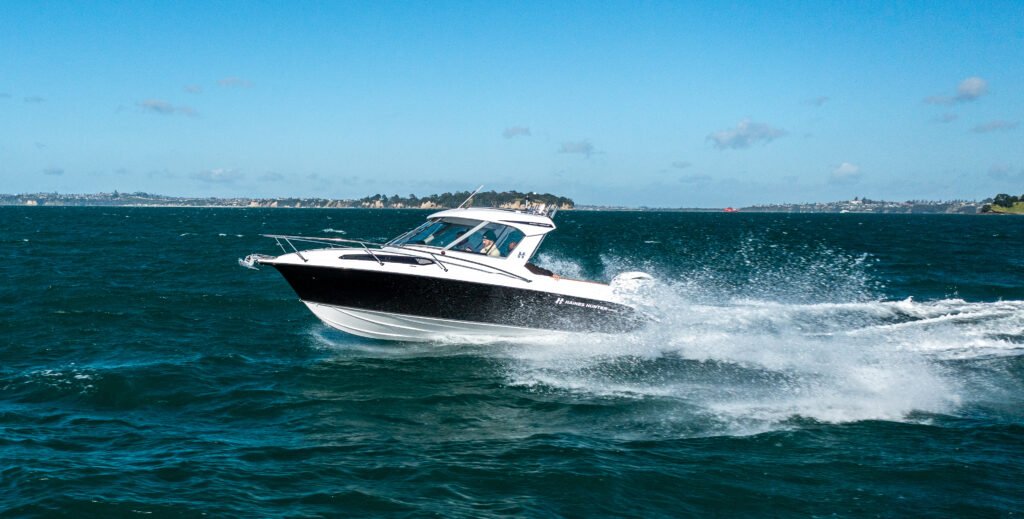
The 2020 launch of the SF635 neatly illustrates the balance between heritage and improvement. Rather than continue modifying the long-serving SF600, Haines Hunter spent two years developing a completely new hull and deck. The 635 retained the 21-degree deep-vee and recognisable Haines Hunter layout, but added a revised bow entry, reverse sheer, more space, a dash sized for modern displays and a bonded foam-core composite floor creating sealed buoyancy compartments.
The SP635 hardtop followed. Its lightweight resin-infused carbon-composite roof, sliding side windows, CZone digital switching, automatic trim control and integrated electronics showed how far the equipment level of a six-metre trailer boat had advanced. More importantly, when PowerBoat Magazine tested it in a 25-knot Auckland Harbour breeze and a short half-metre sea, the underlying hull did what a Haines Hunter is expected to do. It felt stiff and composed, ran best when allowed to work on top of the chop, and delivered the rough-water confidence on which the brand has long traded.
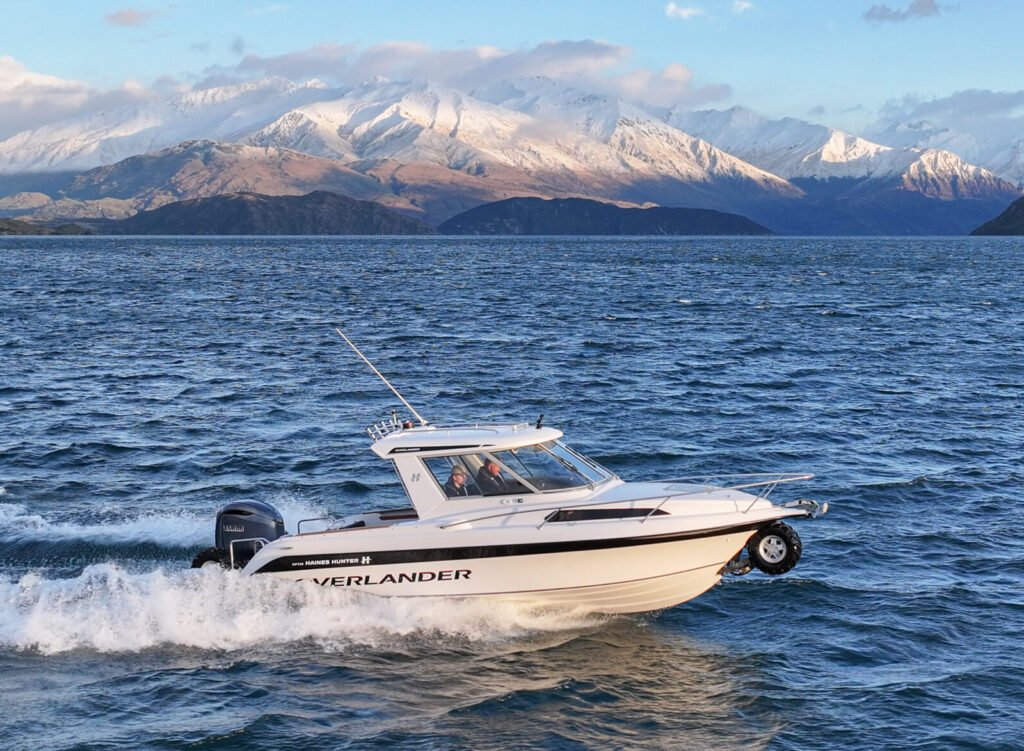
The OP725 Overlander took the next step in 2024, combining the established SP725 platform with Anura’s electric-over-hydraulic amphibious system. Adding roughly 600kg of running gear required far more than fitting three wheels. The hull and high-load areas were re-engineered and reinforced with carbon fibre, while the hydraulic and electrical systems were integrated without consuming the cabin. It was a new use for an established platform and a practical response to the growing popularity of amphibious boating in New Zealand.
Better, not simply newer
Across 80 years, the company has survived material changes, recessions, punitive taxes, ownership transitions and shifting fashions. It has produced timber dinghies, oars, family runabouts, offshore sport-fishing boats, hardtops and now amphibious models. Not every boat was radical, nor did it need to be. Much of the progress came through small changes accumulated over successive generations.
That makes ‘The Ride Just Gets Better’ a fitting summary, provided ‘ride’ is understood in its broadest sense. It includes the deep-vee passage through a head sea, certainly, but it also covers better structure, safer buoyancy, improved shelter, more useful layouts, cleaner installations and technology that reduces the skipper’s workload.
It also describes the relationship between generations. Owners who began in a V198, 535, 600 or 700 have often stayed with the marque as their boating changed, while many of those older boats have become an affordable entry point for younger families. The factory’s job has been to respect that inheritance without becoming trapped by it.
Eighty years after Sandy Sands opened SeaCraft’s doors in Ellerslie, that may be the clearest thread of all. Good boatbuilding begins with sound design, quality materials and skilled people. Tools and materials improve, expectations rise, and boats become more sophisticated, but the obligation to build something worthy of taking a family to sea does not change.
For Haines Hunter, the laurels of its past are valuable only if they provide a foundation for the next boat. That is how the ride got here, and how it keeps getting better.