DISTINCTIVELY DIFFERENT. REMARKABLY PRACTICAL
McLay Boats has a long history and an enviable reputation for producing rugged, go-anywhere, go-anytime, in-any-weather (almost) boats, especially in the 6.5-metre-plus range of Hard Top Cabin (HTC) craft. So, it was quite a surprise to the boating public, including myself, when McLay revealed their all-new 6.9 metre Walk Around HT at the recent Hutchwilco Boat Show in Auckland – a radical departure from anything this company had produced to date.
Steve McLay founded the company almost four decades ago. In fact, McLay Boats will be celebrating its 40th anniversary next year. Based in Milton, south of Dunedin on the South Island’s rugged east coast, Steve recognised that boaties in this part of New Zealand required a tough, reliable craft, especially in their larger range. Boats that would allow captain and crew to get out of the weather when it turned nasty, or when they simply wanted relief from the cold on those frigidly crisp days in mid-winter (and sometimes in mid-summer), often experienced when boating in the lower half of the South Island.
So, how did a 6.9 metre Walk Around Cabin vessel come into existence? And why?
There are a few reasons, but to me, the most interesting and compelling is that this particular boat was pretty much the brainchild of Martin McLay, Steve’s son, who has now taken up the mantle from his father. Although Steve is still involved in the company, the McLay legacy now rests with Martin, and it was he who conceived the idea of an open, walk-around craft that would still offer ‘cabin-like’ protection from the elements.
Discussing the concept with his dad, Steve said, “Why not?”, and thus Martin set to work designing and building an aluminium craft that combines the comfort and weather protection of a hardtop with spacious, 360-degree wide walkaround decks, allowing easy access for fishing all around the boat.
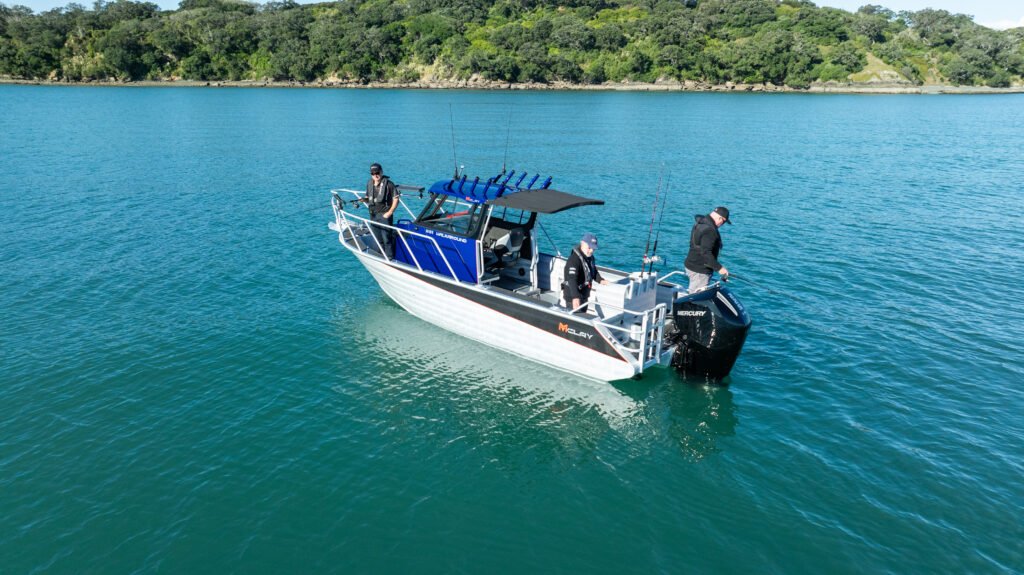
Out on the Hauraki Gulf, while putting the 691 Walk Around through its paces on test day, I asked Steve whether market demand and/or customer feedback had contributed to the concept and design. His typically laconic, South Island response was brief and to the point: “Partially, but it was mainly Martin’s idea”.
A walk-around boat has a wide deck around the entire perimeter of the boat. This allows convenient access to the water for fishing or swimming and provides ample room for passengers to move around on the boat. With this in mind, let’s have a closer look at the McLay 691 Walk Around and discover what this craft is all about.
Over the past thirty-plus years, McLay Boats has introduced a vast number of Hard Top (HT) and Hard Top Cabin (HTC) aluminium vessels to the boating market. Everything from the 571 HT through to the 851 Gen 2 HTC. In addition, there are a number of ‘open’ McLay boats. For example, the Fortress and smaller end Crossover and Sportsman range of boats.
Every boat is a compromise. But the 691 Walk Around is somewhat of a unique compromise in the under 7 metre category. Why? Well, for starters, there are plenty of centre console walkarounds on the market, lots of larger cabin boats (enclosed and semi-enclosed) walkarounds, but a smaller, hard top, semi-enclosed cabin boat walkaround? To the best of my knowledge, that’s rare.
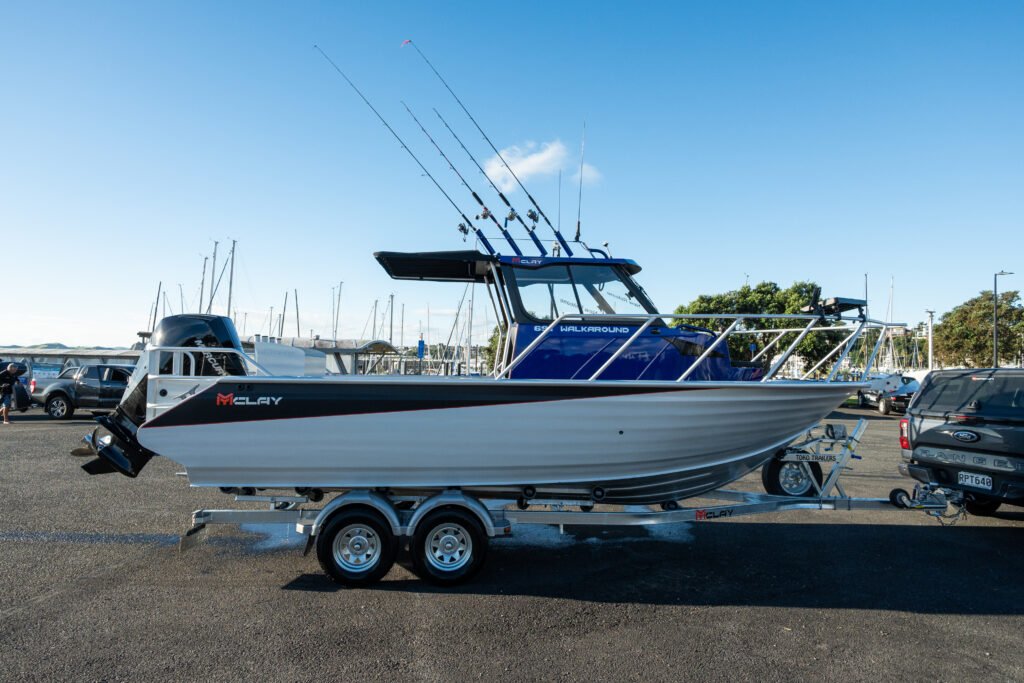
What McLay Boats have achieved with the 691 Walk Around is a functional and aesthetically pleasing aluminium craft that offers a large cockpit, easy access to the open bow (which resembles a bowrider type craft), a semi-enclosed helm cabin and a compact forward berth cabin, that in a pinch, allows you to stay out overnight if necessary.
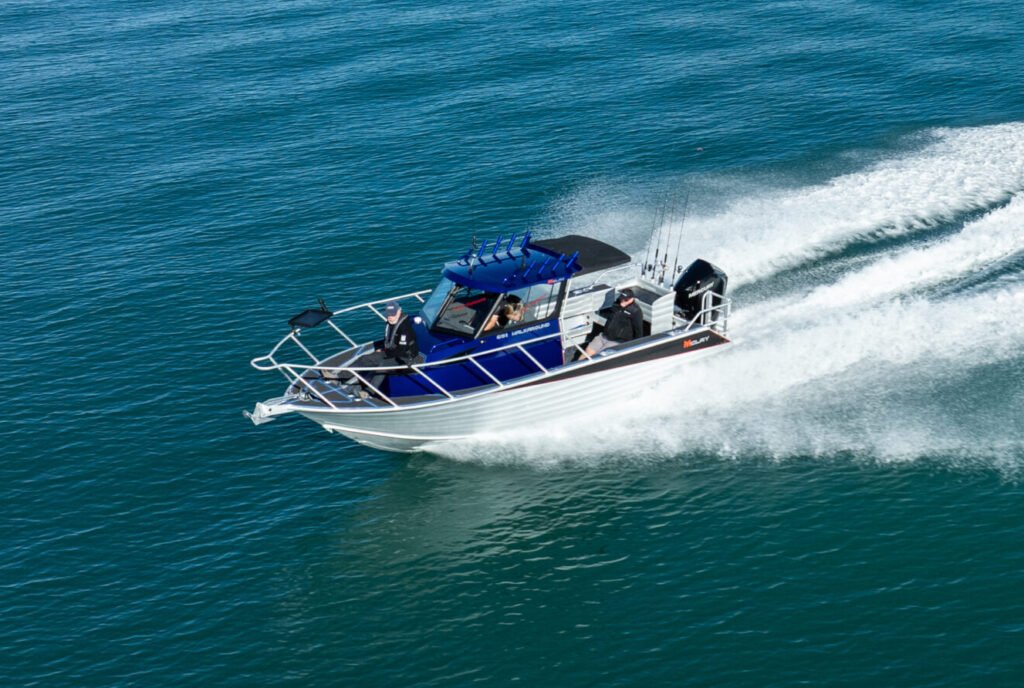
Arriving at Half Moon Bay Marina on the morning of “test day”, I found Steve and Peter Brown, the Mercury Outboard Distributor, already aboard the 691 Walk Around, launched and ready to go. With our photographer/videographer unable to join us until later in the day, the three of us set out towards Motuihe Island, in the Hauraki Gulf, to put the boat through her paces, record the all-important performance data and generally get a feel for the boat and whether or not she had achieved her design expectations.
Right from the get-go, I was impressed with this craft. Observing the 5-knot limit as we slowly manoeuvred out of the Tamaki Strait gave me ample opportunity to inspect the boat, discuss its features with Steve, and chat with Peter about the suitability of the 225 HP Mercury motor chosen for this all-new boat.
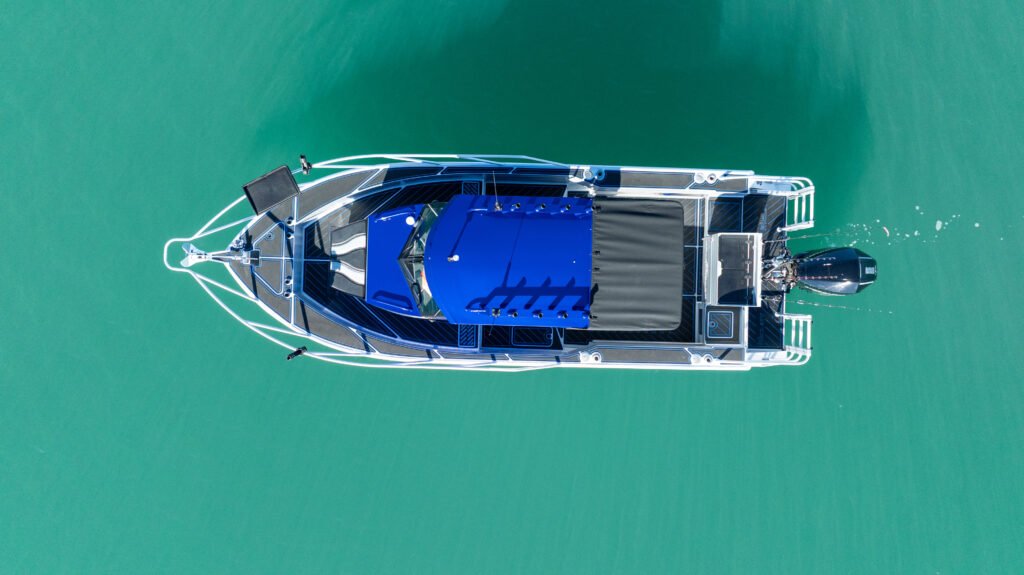
Jumping ahead a wee bit, allow me to state that there are a lot of features on this boat, but the four key elements that immediately caught my attention were the spacious walk-around decks, the semi-enclosed hardtop cabin, the large cockpit, and the open bow area.
It would seem to me that the hardest design challenge must have been incorporating the first two elements – the 360° walk-around decks and the helm station hardtop cabin – so that both actually work. You’d think something had to give, and something did give – space in the cabin. But not to the point that this has created a problem. Remember, compromise is a factor in any boat. With the McLay 691 Walk Around, the trade-off between usable walk-around decks and enough cabin space has been achieved. Sure, it’s a bit snug in there, but not to the point where three to four people can’t get out of inclement weather if need be.
This balance has been achieved by cleverly laying out the area such that, when the helmsperson is comfortably seated, with a full view of the simply and comprehensively laid out helm station, another crew person has ample room to stand alongside while underway, conveniently located grab handles providing security even in rough seas.
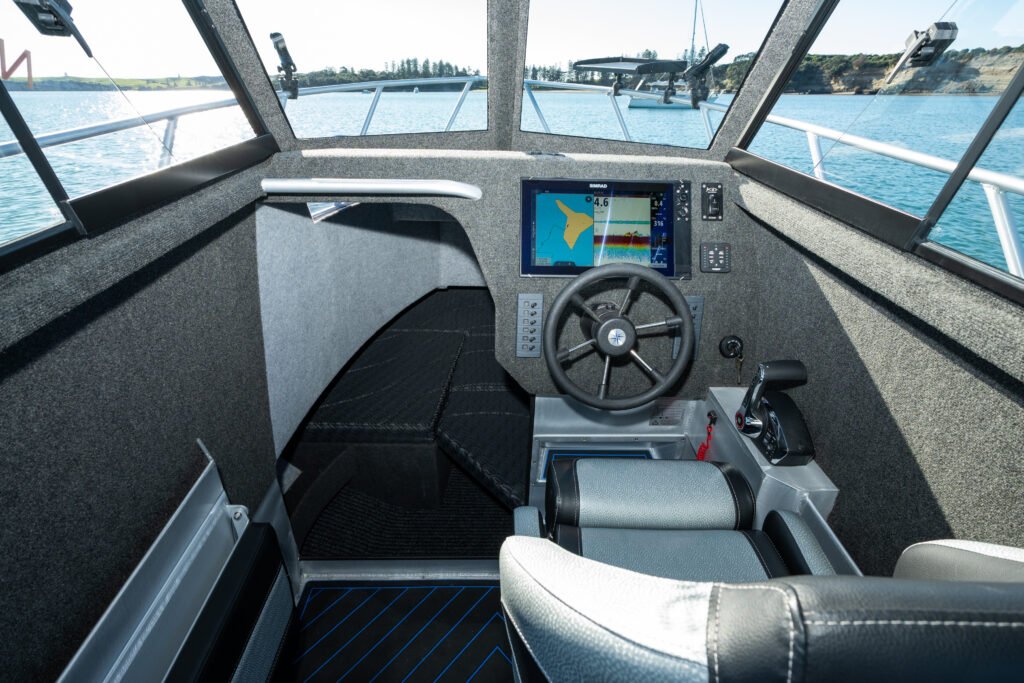
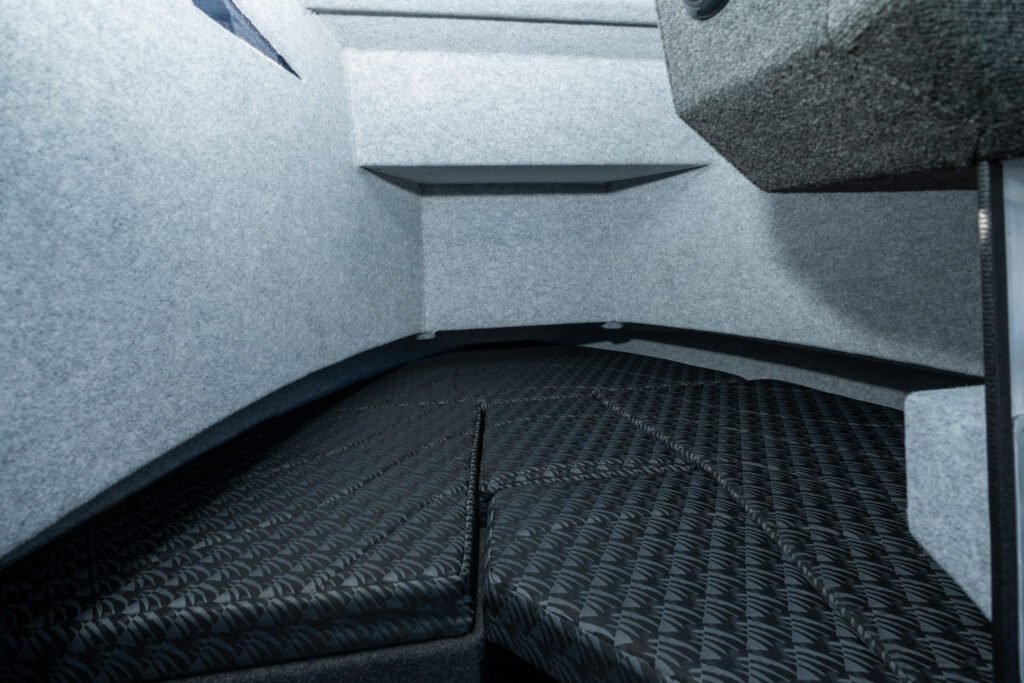
Now here’s a bit of design brilliance. An ingeniously designed and built flip-up double bench seat, fitted against the port wall of the cabin. In the down position, you have plenty of room to move around in the cabin or move forward to the forepeak cabin, where there is a snug, but usable twin V-berth with enough room under the removable centre squab to install a portable toilet. However, in regard to that fore/aft cabin bench seat, when it is flipped up and locked in (a very simple manoeuvre), you’ve got seating for two people to get out of the weather. But what if you have five people aboard? Where does the fifth poor shmuck sit? Da dah! The large, split lid chilly bin! Located under the non-conventional helm seat support, it protrudes just enough to provide space for a fifth person to sit and still be under cover. Comfortable enough, but as I pointed out to Steve, putting a Velcro secured squab atop the aft lid would be a bit comfier. His reply? “Yes, we were going to do that but just didn’t have enough time before the Boat Show”. Issue resolved.
Digressing for a moment, I asked Steve for his opinion on the boat’s performance as we idled out of the Tamaki Strait. Interestingly, he didn’t have an opinion because, other than a brief 15-minute run on Lake Waihola, close to the McLay factory, in order to ensure that everything was working (before shipping it up to Auckland for the show), they really hadn’t tested it. Turns out that Steve was looking forward to our sea trials out on the Hauraki Gulf as much as Peter and I were!
Impressed as I was about the snug but functional cabin and forward berth area, I was equally (and perhaps more) impressed with the rather wide walk-around decks. Sacrificing a bit of room inside the cabin allowed for more than ample walkway decks outside of the cabin. Not only are these port and starboard side decks wide enough to comfortably and safely (due to the high bow rails) move forward to the roomy and open, bow rider like foredeck, they are expansive enough to comfortably stand while fishing off either side. Moving from the aft cockpit to the bow on either of these side decks, you will find a double step up, with a lidded compartment between the two steps on the port side, for additional storage such as dive weight belts. Forward of the top steps are integrated drainage scuppers with artistically styled covers. Do they work well? We were not to find out on test day, as the sea was as calm as you are ever likely to encounter, and the only way we could test the boat’s capability in large waves was by slamming the boat through the wake of frequently passing ferries or bouncing through our own wake, generated by successive tight turns. After doing this several times, I was amazed to discover that very little water came over the bow. Another design plus.
Up until now, I have alluded to a plethora of features in addition to those I’ve already mentioned, many of which you might expect, some you may not expect and some that turn out better than you might expect. But to avoid being overly verbose in pointing these out, I’ve instead summarised them as ‘features and benefits’ bullet points as follows:
Cabin:
- Helm station instrumentation – minimalist, simple and intuitive, with the Simrad EVO3 16-inch Multifunction Display (MFD) providing all the information you need (see also below).
- Helm station controls – minimal and ergonomically situated for easy access and use, comprising the up/down remote anchor switch for the drum reel, rope/chain anchor winch, the Electrotab trim tab control, two six-switch panels for the likes of the bilge pump, wash down hose, wipers and lights, etc., outboard motor switch and the steering wheel. That’s it!
- Helm seat and footrests – whether sitting on or standing in front of the comfortable, deluxe bolstered pilot seat, you’ll find two cleverly designed footrests incorporated into the forward bulkhead.
- Windows – large forward windows with twin wipers, opening side windows for ventilation and clear visibility through both these and the windscreen.
- VHF and lights – the radio, mounted above the windscreen, is easy to reach, and an interior cabin, roof-mounted high-intensity light (facing aft) provides ample cockpit lighting.
Forepeak:
- Forward cabin/berth – although not large, it is just spacious enough for two adults if overnighting becomes necessary. Otherwise, it provides an ample area to relax or a place for the kids to play.
- Fusion stereo – mounted to the starboard bulkhead as you enter the forward berth and easily accessible from the helm station. Two speakers – one internal and one external.
Cockpit:
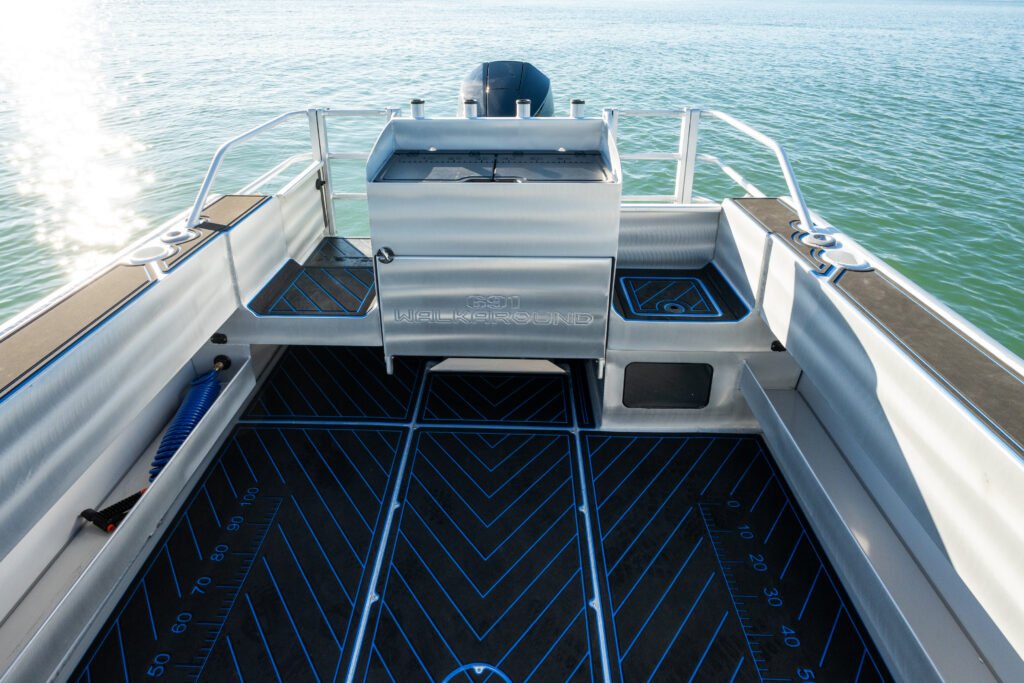
- Large and spartan – everything you need and nothing you don’t, with room enough for four anglers. An extendable canvas sunshade provides additional shelter and sun protection.
- Smartly designed bait station – incorporates a twin lid cutting board, bait sink, four rod holders and a useful, fold-down aft seat that also gives access to the battery and electrical switch gear compartment.
- Saltwater live bait tank with Perspex window – located at the port stern of the cockpit, above which, through a removable panel, provides entry to the Portofino-style transom and swim platform, which can also be accessed through a similar aft starboard panel.
- Rod holders – abound everywhere. Four on the aft side of the bait station. Two (along with associated cupholders) on the top of the port and starboard gunwales. Eight on the hard top cabin roof and four more up in the bow area.
- Swim platform – wide and roomy (access described above).
- Cockpit and deck surfaces – non-slip and soft underfoot Boat-dek ® cladding is extensively used throughout the whole cockpit area and elsewhere on all walking deck surfaces and atop the gunwales around the boat.
Foredeck:
- Bow Rider Appearance – this carefully thought-out area provides more room for anglers with an additional four rod holders mounted in the foredeck. There is easy access to the self-draining chain locker, housing the Sav1500SS rope/chain drum reel anchor winch.
Construction:
- Hard-wearing aluminium plate – like most of McLay’s boats, the 691 Walk Around features a reverse chine. This design deflects spray outward and keeps the ride remarkably dry even in choppy offshore waters.
- Hull and chines – 5 mm marine-grade aluminium with 4 mm sides and tops, featuring a strong double keel, wide gull wings for stability and multiple sealed buoyancy chambers. The stern of the gull wings allows easy provision for either Humphree or Zipwake stabilisation systems.
Mercury 225 HP V6 Four Stroke Outboard:
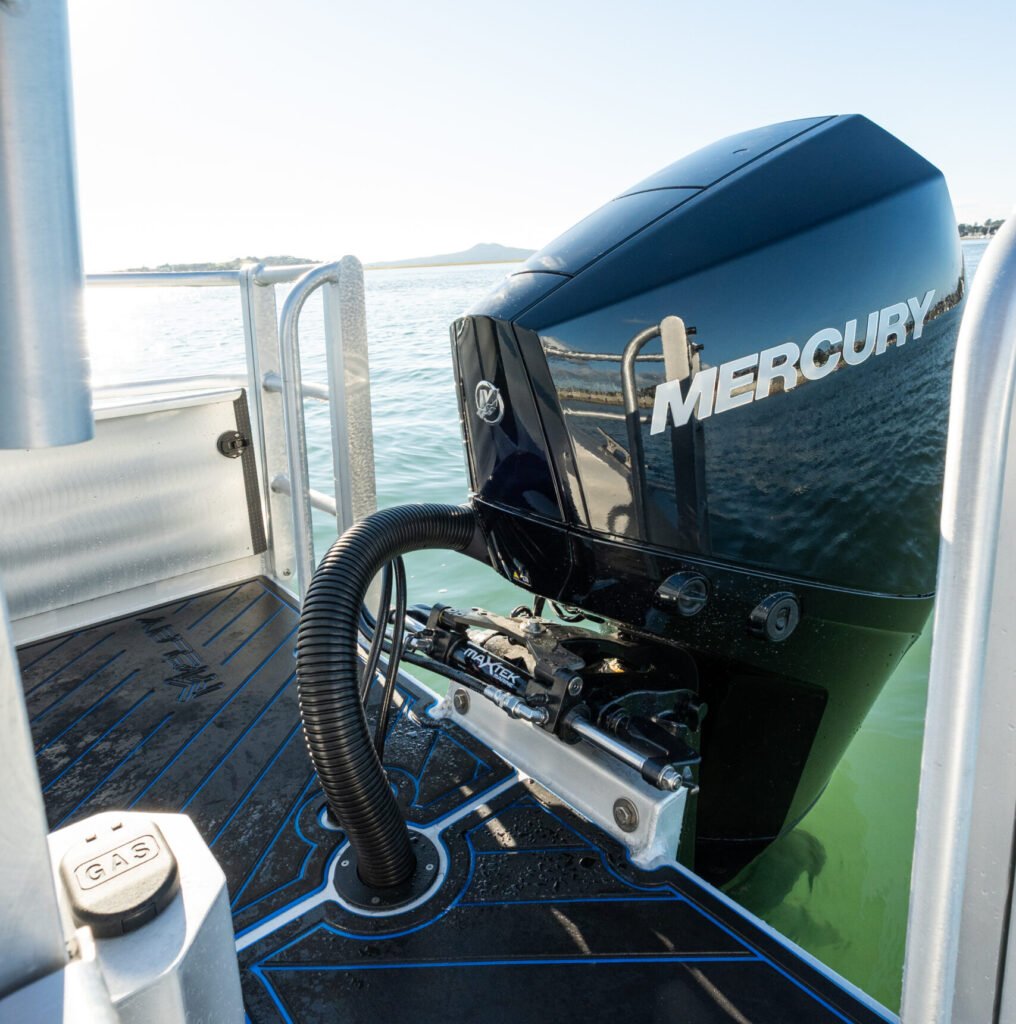
Although the 691 Walk Around can be spec’d with an outboard from between 175 HP to 250 HP, McLay and Mercury jointly agreed that the 225 HP was the best option for this latest vessel. I agree. The 225 HP Mercury is ideal, getting the boat up on the plane quickly and smoothly, and the only benefit of perhaps fitting a smaller unit would be slightly better fuel economy. And, as I previously mentioned, the helm station Simrad EVO3 MFD supplies just about all the information you need, from navigation to depth sounder and everything in between, including complete outboard engine information.
In talking to Peter Brown, I was impressed by the fact that the Mercury ‘Vessel View Link’ integrates your Mercury engine data with compatible Simrad or Lowrance displays, giving you full control and monitoring of engine and ‘Smart Craft’ features like Troll Control, Cruise Control, Smart Tow®, and Eco Mode. ‘Smart Craft Connect is designed to provide boaters with comprehensive engine monitoring and vessel intelligence. The Adaptive speed control is a standard feature that runs the ‘Vessel View Link’, supplying engine data directly to the Simrad MFD to provide real-time access to vital engine data, including RPM, speed, fuel flow, efficiency, temperature, trim, and battery voltage.
Adaptive Speed Control (ASC) is a standard feature on Mercury V6 Four Stroke Outboards, offering the following benefits:
- Consistent Performance: ASC allows for maintaining engine RPM without frequent throttle adjustments, which is particularly beneficial in rough waters or during tight turns.
- Enhanced Control: The system automatically adjusts throttle and airflow to achieve or maintain a given RPM, improving overall handling and responsiveness on the water.
Performance:
Now that you know about the boat, its features and its propulsion system, what about overall performance?
It may sound like a cliché, but when it comes to a McLay boat, you kind of expect that impressive performance is a given. This new Walk Around is based on McLay’s proven 6.61m hull. Having tested their similarly hull-designed 621 Sportsman HT about a year ago (Powerboat September/October 2025), and being mightily impressed, I expected no less of the Walk Around performance. My summary then of that craft: “The 621 HT is one mighty little performer as well as being highly practical”. That pretty much sums up this new McLay 691 Walk Around, with one final comment. I really couldn’t find much wrong with this boat. If an under 7 metre Walk Around is what you’re looking for, take a close look at the McLay 691 Walk Around HT Cabin.
Summary:
The 691 Walkaround is the latest addition to McLay’s range, an exciting new model that stands apart from anything they’ve built before. It combines the comfort and weather protection of a semi-enclosed hardtop cabin with spacious, wide walkaround decks, allowing easy access for fishing all around the boat. Thoughtfully designed and packed with features, it’s perfectly suited for families, anglers, and divers alike. Built for both lake and sea use, the 691 Walk Around offers versatility, performance, and practicality in one impressive package. I expect this model to become a standout favourite in the McLay range during the months and years ahead.
SPECIFICATIONS
LOA 7.10m
Beam 2.33m
Freeboard 830mm
Hull Weight (approx) 1400kgs
Transom Height 25″
Outboard HP Required 175-250
Fuel Capacity 220 L
PERFORMANCE DATA
RPM L/PH KNOTS
600 2.2 3.3
1500 6.6 6.7
2500 14.4 10
3500 25.4 21.5
5000 51 32.6
5800 73.8 39.4