BREAKING THE WATERLINE
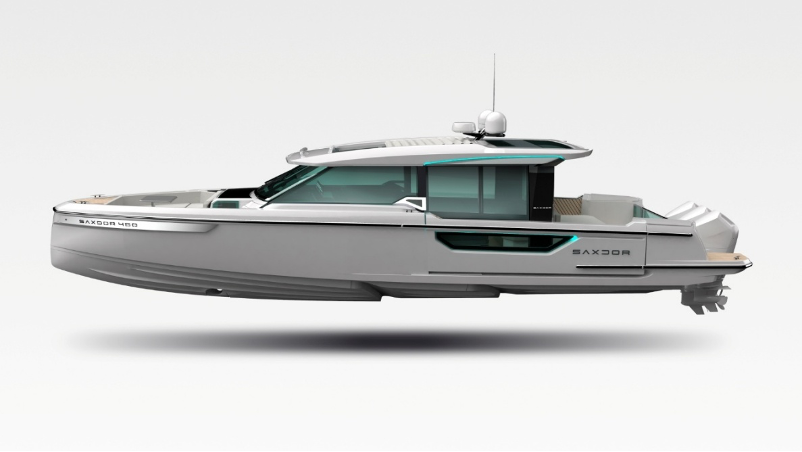
For decades, powerboat hull design has followed a familiar path, refining the deep-V, improving ride softness, and squeezing out incremental gains in efficiency and speed. But beneath the surface, a quiet revolution has been underway. From stepped hulls to foil-assisted designs and air-managed running surfaces, the modern planing hull is evolving into something far more sophisticated than its predecessors.
The question is no longer whether hull design is changing; it’s how far and how fast it will go.
The Rise and Maturity of the Stepped Hull
Stepped hulls were once the preserve of high-performance offshore race boats, often viewed as temperamental and unforgiving outside expert hands. Today, they’ve become mainstream. Builders across the spectrum, from trailer boats to luxury cruisers, have embraced stepped designs as a proven way to increase performance without dramatically increasing power.
At their core, steps introduce controlled air beneath the hull, reducing wetted surface area and drag. The result is a boat that can run faster, flatter, and often more efficiently. Gains of 10–15 per cent in speed or fuel economy are not uncommon when executed correctly.
But the story of stepped hulls in 2026 is less about adoption and more about refinement.
Designers are now fine-tuning:
– Step placement and geometry to balance lift and stability.
- – Air flow management to ensure consistent performance across conditions.
- – Hull stiffness and structure to handle the different load paths introduced by aeration.
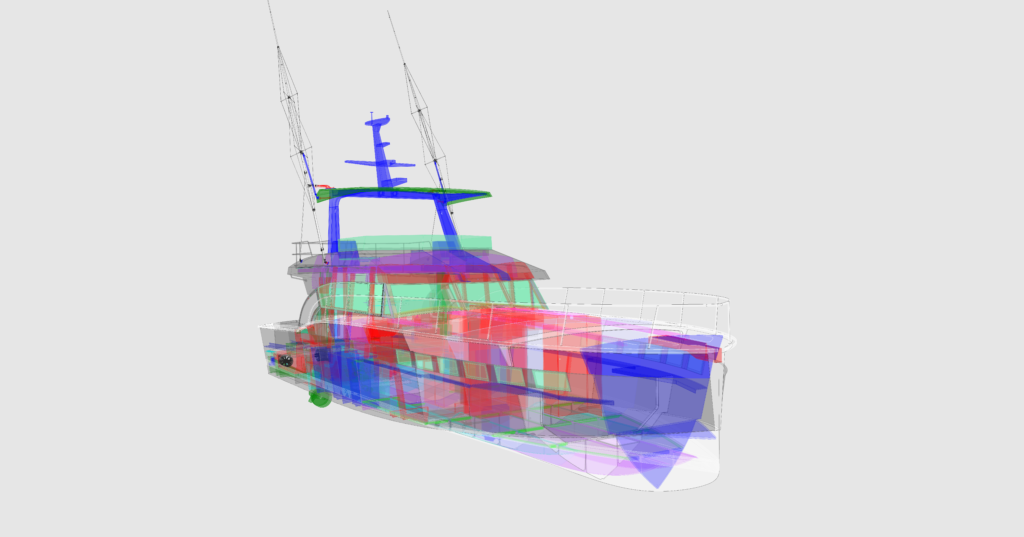
Modern stepped hulls are also far more forgiving than early examples. Advances in CAD design and computational fluid dynamics (CFD – using computers to simulate how fluids move and behave) have allowed naval architects to simulate real-world conditions with remarkable accuracy, reducing the trial-and- error that once defined high-performance hull development.
Managing Air, Not Just Water
If stepped hulls introduced the idea of aeration, the next wave of innovation is taking it further. Increasingly, designers are thinking not just about how a hull moves through water, but how it interacts with air.
Concepts such as:
- – Air lubrication systems
- – Fully ventilated running surfaces
- – Tunnel and hybrid hull forms
…are all aimed at one goal: reducing drag by replacing water contact with air wherever possible.
This is not without its challenges. Air is far less predictable than water, and maintaining consistent flow beneath a hull at varying speeds, loads, and sea states is complex. Too much aeration in the wrong place can lead to loss of grip, instability in turns, or inconsistent handling.
Yet the potential gains are compelling. Less drag means:
- – Lower fuel burn
– Higher speeds with the same horsepower - – Reduced hull stress at speed
For offshore and long-range cruising applications, these efficiencies are becoming increasingly attractive, particularly as fuel costs and environmental considerations come into sharper focus.
Foils Enter the Conversation
While aeration refines how a hull interacts with the water’s surface, hydrofoils offer a more radical proposition, lifting the hull partially, or even fully, clear of the water.
Foiling is hardly new. It has revolutionised high-performance sailing as we see with Team NZ, and is now firmly established in that world. But in powerboating, adoption has been slower, more cautious, and often more practical in its application.
Rather than full “flying” boats, the most relevant development for mainstream powerboats has been foil-assisted hulls.
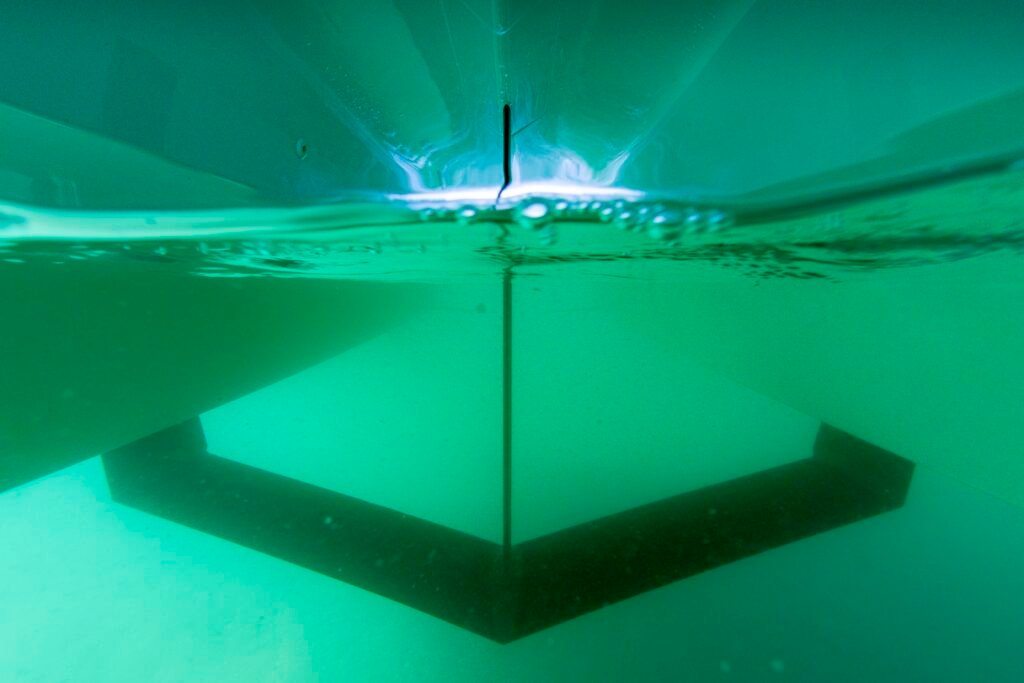
These systems, often mounted between twin hulls on catamarans or integrated into monohulls, generate lift as speed increases. The effect is to:
- – Reduce displacement.
- – Improve ride softness.
- – Increase efficiency without requiring full take-off.
Hydrofoil-supported or assisted catamaran designs have demonstrated that foil assistance can deliver tangible gains in both performance and fuel economy, particularly in moderate sea conditions.
The key advantage here is balance. Unlike full foiling craft, which demand precise control systems and often operate within narrower speed envelopes, foil-assisted boats retain much of the predictability and usability of conventional hulls.
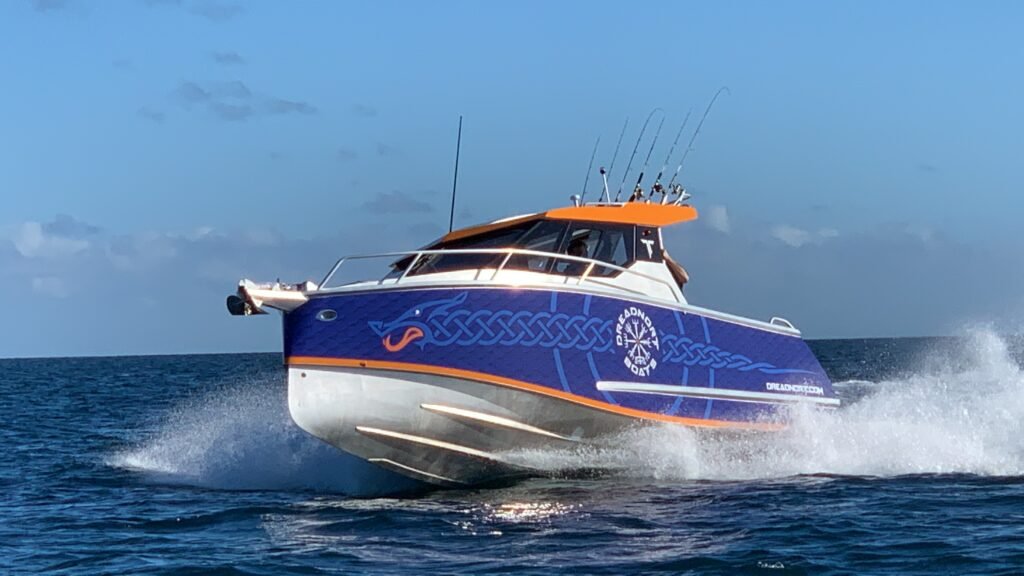
However, there can be challenges such as:
- – Cost and complexity
– Vulnerability to damage in shallow or debris-filled waters - – Design integration with propulsion systems
- – Build accuracy around forecasted weights and their positions within the boat is critical, as it directly affects the vessel’s centre of gravity. The relationship between this and the foil position is key to a successful build, and it is extremely difficult to correct once the boat is complete.
As a result, foils are still more common in niche or premium segments, but their presence is growing in other applications.
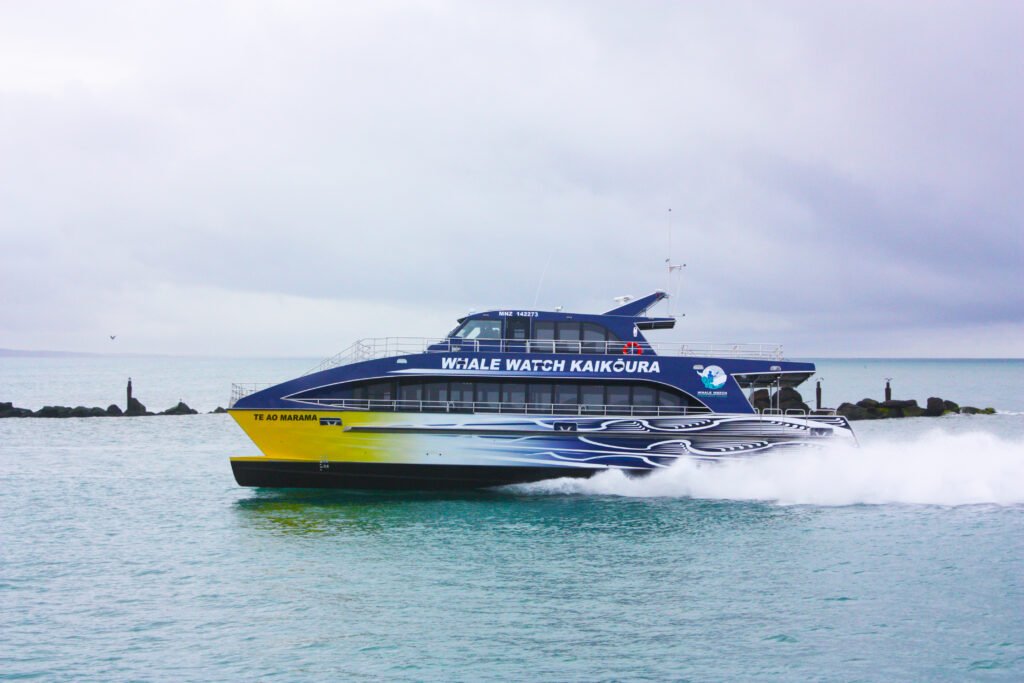
Teknicraft is a brand with extensive experience and a proven track record of how well-designed foil-assisted hulls perform. They started designing foil-assisted boats back in 1996 and are now in their 30th year of refining this technology. Even though the majority of their designs are being used in commercial applications, there are also many examples of the technology applied to recreational power boats. Currently, there are some 200 of Teknicraft’s foil-assisted hulls operating worldwide, of which almost fifty have been built in New Zealand. They use a system that enables the foil’s angle of attack to be adjusted for applications that demand large changes in load (such as passenger ferries) or in speed (such as patrol vessels). Changing the foil angle increases or decreases lift at a given speed, and the system therefore adapts to the conditions.
Aquila is another brand that has adopted foils into their catamaran range. Aquila’s Hydro Glide® foil system signals one direction modern cat hull designs could be heading: an integrated, efficiency-driven platform that reduces drag rather than simply powering through it. Developed by America’s Cup designers Morrelli & Melvin, the system uses a fixed, computer-free foil spanning the tunnel between catamaran hulls, paired with stabilising fins, which are said to deliver up to 40% lift at cruise speeds. Their engineers also added, ‘This “set-and-forget” approach improves ride comfort, cuts fuel burn, and reduces engine load, while maintaining inherent stability through its dihedral V geometry. With lift-to-drag ratios dramatically higher than conventional hulls, and increasingly standard across Aquila’s range, it reflects a broader shift toward passive foil-assisted hulls that blend simplicity, durability, and real-world efficiency gains, pointing to a future where boats glide more and push less’.
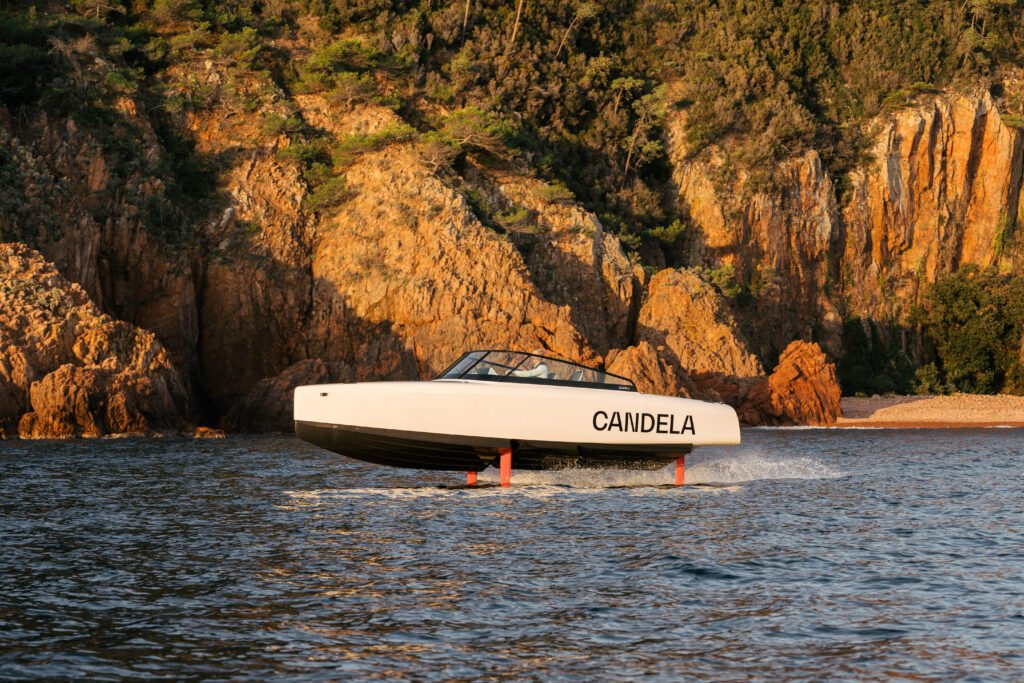
Another exciting advancement in modern hull design is the integration of intelligent hydrofoil technology, as pioneered by Candela. Designed to lift the hull clear of the water at around 16 knots, the system dramatically reduces drag, noise and energy consumption while delivering a smooth, stable ride in varying sea conditions. Managed by advanced onboard software, the hydrofoils automatically adjust to wind and wave movement.
The Hybrid Future: Convergence of Technologies
What’s most interesting about current hull design trends is not any single innovation, but the way they are beginning to converge.
We are now seeing the early stages of hybrid hull thinking, where multiple concepts are combined into a single platform:
- – Stepped hulls incorporating advanced aeration channels
- – Hulls designed with integrated foil assistance
- – Running surfaces optimised through CFD (Computational Fluid Dynamics – the use of numerical software to simulate how water and air flow around hulls) to manage both air and water dynamically
This convergence reflects a broader shift in naval architecture. Hulls are no longer designed purely as static shapes but as dynamic systems that interact with speed, load, trim, and sea state in increasingly complex ways.
In many cases, the biggest gains are no longer coming from dramatic new shapes, but from incremental optimisation across multiple variables:
- – Trim angles
- – Centre of gravity
- – Propulsion alignment
- – Air-water flow interaction
It’s a more subtle form of innovation, but potentially a more impactful one.
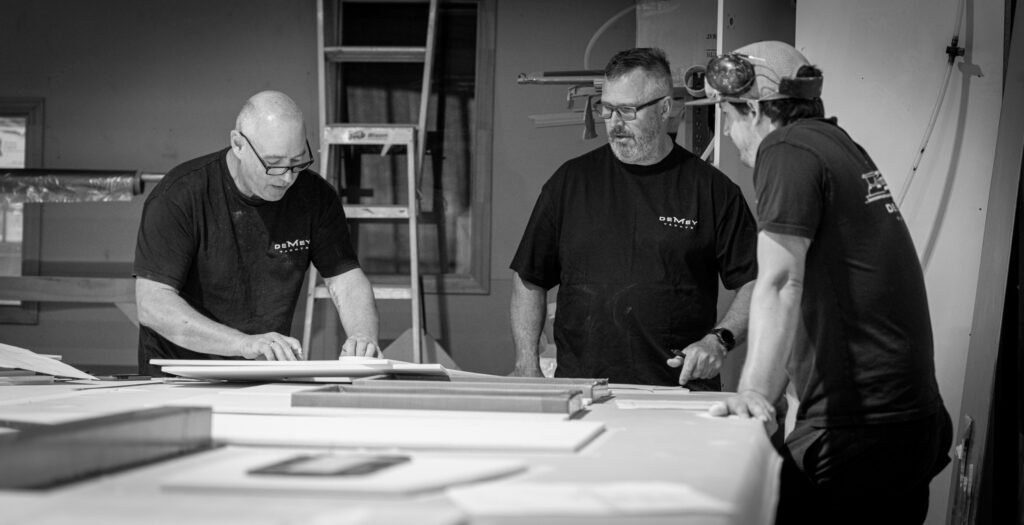
“New Zealand builders and designers have a long history of innovation and tackling complex builds. With advanced design software and AI now so readily available, we’re set to push the boundaries of hull design and construction even further. It’s a win for the marine industry, for clients, and for the environment.”
— NIC DE MEY, DEMEY YACHTS
Barriers to Adoption
If the technology is advancing, why isn’t every new boat radically different?
The answer lies in the realities of the market. Production builders must balance innovation with:
- – Cost constraints
- – Reliability and warranty considerations
- – Ease of use for a broad customer base
A highly optimised hull that performs brilliantly in ideal conditions but proves unpredictable in everyday use is unlikely to succeed commercially.
There is also the matter of perception. Many buyers still prioritise:
- – Proven ride quality
- – Predictable handling
- – Familiar layouts and performance characteristics
- – Customer acceptance is critical, significant shifts in design language can be unsettling and may deter buyers.
As a result, the industry tends to adopt new technologies gradually, refining and integrating them rather than embracing wholesale change.
What Comes Next?
Looking ahead, the future of powerboat hull design is unlikely to be defined by a single breakthrough. Instead, it will be shaped by the continued blending of ideas.
We can expect to see:
- – More sophisticated stepped hulls with finer control of aeration
- – Selective use of foil assistance in efficiency-focused designs
- – Greater reliance on simulation and data-driven design
- – Incremental gains in fuel efficiency and ride comfort
At the same time, fully foiling powerboats will likely remain a specialised segment, impressive, but not yet practical for widespread adoption in typical recreational use.
That said, brands such as Candela, which produce electric Hydrofoils, have found a place in many markets worldwide, in both recreational and commercial applications.
A Subtle Revolution
Hull design may not be changing in ways immediately obvious at the dock, but on the water, the differences are becoming increasingly apparent.
Boats are running flatter, faster, and more efficiently than ever before. They are covering greater distances with less fuel, handling rougher conditions with more composure, and doing so with a level of refinement that would have seemed ambitious just a decade ago.
It’s not a revolution defined by radical shapes or futuristic concepts as we are seeing in the automotive industry, at least not yet. Instead, it’s a story of quiet, continuous evolution.
From steps to foils, from water to air, the modern powerboat hull is becoming a far more intelligent machine. And in that evolution, the real gains are only just beginning to surface.