EVOLUTION PERFECTED
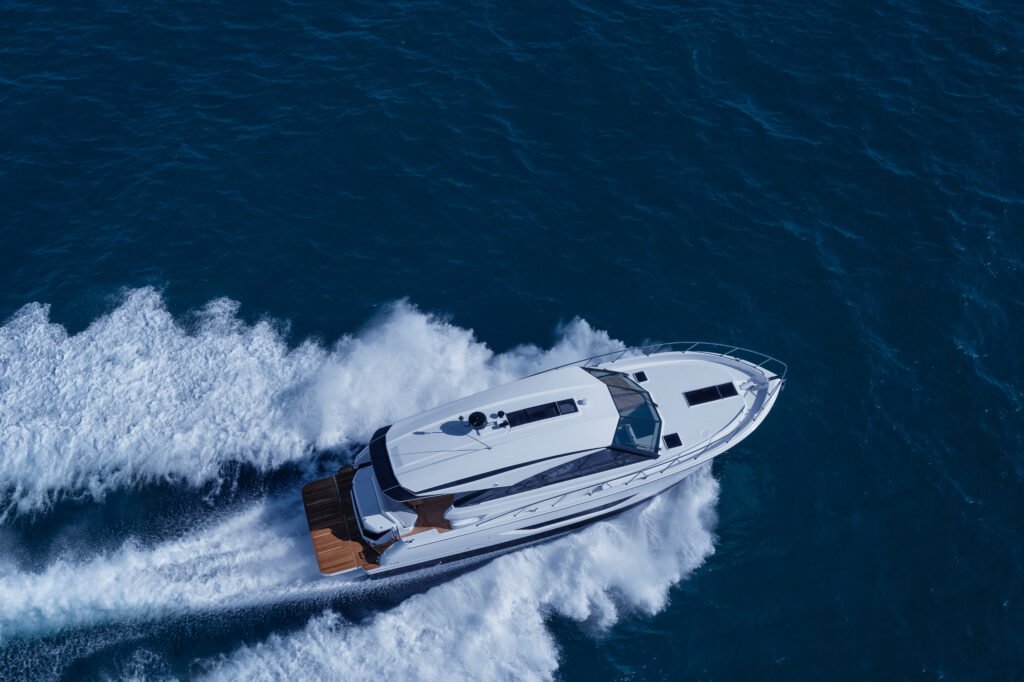
Maritimo’s new S50 may share DNA with the M50, but it’s far more than a flybridge model with the top taken off. With a seamless layout, clever storage, a patent pending swim platform and composed handling, the S50 showcases Maritimo’s relentless approach to refinement. Kyle Barnes discovers a motor yacht where some of the smartest innovations are the ones you barely notice.
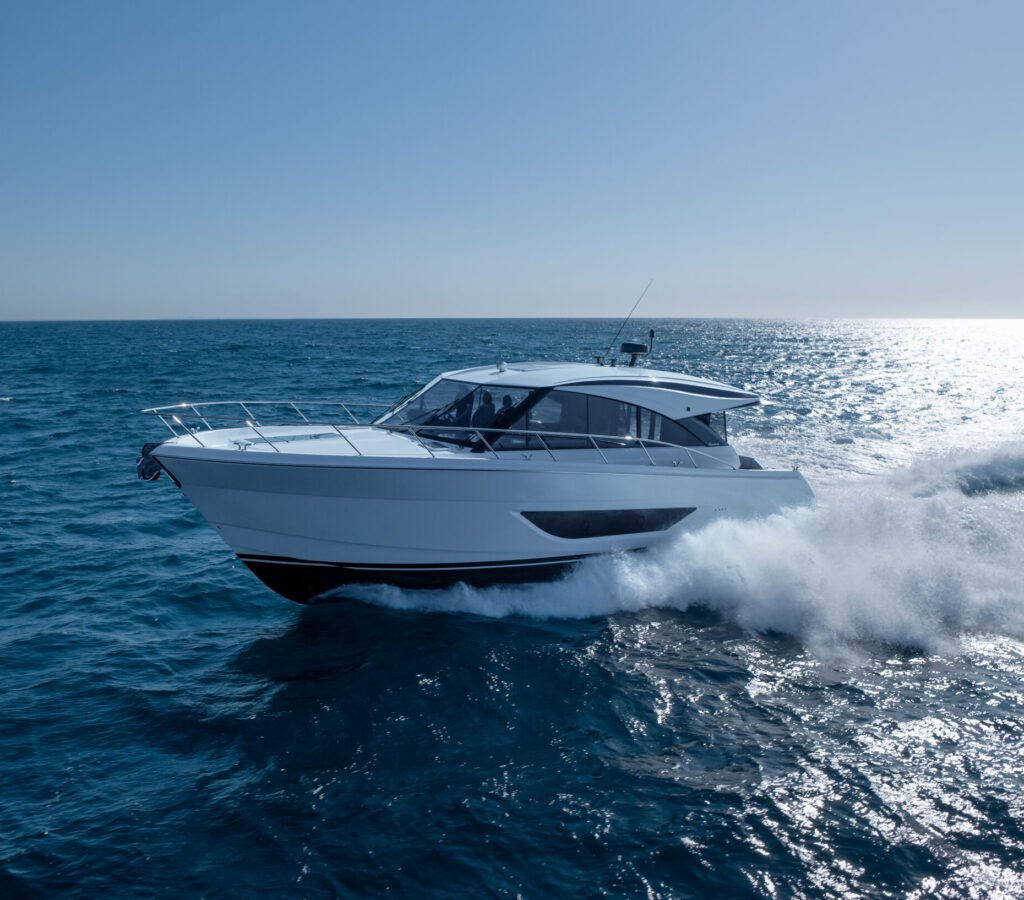
There was quite a bit of hype whipped up around the newest addition to the Maritimo fleet, a sports version of the M50. I was really not too sure what to expect; was it going to be an M50 sans the flybridge, giving the saloon a bit more room by removing the stairs? But what about the helm station that had to go somewhere, so surely the sans stairs/flybridge argument would not stack up. They were just some of the questions pounding around my cranium. But I needn’t have given it too much brain bandwidth as rather than being a Frankenstein horizontally cut and shuck monstrosity, it simply appeared to be freshly hatched, a totally new concept shedding the skin of the M50 as a caterpillar sheds its chrysalis.
AFT
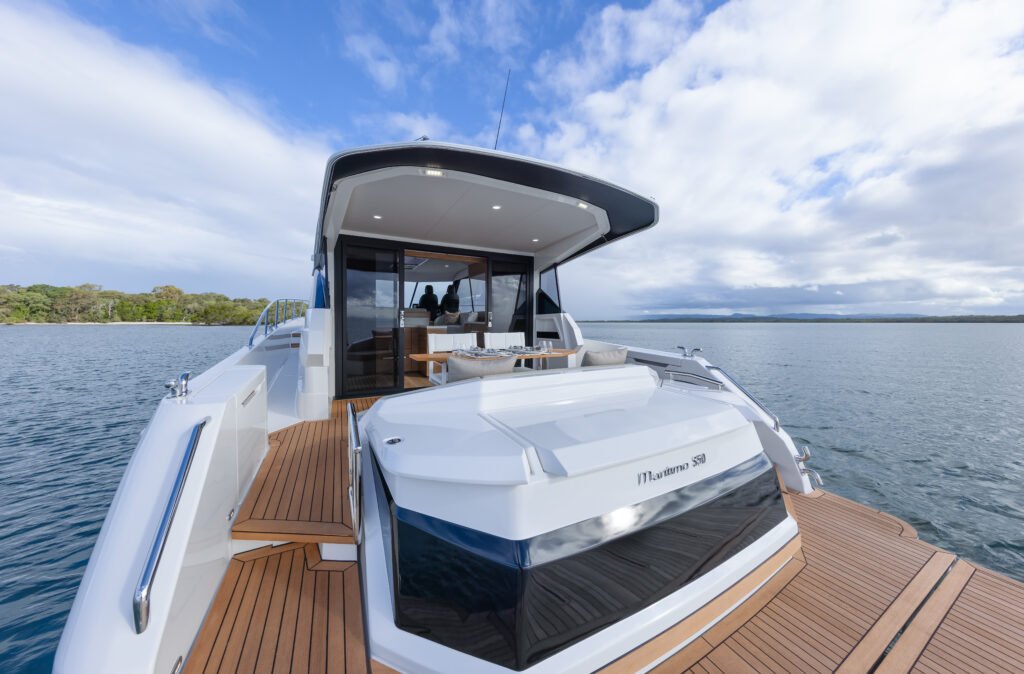
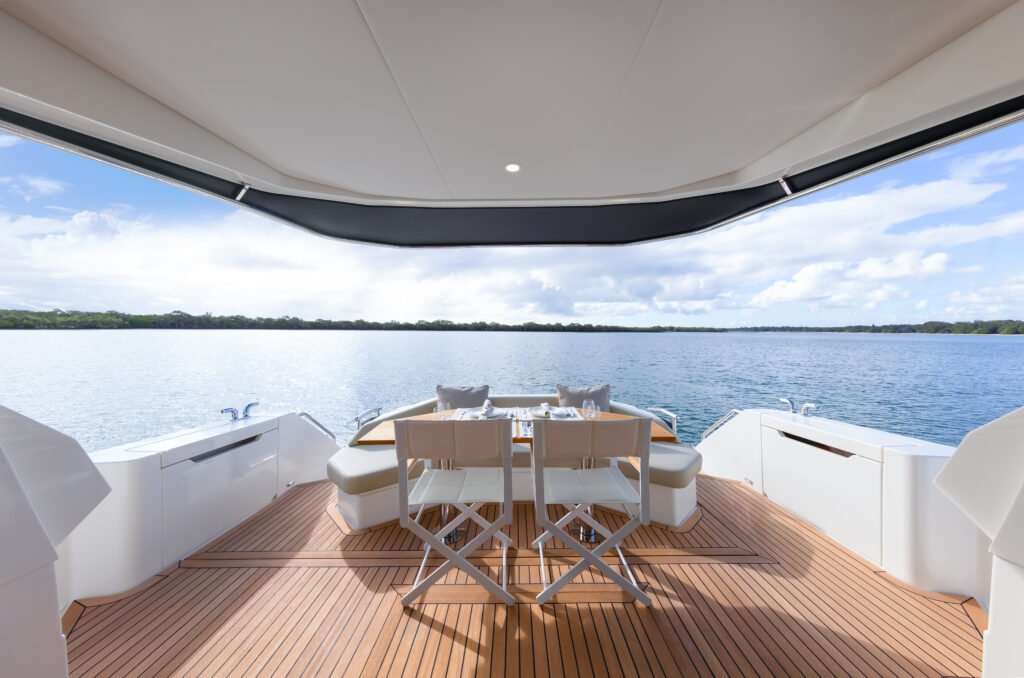
The back floor has been kept the same as the M50 but raised substantially compared to previous models, eliminating the awkward multi-step transition that plagues many boats this size. In its place, just two well-proportioned steps up to cockpit level. It’s a small thing until you realise the payoff below – a lazarette with almost a couple of cats to swing. Descending into it feels genuinely surprising. Stand-up paddleboards, kayaks, dive gear – nothing is going to be a problem down here. Dual access points, one from the cockpit and another from the forward seating area, mean you’re never playing Tetris to retrieve the one thing you need. Every hatch is rubber-sealed, and the design makes water ingress a theoretical rather than a practical concern. A raised rubber seal of 150 millimetres along the cockpit perimeter ensures water tracking down the side decks stays well away from the storage areas. I must also mention the no-step double door into the galley; this is achieved because of a huge 300mm gutter that runs under the double doors. It has huge direct drains which end up scuppering between the two stairs aft – a fair dinkum sea safety factor that will take care of most big sea pooping situations, or simply guarantee a dry saloon in more favourable conditions.
THE THINKING
Bill Barry-Cotter has been building boats since he was a teenager and the Australian industry has never been the same. Mariner Cruisers, Riviera and now Maritimo – three chapters in a career that most would consider three careers. He sold Riviera in 2002 and could have easily stepped back; instead, he started again, channelling the same obsessions – performance, integrity, longevity – into a new brand. The S50 is the latest result of that restlessness, and walking through the vessel with General Manager Phil Candler, it’s clear there’s plenty of fuel in the tank left yet.
Phil is characteristically modest about the process behind these decisions. “When you’re innovating, when’s it going to stop? Never,” he tells me. “Every new model we do a lot of conceptual drawings. A, B, C, D – sometimes 10 conceptual drawings in one area. Bill and I meet with the design team; they present the concepts, and we go back and forth until we find the right path. “It is also, notably, a collaborative process. The interior design team – including those who recommended the warm oak timber that runs through the S50 – are involved from the concept phase, not brought in at the end to choose cushion colours. The result is a coherence of vision that you can feel throughout the boat. Bill’s wife Leslie, herself a seasoned and discerning judge of such things, came aboard and declared she’d have it exactly as it was. High praise from any corner. From that corner, it carries particular weight.”
FLOATING ILLUSIONS
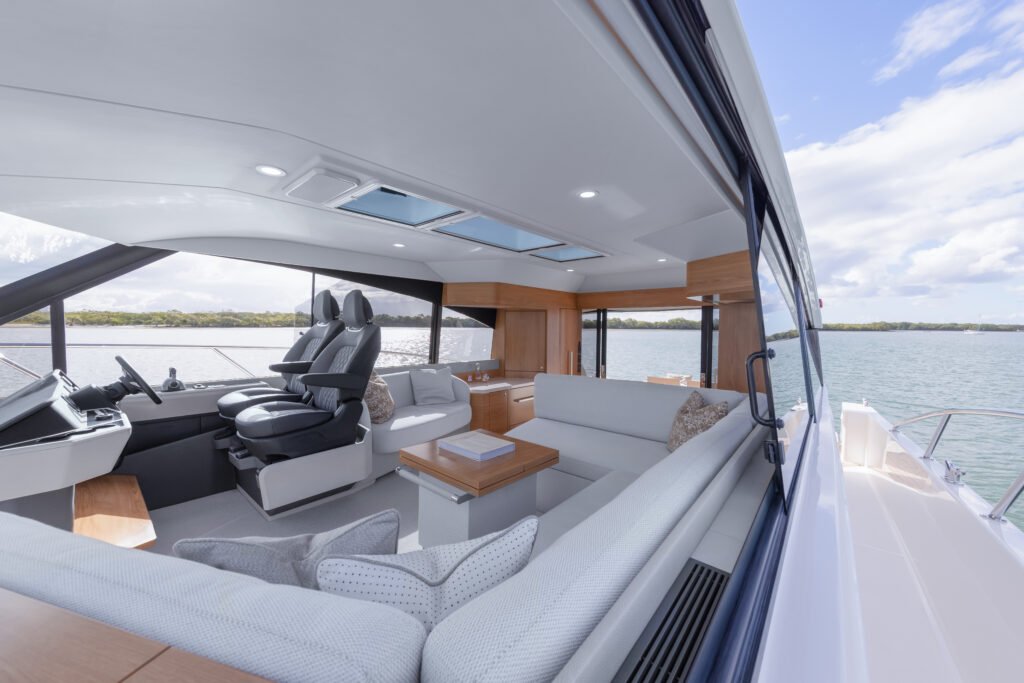
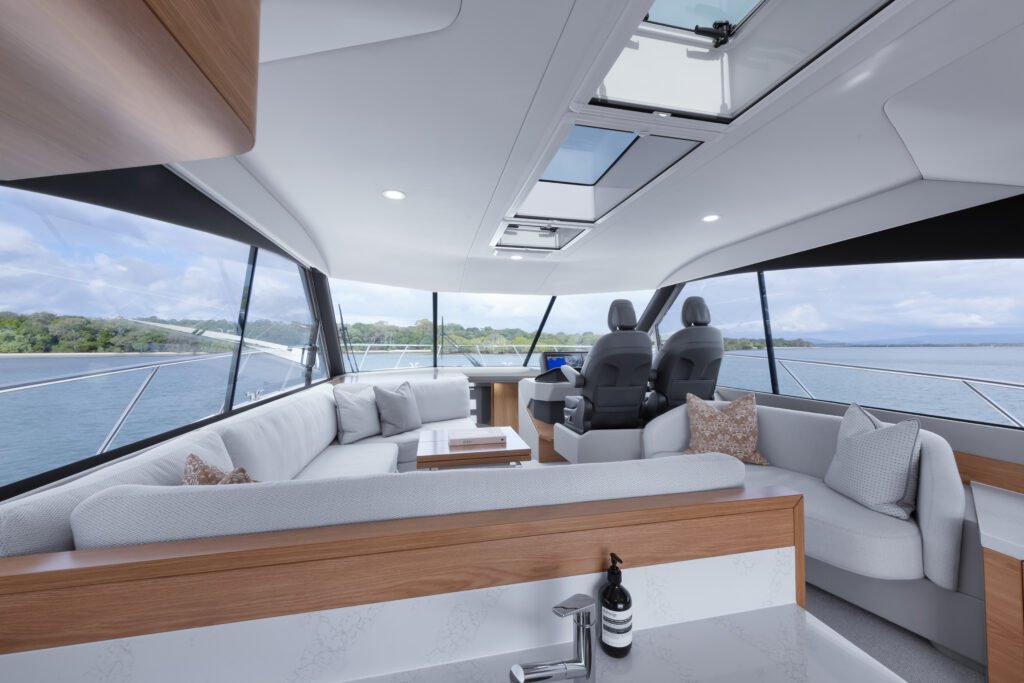
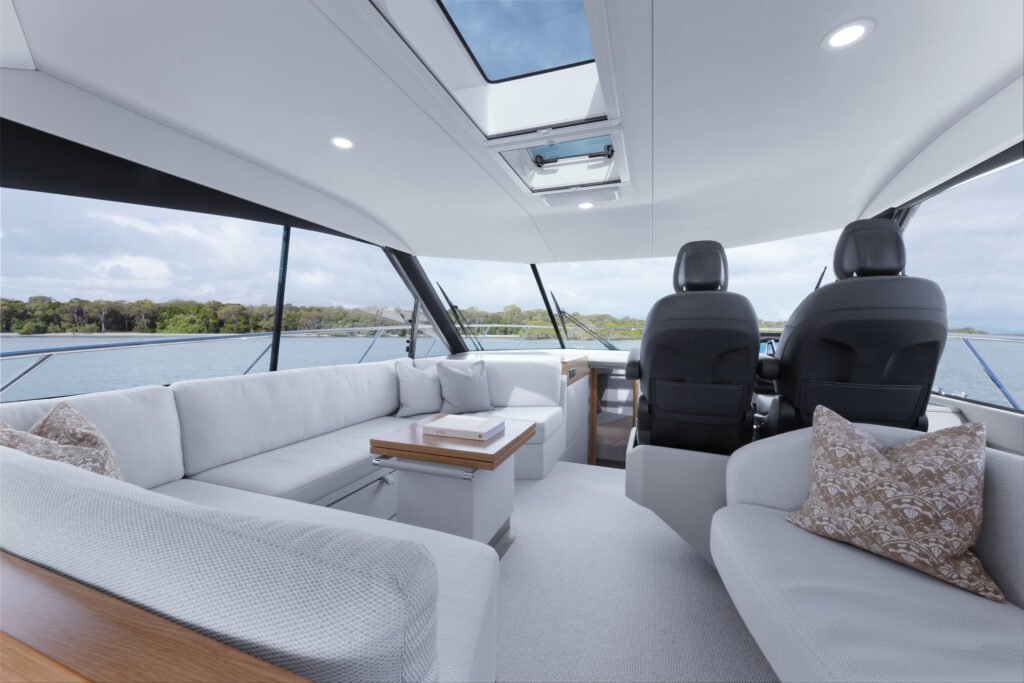
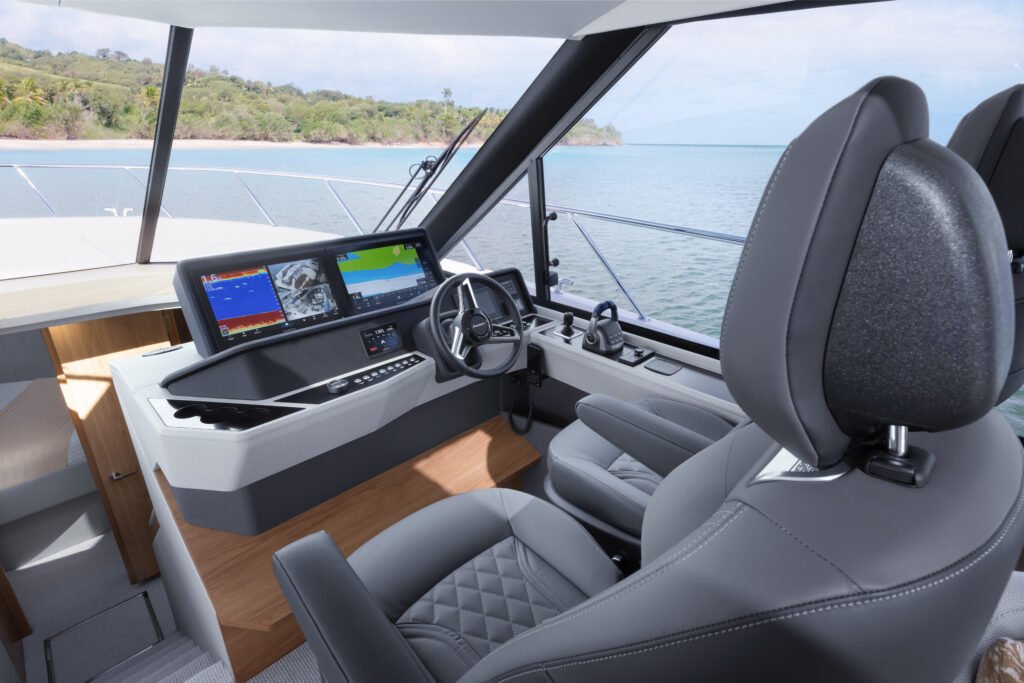
Stepping up into the helm area, I encounter what becomes something of a recurring theme on the S50 – Maritimo’s talent for making fixed things appear to float. The skipper’s seat is the first example, a commanding position that anchors the helm without dominating it. But it’s the mate’s chair that really stops you. It appears to hover, almost detached from its surroundings, drawing the eye forward and creating a sense of spatial depth that makes the helm area feel considerably larger than it is. It’s a deliberate optical trick, and it works beautifully.
The same philosophy extends to the couch aft of the helm controls. At first glance, it looks like a piece of furniture that someone has simply placed there – tastefully, but loosely. You half expect to be able to slide it aside. You cannot.
It is, of course, going absolutely nowhere, but the design conceals all evidence of that fact. The Maritimo team clearly understand that the feeling of space is as important as the reality of it.
THE POTS AND PANS
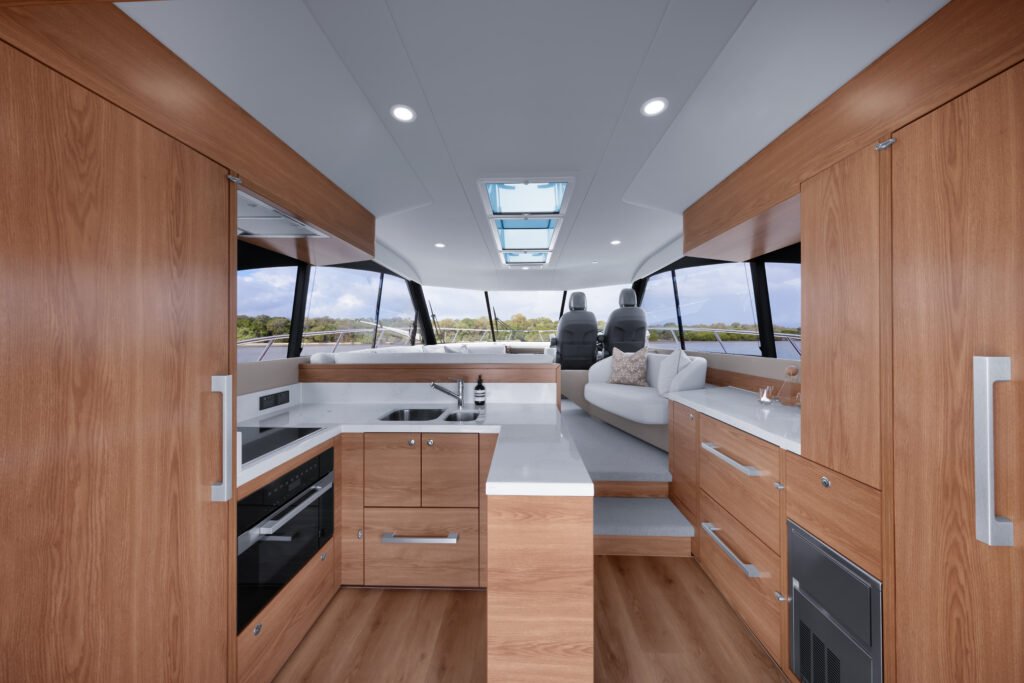
The galley on the S50 is a new design — repositioned to the port side and, critically for my money, free of the island bench that featured in the flybridge models. I’ll be honest, I am not a fan of the island. It breaks up the flow of what the designers were clearly trying to achieve. The new layout opens everything up, restoring the seamless indoor-outdoor transition that the raised cockpit floor promises from the outside.
The fit-out remains serious – separate fridge and freezer drawers, a pull-out pantry on full-extension slides, dishwasher, ice maker and a Fusion stereo system controllable via iPhone. Everything you need for genuine passage-making, nothing you don’t.
LIVING WELL
The saloon rewards with a closer inspection. Dining to port, with the aforementioned seemingly floating lounge to starboard, a pop-up television from the front of the saloon completes the picture, but it’s the view which really grabs you. I know the M50 had great all-round vistas you felt like you were sitting up high, but this boat has an even better grasp of the view, and you are truly left with the ability to drink in the horizon. This is the most impressive design decision in the saloon, and genuinely my favourite innovation on the entire boat, achieved by lowering the coamings to increase the visual line. Finally, for someone standing 6’2”, the headroom throughout remains generous – always a detail I notice and appreciate. And if the convertible port settee gets pressed into service, you’re sleeping six – properly, not in that apologetic way boats usually mean when they say six.
DON’T MESS WITH PERFECTION
Below decks, the forward cabin makes intelligent use of its space with twin berths hard against the port hull, sized to be used independently or slid together as a double. Storage is plentiful – pigeonhole lockers, under-mattress compartments and an en-suite that doubles as a day head. Down the switchback stairs on the starboard side, the concealed washer and dryer, originally mounted high and since repositioned in response to customer feedback, are tucked behind panelling in the hallway. Maritimo listens, and it shows.
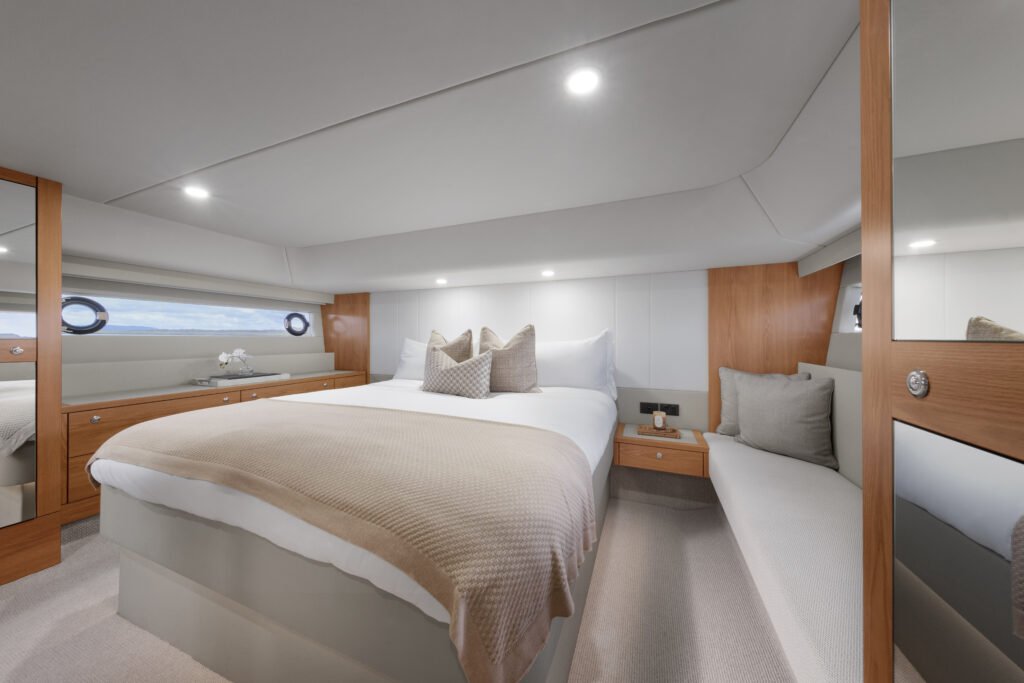
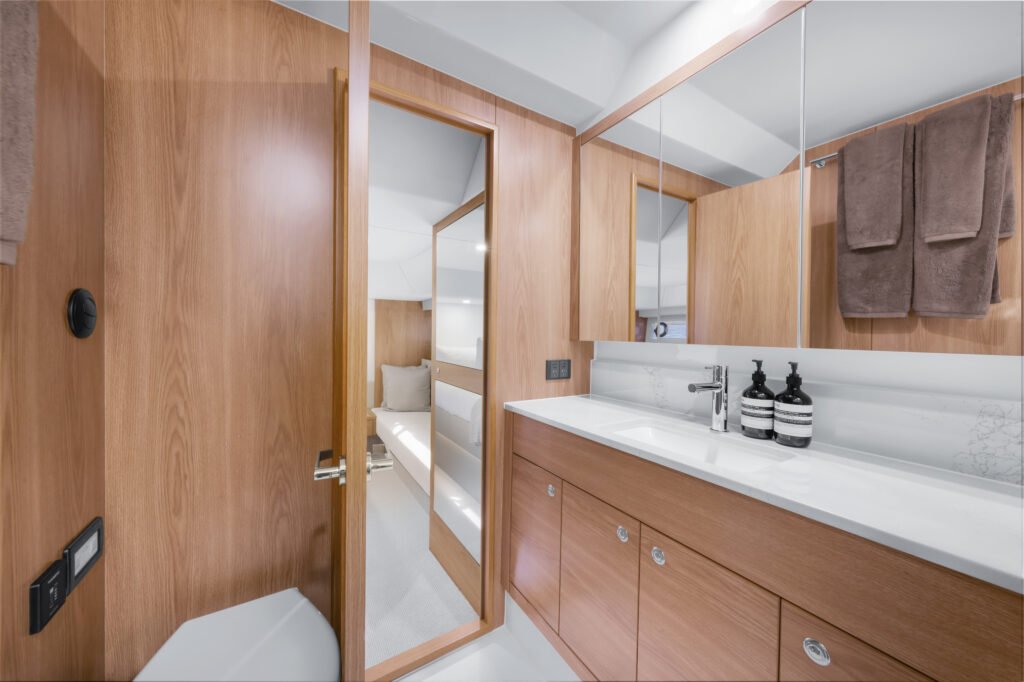
The master stateroom sits below the main saloon with what’s advertised as a king-size bed. But it’s got to be bigger than a king; it looks to me like a super king, room for the wife and a couple of dogs. It’s positioned above the single central fuel tank. That tank is a clever piece of engineering in its own right, maintaining low, centred weight while delivering serious range. They have eliminated the wing tanks, keeping the weight dead midships with plenty of range. The en-suite features stone surfaces manufactured in-house – a detail that speaks to Maritimo’s broader commitment to controlling quality at every stage. The walk-in shower requires no door; the geometry handles the splash issue by design rather than by hardware.
CORNERING LIKE IT’S ON RAILS
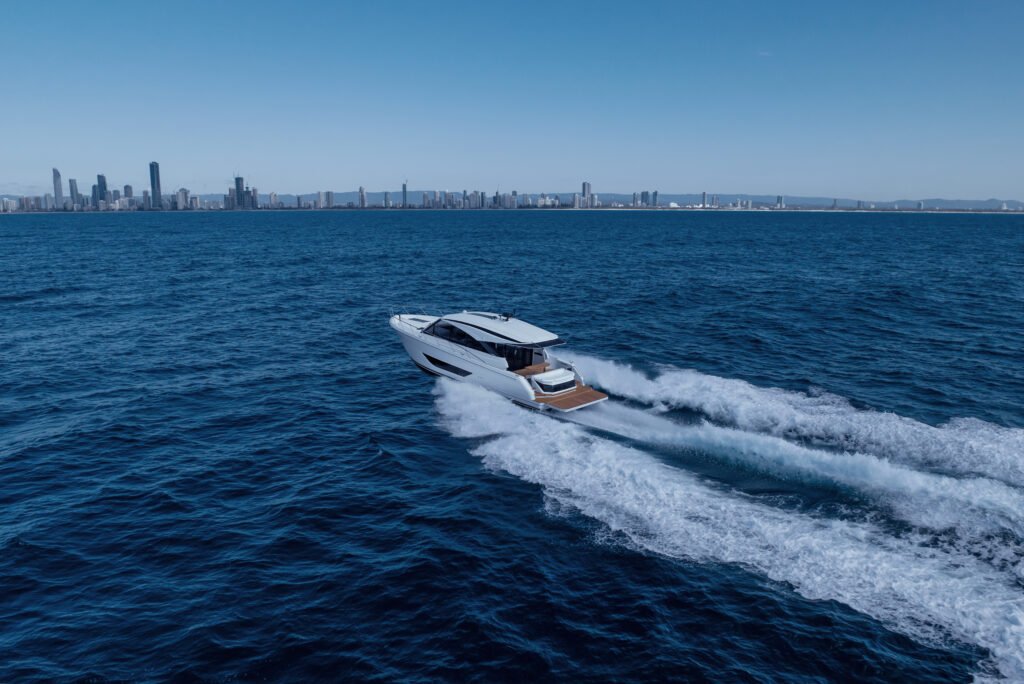
It wasn’t a terribly challenging day through the Gold Coast Seaway and out to the “Humpback Highway”. But you could see this vessel was a very dry boat as I looked for any bumps, wakes, but not whales to play with. I had done an article on a refurbished Haines Hunter 17 L earlier that week, taking it out through the challenging Jumpinpin bar between north and south Stradbroke. A notorious piece of water and it was a lot of fun. And except for the price tag, luxury and a long bow to draw of extras, the parallels are hard to ignore with the handling of this boat. It was lively, responsive and at no time were you at the mercy of helm lag or tipping. This was all made possible by the Interceptor trim tabs, which were set up beautifully to push back against the cornering and present just enough bluff in the bow to keep the splash well abaft the beam.
THE LAST TRICK BEHIND THE TRUNK
The last trick up Maritimo’s sleeve was saved for the dock. As the crew gathered at the stern for what felt like a finale, they ran through the high-low swim platform – a patent-pending design entirely of Maritimo’s own making. What followed made it immediately clear this was no afterthought bolted on for the brochure.
The mechanism does the obvious thing first – it raises and lowers – but the real cleverness comes when the tender isn’t onboard. The entire platform flips vertically, trimming the boat’s ISO hull length from 16.82 metres down to 15.7 (TBA). For anyone who has recently winced at a marina invoice, that gap matters. Berths are priced by the foot, and the ability to occupy a shorter one when you’re not carrying the tender is exactly the kind of practical engineering that makes you wonder why it took this long. Deployed, the platform becomes a proper entertainment space and then dunks into the water around 70 cm (TBA) for cocktail-sipping mermaids on a hot day. Also, for the practical purpose of retrieving the tender.
THE SUM OF THE PARTS
The air intake is the final detail worth noting. Where other builders use external grills and stainless-steel fittings – things that corrode, need polishing, and eventually fail – Maritimo has integrated the engine room air intake directly into the quarter panel structure. Clean lines, no external fittings, no added maintenance. It is the same philosophy applied across the entire boat: solve the problem properly, then make it look like there was never a problem to begin with.
The S50 is, in the end, a motor yacht that rewards the curious. Its innovations are not always immediately visible – they are embedded in the floor height, the seating geometry, the floating furniture, the flipping platform. Maritimo have built something that manages to be quietly revolutionary. And if Bill’s wife would have it exactly as it is, well – that’s probably the most reliable review of all.
SPECIFICATIONS
Hull Length 15.69m
Beam 5.22m
Draft 1.39m
Dry Weight 28,000kgs
Fuel Capacity 3,500L
Sleeping Cabins 2 x Standard
Water Capacity 750L
Engines 2 x Volvo D13 – 800 MHP – ZF
PERFORMANCE DATA
RPM KNOTS L/PH RANGE
600 6.2 8.5 1276
1000 8.95 31.5 497
1500 12.7 110 202
2000 23.9 202.5 207
2380 30.7 298.5 180