LA DOLCE VITA
Combining famed Italian workmanship with modern technology makes the Mimi an interesting range for our Australasian waters, reports Kevin Green.
Classically Mediterranean, and named after the southwest wind that blows off the Libyan deserts, the Libeccio is indeed a fresh breeze for Pacific waters. The 13.5 Mimi Libeccio is a distinctive 44-footer with a rounded stern, flared bows and teak decks. Imported by Australian dealer Zain Moloobhoy of Boatology, but being a new brand to the region, he understood the need to do it well. “So, we offer a complete maintenance service on our boats by establishing our own shipwright company, with local staff who were trained at the yard in Italy,” said Zain.
The Libeccio is a cabin-cruiser-style coastal cruiser with a traditional wheelhouse, and below decks there are six berths. The range currently goes from 6.5m to 13.5m. Across the range, the Naples Cantiere Mimi yard has built more than 3,000 hulls since its foundation in 1975. The design is based on the workboats found along Italy’s west coast, from Liguria to Sicily, that were designed for their seaworthiness, carrying capacity and generous internal volume. The age-old designs have a high flared bow, lower freeboard amidships, and the stern provides a stable platform for fishermen; or in the case of the 13.5, a graduated swim platform for easy water access. The modern versions are fibreglass and streamlined designs to give a new twist, which is both classic and practical.
FIRST LOOK
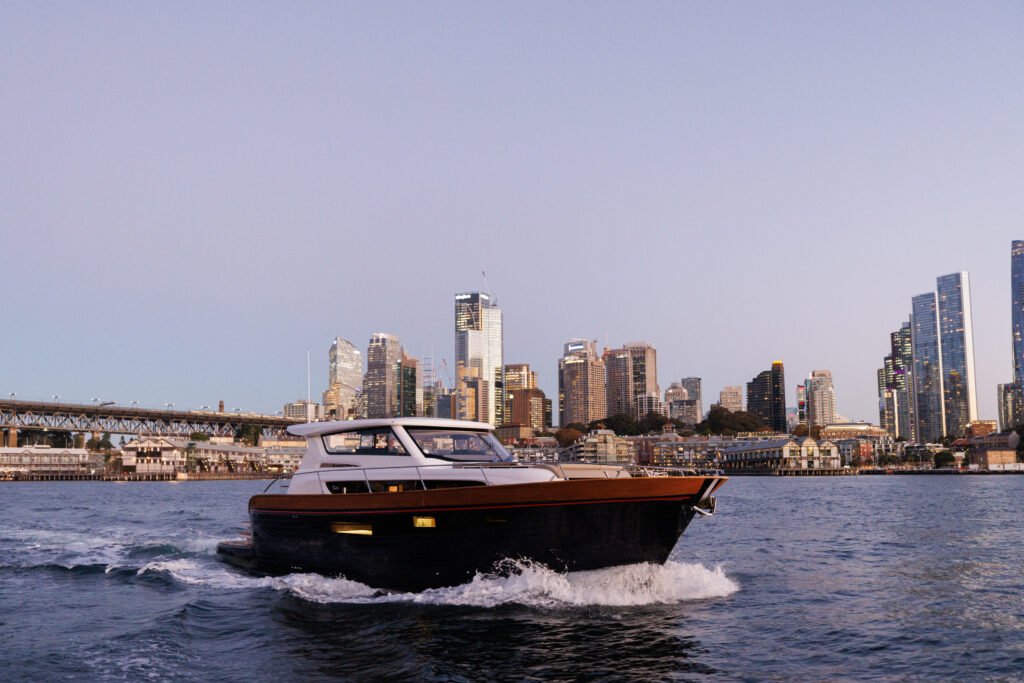
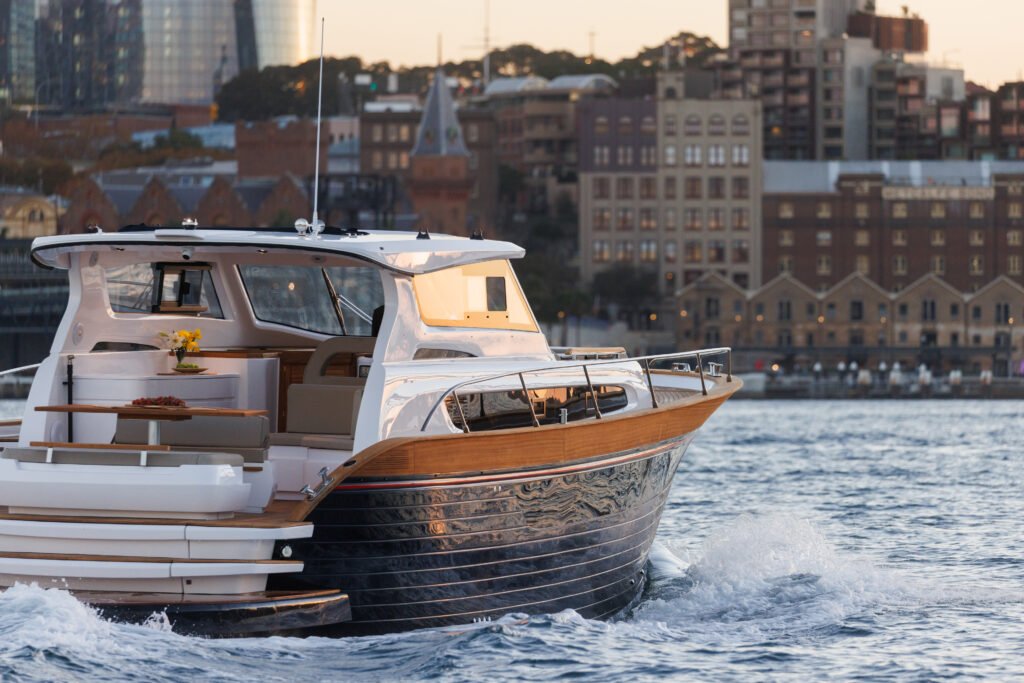
Walking down the dock in Drummoyne on Sydney Harbour, it’s easy for me to spot the Libeccio (hull #13) in its dark blue livery and full-shaped hull below a sleek cabin. Over the years of attending the Genoa Boat Show and travelling down the Cinque Terre coast, I’ve seen numerous variations on these designs, including both small commercial fishing boats and cabin cruisers. Stepping onto the cascading teak swim platform of the Libeccio, I clearly see that this traditional style has been elevated to a much higher standard. Hand-finished teak abounds on the decks and topsides, while amenities include dual shower outlets to refresh bathers, who have a convenient ladder to clamber aboard. I press a button to reveal the dinghy garage that fits a 1.8m rubber ducky, which has to be pushed manually across the swim platform.
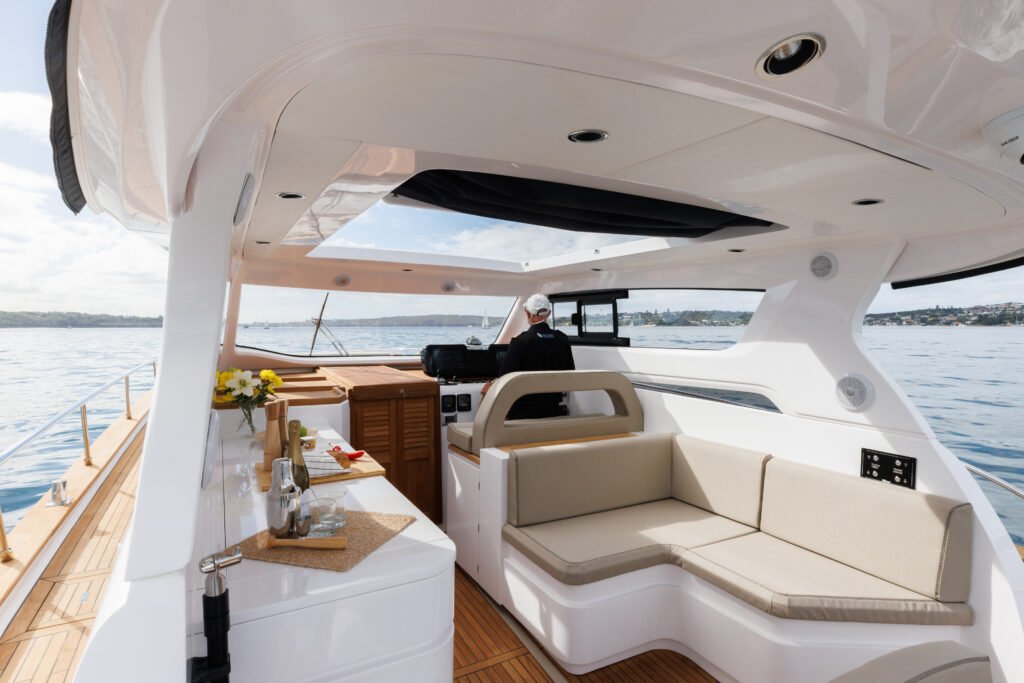
Stepping up into the aft cockpit, there’s a transom bench seat with movable backrest adjoining the large teak table (with telescopic base) with another bench on starboard. The open back of the wheelhouse (which can be sealed with clear plastics) allows easy access all round. Inside, the catering is done on the portside electric plate, wet bar (with two fridges) and space for dishwasher. There’s also a small optional table which has two choices of fixing points; all done under the shade of the fibreglass overhang, with a canvas extension available to cover the entire area as well. Noticeable is the solid layup of the fibreglass throughout, including the solid wet bar lid and worktop beneath; along with the thick teak cladding around the forward section of the wheelhouse. Also hidden is a 40-inch popup television, essential for Italians watching their beloved Serie-A and other soccer leagues.
Despite the sleek overall profile, the wheelhouse has generous volume, aided by vertical bulkheads with large windows, including sturdy sliding ones on each side, with the starboard one ideally placed at the helm. Here, there’s a good mix of sturdy pushbutton controls – for the wipers and other essentials – below the twin 12-inch Garmin screens. A classic steel steering wheel with leather padding is just the right diameter for me to reach from the double bench helm seat. Beside it are the other essential controls – electronic throttle controls outboard, while inboard is the joystick and lever for the tunnel bow thruster. Nearby at the main hatch is a well laid out main switchboard with jumpers and clearly demarcated shore power controls.
THREE CABINS
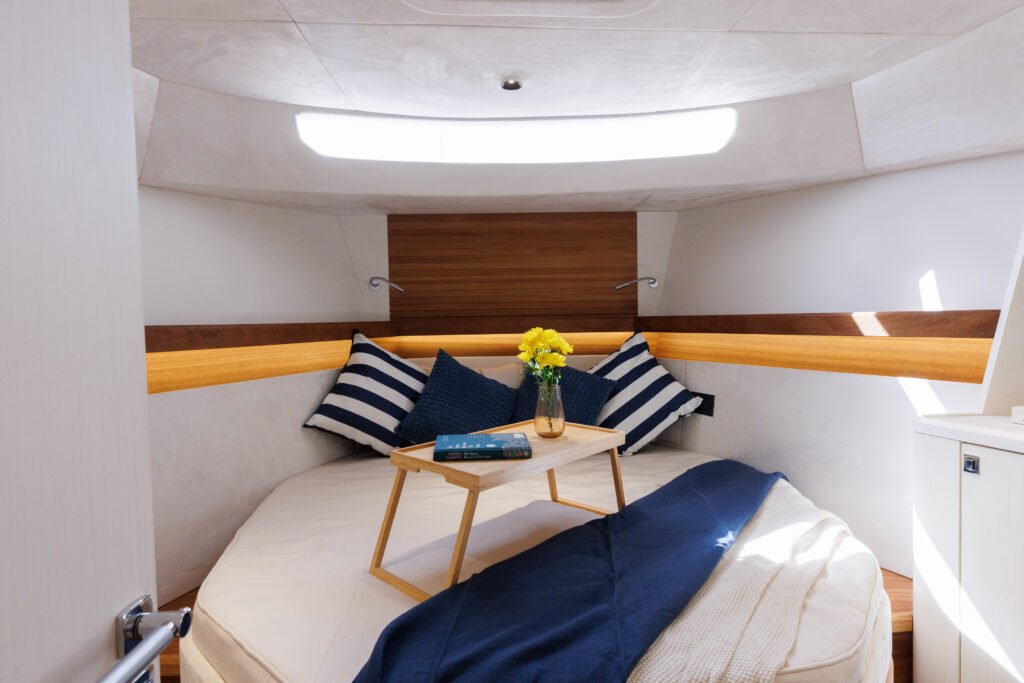
Below decks is reached via a central main hatch with teak doors and steps, taking me down to the three cabins. Volume again is good, thanks to the deep and full hull shape. The layout uses the added volume of the flared bows to house the owner’s suite, with a cabin on each side behind, plus a day head on port. The owner’s cabin is fairly unadorned but functional, with a queen-sized semi-island bed, shelf space, and a wardrobe on the port side. The area is zoned for both individual aircon and Fusion Hi-Fi, including USB points. The skylight and port lights bring natural light into the cabin. Ablutions are well done, with a spacious bathroom, moveable shower cubicle walls and ample ventilation; stylishly finished with a solid teak floor grate. Fresh water is used in the head, but go easy unless you fit an optional watermaker. Equally well done is the day-head, although it’s a wet head – the shower sharing the toilet space.
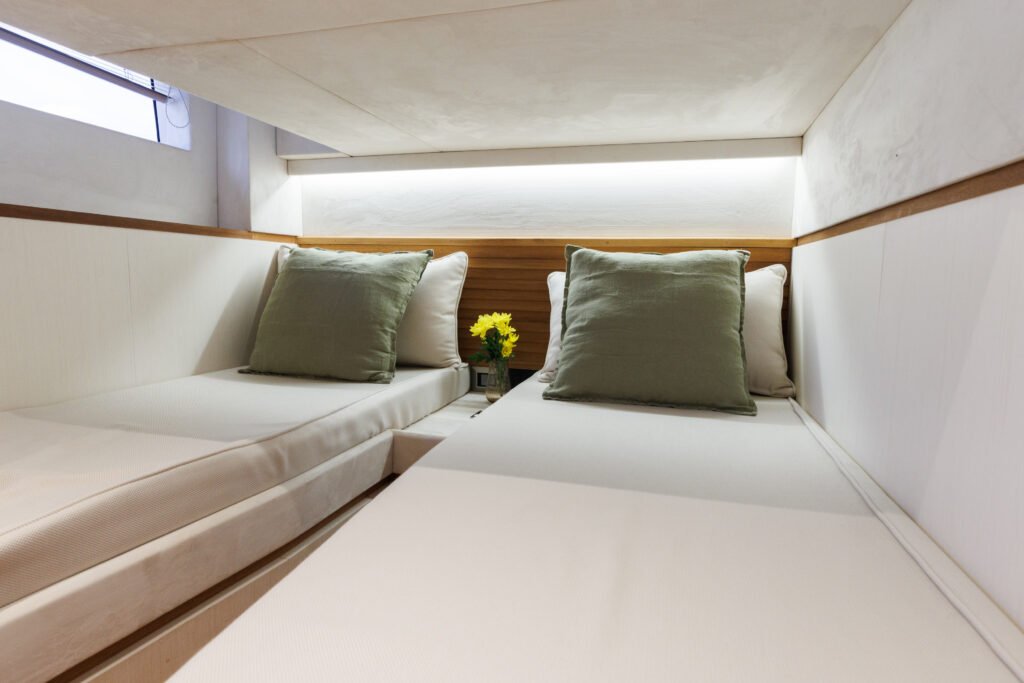
Guests are well taken care of, with the double bed cabin on port which lies across the beam but under the wheelhouse bulkhead. Here, there’s also a sizeable wardrobe and a small night table, and the ample natural light highlights the high standard of the bulkhead finish – a type of cream suede called Ferrari Beige. Over in the cabin with twin beds, it’s a similar scene, but the fore-and-aft layout allows tall guests to rest, and there’s wardrobe space again. All mattresses throughout are thick memory foam. Both cabins benefit from the main part of the tinted hull windows, which give them plenty of natural light. Throughout, the Ferrari decor blends with the lightwood veneers which give a more contemporary finish to this outwardly traditional vessel.
HULL AND SYSTEMS
The Libeccio hull is vacuum-infused with foam core to reduce weight, with moulded longitudinal indents for added strength. Full at both ends and with a strong hard chine from the bow, it also has an interesting transom to promote planing. A feature designer Valerio Rivellini explained to me during his visit to the 2026 Sanctuary Cove Boat Show: “The hull incorporates an integrated stern flap system moulded into the underwater body. This solution was specifically developed to compensate and optimise the naturally soft and rounded stern geometries typical of traditional planing gozzo hulls, improving trim control, longitudinal balance and dynamic behaviour during acceleration and cruising.”
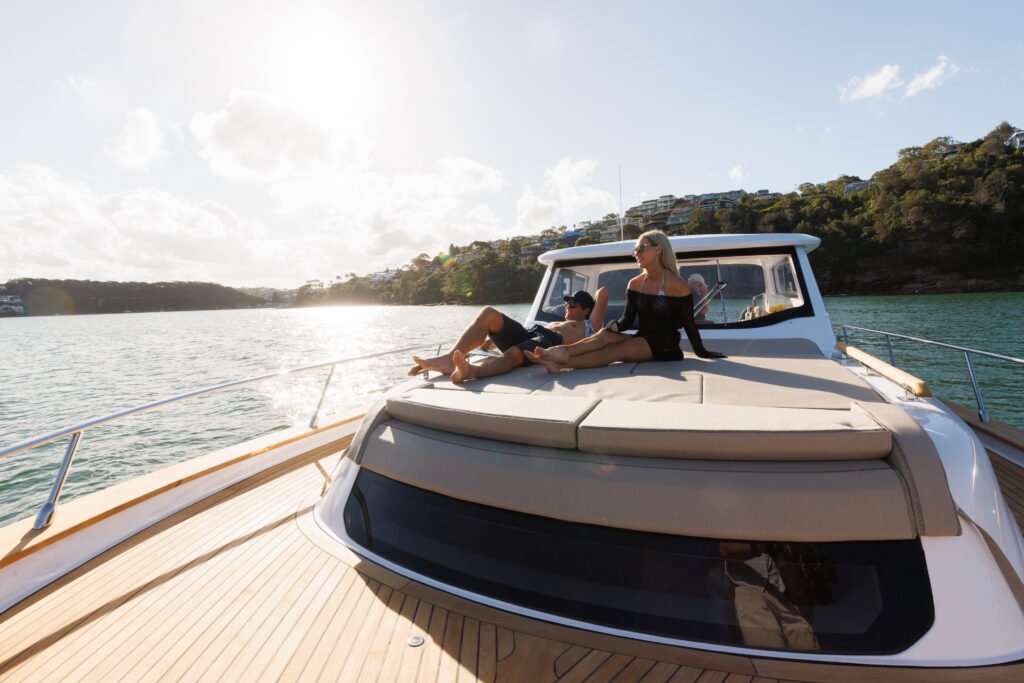
Elsewhere on the Mimi, tinted longitudinal windows blend seamlessly into the hull and contrast beautifully with the solid teak gunwales. There’s oversized cleating all-round and a similar over-specified Quick horizontal windlass with capstan, sitting above a deep chain locker, so a good cruising arrangement. Foredeck space allows for a double sunbed, strongly fixed down, with elevating backrest. Surrounding the teak decks are sturdy guardrails as well.
Engine access is via a hatch in the stern cockpit, which reveals the twin-shaft-drive Yanmar 370 HP turbocharged eight-cylinder engines. These have forward V-drive transmissions and are controlled by the company’s proprietary JC20 joystick transmission system. These 8LV engine blocks are 90-degree V8s with a highly balanced common-rail system, which creates exceptionally low vibration, making a good fit for shaft drives where the engine sits near the wheelhouse. Space and volume were sufficient for me to crawl around and inspect the area, noting the deep bilges and the easy access to saltwater filters and motor service points. Other systems here included the generator (8kw), hot water system and air-conditioning units. Forward-located wing fuel tanks also help the hull trim. I also noted the sturdy hydraulic steering connections to the quadrants and other connections to the twin rudders.
ON THE WATER
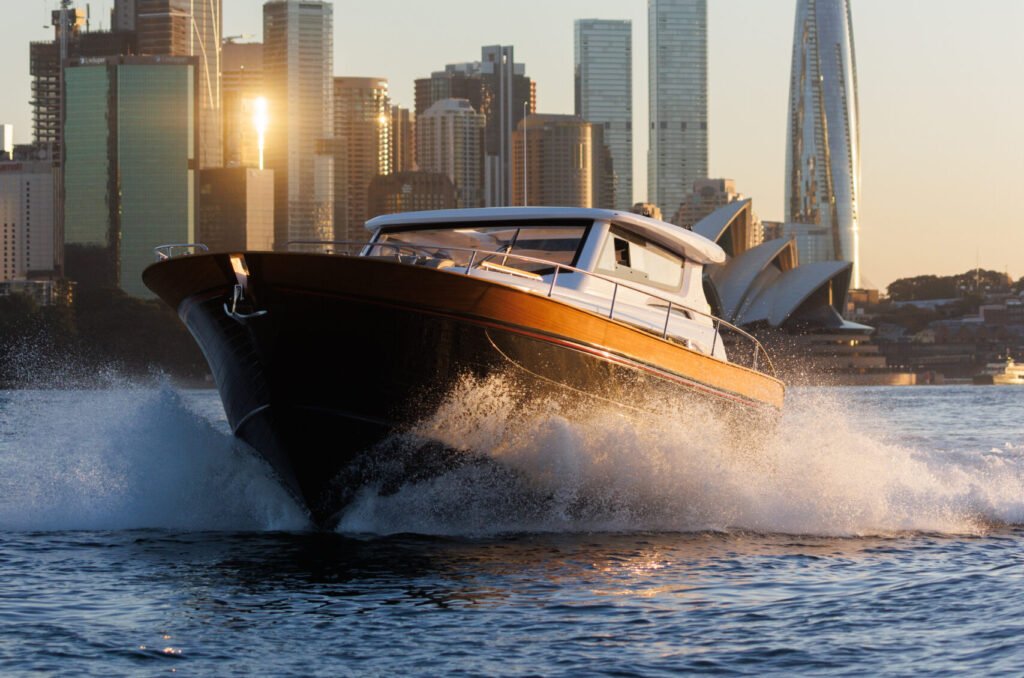
A gusty 30-knot westerly was blowing across Sydney Harbour as we set off, so the Libeccio’s transmission was well tested – the joystick and tunnel bow thruster required by company representative Jakub to guide us through the narrow exit of the private marina. Safely at sea, I took over the helm, enjoying the clear views all round. Which was just as well, because the windy day had attracted several windsurfers to enjoy the weather, so I gingerly throttled forward while noting the smooth transmission. Also surprising, as the speed reached about 15 knots, was the ease and agility of the hull as it got onto the plane. I enjoyed steering without worrying about the trim, because I left the tabs on automatic, reaching a fast cruising speed of about 18.5 knots.
Another plus was the lack of noise from the Yanmars, despite the open-backed wheelhouse; so good engine room soundproofing. Pushing the throttles fully down eventually produced 25.5 knots; handy for running from weather but costly at the bowser; so I throttled back to do some figure-of-eights, which showed a well-behaved hull with only a small heel as I turned. To windward in strong gusts, the foredeck remained dry thanks to those flared bows. Nearing Cockatoo Island, famed for its shipyards and maritime history, I slowed and practised mooring the Libeccio using the joystick – going across the wind and beam-on; all done fairly easily, so ideal for giving new skippers confidence and plenty of ‘La dolce vita’, as the Italians say
SPECIFICATIONS
LOA 13.5m
Beam 4.25m
Draft 1.0m
Displacement 10,180kg
Accomodation 6 + 1
Fuel 1,000L
Water 430L
Holding Tank 100L
Designer Valerio Rivellini
PERFORMANCE DATA
RPM KNOTS L/PH RANGE (NM)
1000 5.6 2.2 2545
1500 7.7 6.5 1184
2000 9.45 19.2 492
2500 12.8 31.6 405
3000 18.5 44.6 415
3500 22 60 367
3650 25.5 70.5 362