THE LEGEND RETURNS
There is a quiz question that separates the initiated from the uninitiated in Australian boating circles. Name a boat that has dominated the East Coast game fishing fleet for over 30 years, been passed down through families with the stories still attached and sold thousands of hulls since 1958. If you answered Caribbean, move to the front of the class.tice.
The story begins, as so many great Australian boating stories do, somewhere else entirely. In 1958, an American named Richard “Dick” Bertram watched designer C. Raymond Hunt demonstrate a small deep-V hulled boat in rough water off Miami and had one of those moments of clarity that change industries. Hunt’s deep-V, a hull form that cuts through waves rather than slamming over them, was revolutionary. Bertram founded Bertram Yacht Company in 1960, launched the Bertram 31 at the New York Boat Show in 1961, and within a few years, Time Magazine was calling him the “Enzo Ferrari of offshore boats”. They were not wrong.
In 1963, Bertram licensed Australian production to Archie Spooner’s International Marine in Melbourne. The deep-V hull arrived in Australia and promptly refused to leave. The Bertram 25 became a fixture on the water, wide-beamed, heavily built and seaworthy well beyond what its size suggested. And when the licensing agreement with the American parent eventually ceased in the late 1980s, International Marine simply kept BOAT REVIEW building the same beloved hull and renamed it the Caribbean 26. Next to the boat factory, the Spooner family built a major public tourist attraction called Caribbean Gardens, a site which also hosted a massive openair market. The name Caribbean, I guess, was better than Scoresby and evokes a sense of the Caribbean Sea, universally romanticised as the world’s premier destination for blue-water cruising, big-game fishing and tropical adventure at the time.
The Caribbean 35 that followed became arguably the most successful production game boat ever built in Australia. Between 300 and 400 of them were plying Australian waters at any one time, with names like King Kong, Rampage, Black Pete and Ulysses painted on transoms from Sydney to Cairns. “There were no seas you’d be worried about in that boat,” one longtime owner recalled. That reputation, earned over decades of genuine offshore use, is not the kind of thing you manufacture with a marketing budget.
Then International Marine folded, and for a while the boats simply stopped. The legend went quiet.
It didn’t stay quiet for long. In early 2025, Bill Barry-Cotter – the man who built Mariner Cruisers, founded Riviera, and then started Maritimo from scratch because apparently that wasn’t enough – acquired Caribbean Boats from International Marine’s estate. When word got out that new models were coming, the response caught even those running the project off guard. “We’ve done no marketing, zero,” said Sean Savage, Maritimo’s Business Development Manager, “and we’ve been overwhelmed by interest.
“That says something about the strength of the Caribbean brand”. At Sanctuary Cove 2026, the Caribbean 40F and 27F made their global debuts. The legend, it turns out, was just resting. Which brings me to the part where I actually had to get on the floating fable.
A NUMBER THAT NEEDS CONTEXT
International Marine’s old Caribbean 40, the one this new boat quietly replaces, topped out somewhere around 500 horsepower and, by most accounts, never got near 30 knots in its life, but that’s not a criticism. It’s a fishing boat from a different era, built for a different job. But it means the new 40 arrives carrying a number that would have seemed faintly ridiculous to its ancestor: twin Volvo D6 440s for a combined 880 horsepower sitting under the cockpit of a 40-footer.
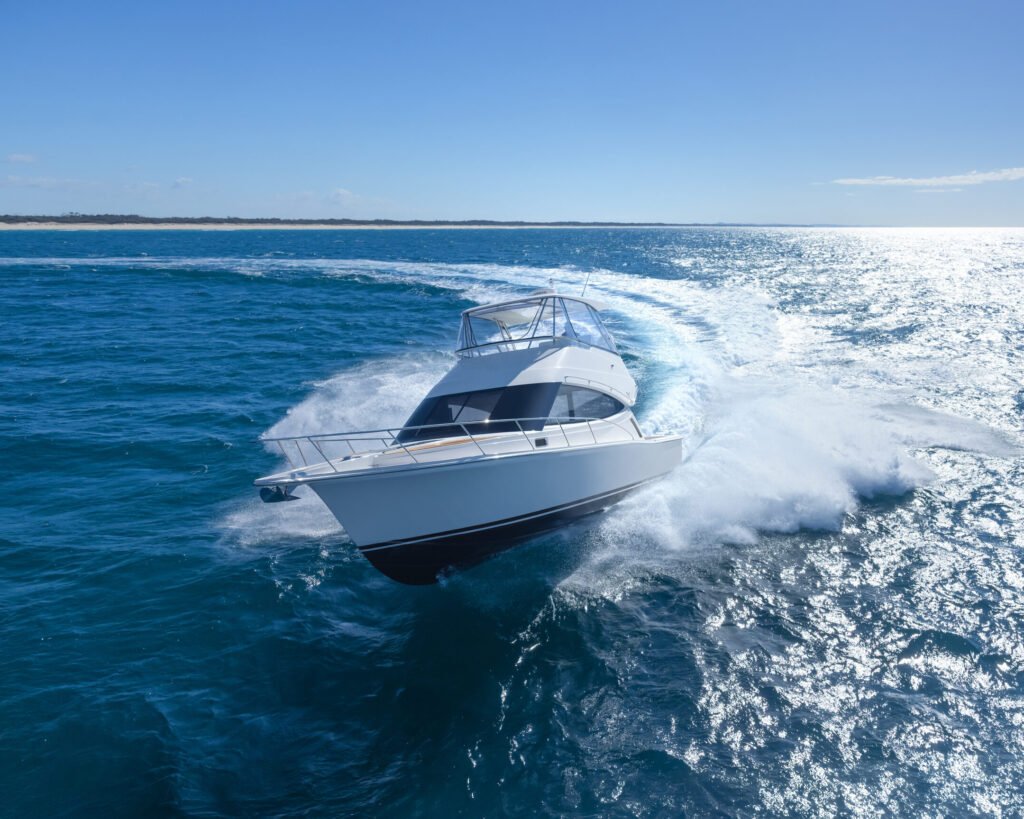
“We’ve never built a boat like the Caribbean, never had that much horsepower in something this small,” Maritimo’s GM Phil Candler told me, standing over the engine hatch with the particular expression of a man who is still slightly amazed by his own handiwork. “The thing’s a bit of a rocket ship.” At the time we spoke, the props hadn’t been finalised, and the factory had been hand-modifying the pitch to compensate for the sheer scale of the engines, which ultimately deliver when the correct pitch prop was fitted long after our sea trial. That being said, she was cruising at 30 knots at 80 per cent load, and once the correct props are fitted, expect smoother and quicker.
Nobody at International Marine had this problem, mostly because nobody at International Marine had ever needed to solve it.
STERN FIRST, AS ALWAYS
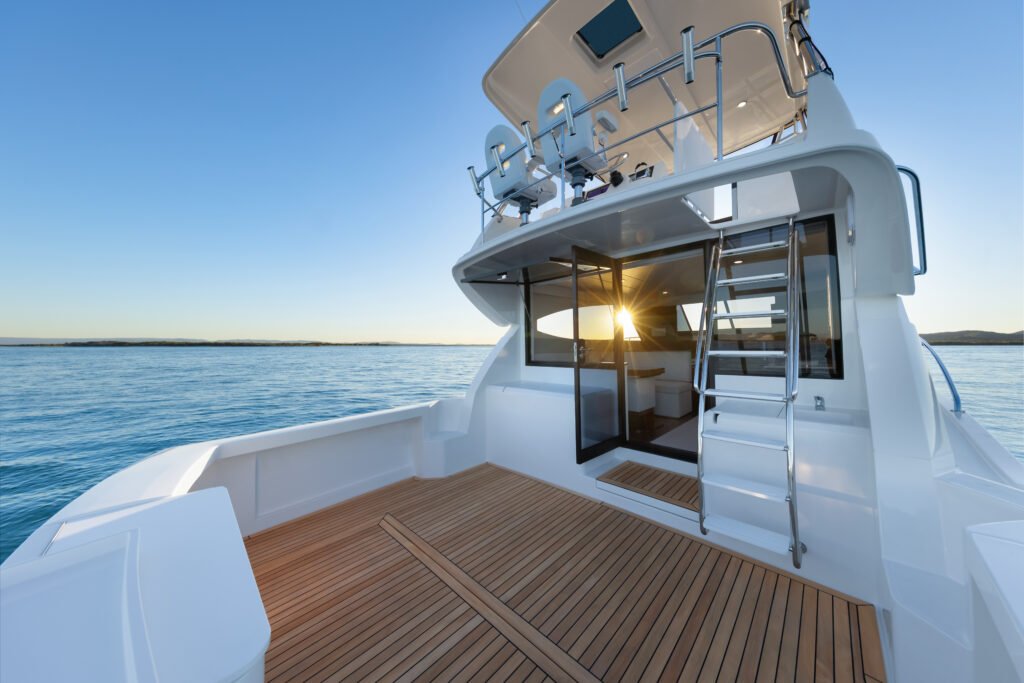
Start where the boat starts working for a living: the cockpit. There’s a proper transom arrangement with drains either side, each fitted with a flap so following water clears itself rather than lingering to remind you it was there. A live-well sits ready for anyone serious about bait, and in the kind of detail that tells you who this boat is actually for, there’s a barbecue built into the transom area, plus a sink, so you can grill dinner about four metres from where you caught it. Provision has also been made for a second set of engine controls at the stern, which matters more than it sounds – with 880 horsepower on tap, backing down on a marlin is not a job you want to manage blind from the helm. I’ll admit I spent a good 30 seconds on the aft deck trying to work out whether the barbecue was actually built into the sink, or whether the sink was built into the barbecue, before someone aboard patiently explained it was neither and both, and that I should probably stop asking.
Fair enough. Whichever way round it goes, it’s a genuinely clever use of a stretch of deck that on most 40-footers does nothing but sit there being wet.
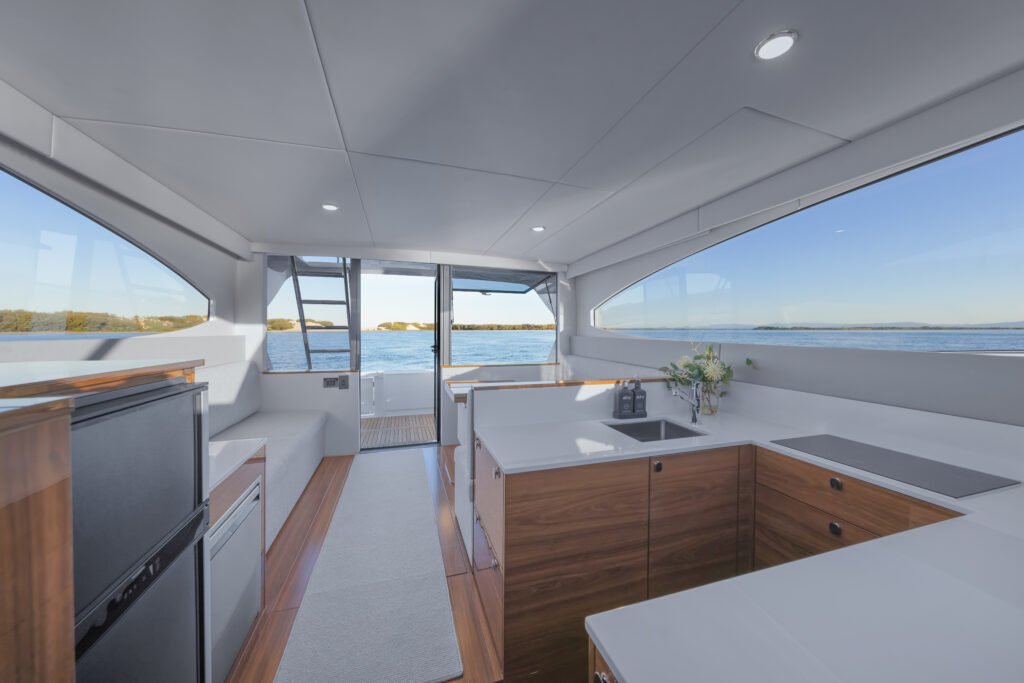
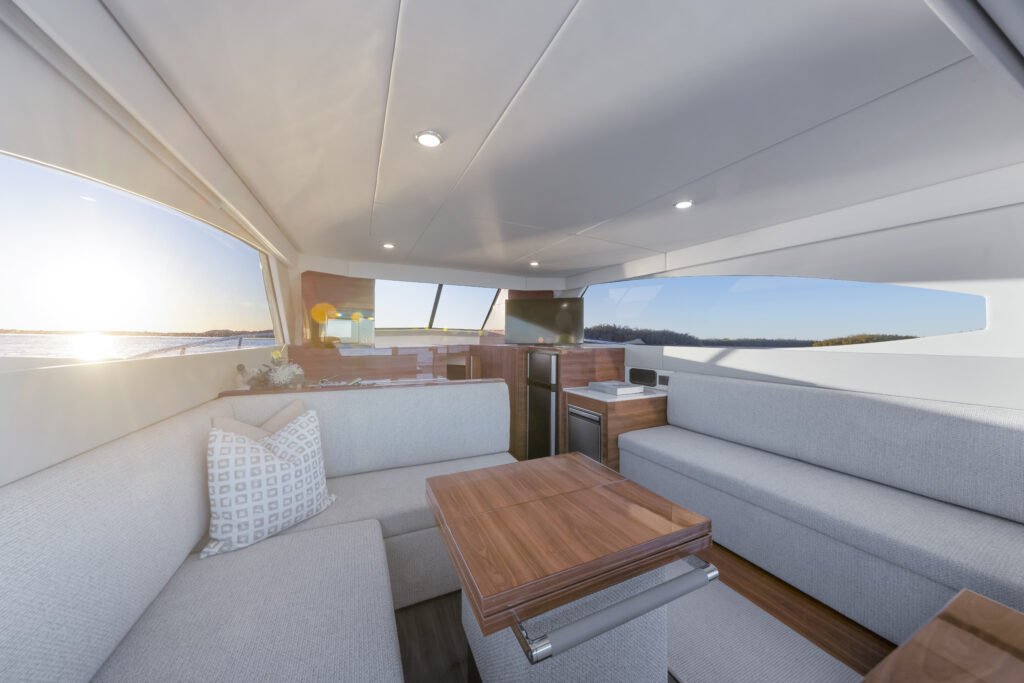
Up the port-side ladder and you’re at the galley, and this is where the 40 starts arguing its case properly. The fridge, and I want to be clear so I don’t say this lightly, opens from both sides. I have reviewed a great many boats and a great many fridges, and I stood in front of this one for an embarrassingly long time just opening it from each direction like a man discovering fire. It’s a small thing, but it is also the kind of small thing that tells you someone in the design office was actually thinking about how people use a boat, rather than how a boat looks in a brochure.
Either side of the galley storage runs deep – a sizeable freezer to port, another freezer-and-fridge combination to starboard, both properly large rather than the token cool-box arrangement some 40-footers get away with. White surfaces, induction cooktop sunk properly into the bench rather than sitting on top of it like an afterthought, and enough reflective, light-fabric finishing in the saloon that the whole space reads bright even on a grey Moreton Bay morning.
THE BOAT THAT BECOMES A HOTEL
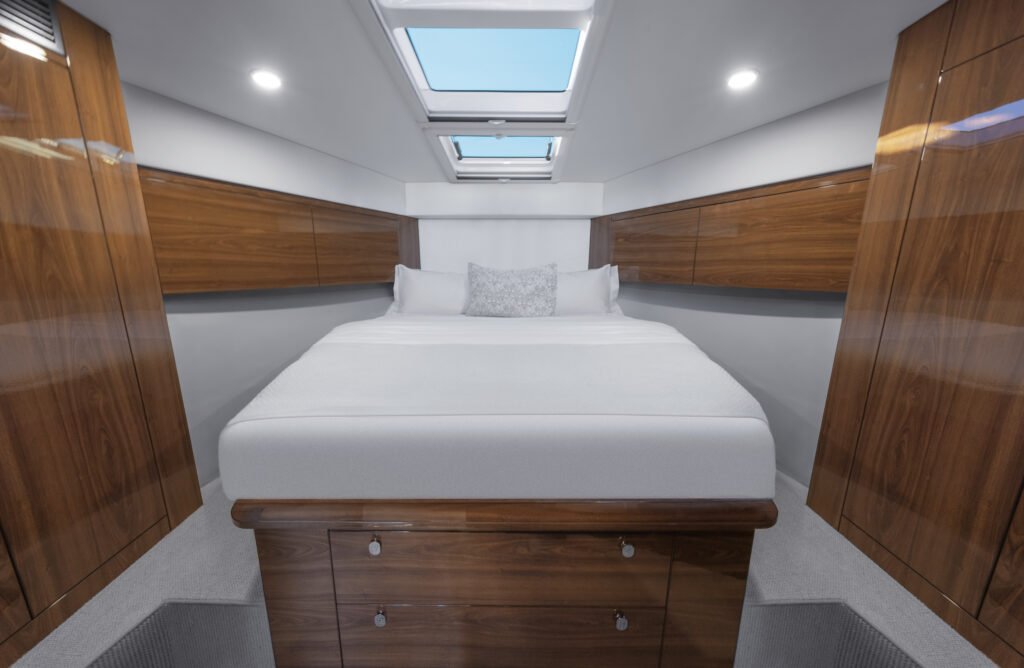
Here’s where the 40 quietly outperforms its length. The port-side dinette lifts and folds to become a double bed. The starboard settee converts to a single. Then add the forward cabin’s up-and-under bunks and the master’s island berth. You’re looking at sleeping arrangements for seven, which is the kind of accommodation math that usually requires at least eight extra feet of hull.
The master cabin itself breaks from the usual Maritimo playbook. Where the stablemate models tend to push the island bed to port, the 40’s berth sits dead centre. That’s not a styling choice; it’s a hull-shaped one. Push the bed forward and to one side on this particular hull form and the ergonomics simply stop working, so the design team went with a traditional centred island arrangement instead. It’s a small admission that even a brand-new hull has to negotiate with its own geometry, and the compromise, if you can call it that, is a genuinely comfortable master.
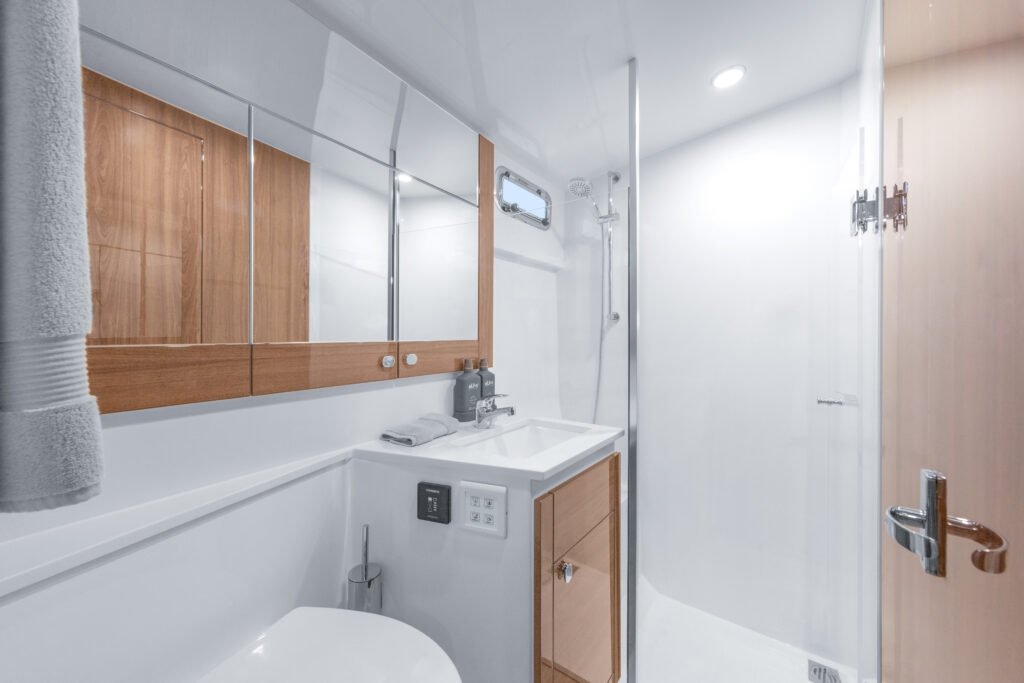
The bathroom does double duty as a day head via a Jack-and-Jill arrangement, with a direct door through to the master, admittedly a little snug in the shower for anyone built along my own generous lines. Forward, the second cabin runs a traditional up-and-under twin bunk, with the mattress base trimmed in solid timber surrounds rather than the vinyl edging you’ll find on cheaper builds. A deliberate nod, apparently, to the timber-heavy heritage of the original Bertramera Caribbeans, now translated into a boat that didn’t exist 18 months ago.
STRUCTURE YOU DON’T SEE, STORAGE YOU DO
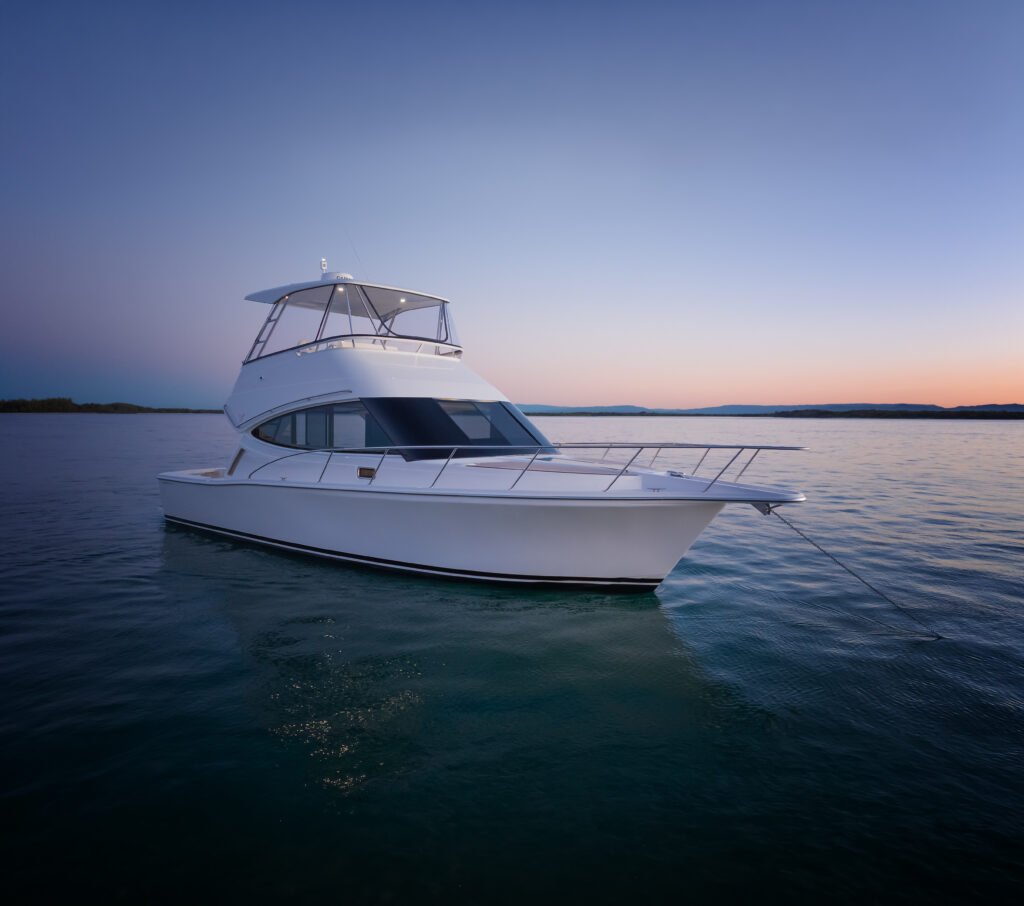
Up top, structural pillars run down from the flybridge itself, through to the deck below, rather than relying purely on the cabin structure for support, the kind of engineering that owners will never think about until the day it matters. Helm-side, dual 19-inch screens sit ready to be daisy-chained with whatever electronics package an owner wants, adjustable footrests slide forward for those of us who like to put our feet up mid-cruise, and a proper skipper’s bridge seat gives genuine 360-degree sightlines, genuinely useful for anyone under six feet who’s spent a lifetime squinting over a coaming on lesser boats. It is also worth mentioning that, instead of the usual way of shipping this boat with the flybridge roof and structure bolted on when it gets to its home port, the clever buggers have made the whole hardtop so it flips down and sits over the transom.
Storage, throughout, is not an afterthought bolted on where space allowed; it’s clearly been designed in from the keel up. New-style catches operate easily even with long fingernails, which I mention only because someone on the walkthrough specifically pointed it out to me as a design win.
WHAT SHE ACTUALLY DOES
Numbers on paper are one thing. Numbers with three knots of tide behind you, five adults aboard and a full load of fuel are the ones that count. On test day, running at 100 per cent engine load, the Caribbean 40F hit 36 knots burning 217 litres per hour for the privilege, which is not a figure for the faint-hearted, but is entirely appropriate for a boat carrying this much muscle.
Given International Marine’s old 40 never saw 30 knots in its life, watching this one clear 36 with a genuine load aboard tells you everything about how far the brand has travelled in a single generation change of ownership.
The engine room access, which has been rethought from the ground up as well. Where the old layout offered a single route down through the saloon floor, the new 40 gives you three: through a forward hatch, through the cockpit hatch or via the saloon floor itself – which lifts clear for full top-of-engine access when something more serious needs doing.
SUMMARY
Every boat review needs one moment that sends you home still thinking about it, and for the Caribbean 40F, it isn’t the horsepower, and it isn’t the twin Volvo D6s pushing this thing to 36 knots fully loaded. It’s that fridge. Sixty-eight years of Caribbean history from Bertram to International Marine to Maritimo, three owners, one name, thousands of hulls and the detail that stopped me in my tracks was a door that opens either way. That’s the whole story of this boat in miniature – a brand old enough to be a legend, wearing new tricks it didn’t need, but is all the better for having anyway.
SPECIFICATIONS
Length Overall 13.32m
Beam 4.3m
Draft 1.15m
Dry Weight 14,000kgs
Fuel Capacity 2,300L
Water Capacity 500L
Engines Twin Volvo D6 – 440 MHP – ZF HS85A
PERFORMANCE DATA
RPM KNOTS L/PH RANGE
600 6.40 8.2 1795
900 8.75 25.0 805
1500 15.55 88.5 404
2100 28.8 159.5 415
2450 34.5 231.0 339