THE REFINED EXPLORER
Both New Zealand and the province of British Columbia on Canada’s west coast share much in common. Both are the most beautiful places on earth, and both offer boaters fantastic cruising, fishing, SCUBA diving and general recreational boating. They now share something else in common – New Zealand-designed and built Herley boats.
Recently I had the opportunity to evaluate a Herley 36 from Mill Bay on Vancouver Island’s southeast coast. The review came about after I had previously tested the Herley 8 metre on New Zealand’s Hauraki Gulf for the September/October 2026 issue of PowerBoat Magazine. During that outing, Herley Boats owner and managing director Nick Herd, mentioned that a Herley 36 had been exported to Vancouver Island the previous year. As I was already planning a trip to British Columbia, the timing was ideal for a possible review of the Herley 36. After some planning with the boat’s current owner, Gordon, I headed to Mill Bay Marina on September 3 to put the Herley 36 through its paces.
BACKGROUND:
Before reporting on my day out aboard the Herley 36, it is important to mention a few things about Pacific Northwest (PNW) boating. Things that are germane to understanding why an experienced British Columbia boater, with a plethora of vessel choices manufactured by renowned local boat builders, would eventually choose a New Zealand-designed and built boat.
Any Kiwi boater who has spent time cruising the Marlborough Sounds or the Hauraki Gulf will feel right at home voyaging around the Strait of Georgia – a huge marine waterway located between the eastern coast of Vancouver Island, the southwestern mainland of British Columbia and encompassing the numerous Gulf Islands. This entire waterway system between Canada and the United States is now referred to as the Salish Sea, named after the indigenous coastal Salish peoples, who have lived and cared for these coastal waterways for thousands of years.
Although New Zealand and British Columbian coastal waters share many cruising similarities, they also have key differences. Not least of which are the facts that it can get bloody cold in the winter, there are often dense fogs and heavy rain, and, because of the huge timber industry along the coast, there are lots of large floating logs, necessitating not only a continual lookout, but also use of sophisticated radar and FLIRtype instrumentation to avoid potentially disastrous collisions with semi-submerged logs, or other boats. Local and offshore boat builders, supplying this market, are aware of these issues and have, for many decades, designed and built suitable craft to meet the demands of PNW boating. So, for a New Zealand company like Herley Boats trying to break into this established and experienced market, was no mean task.
FIRST IMPRESSIONS:
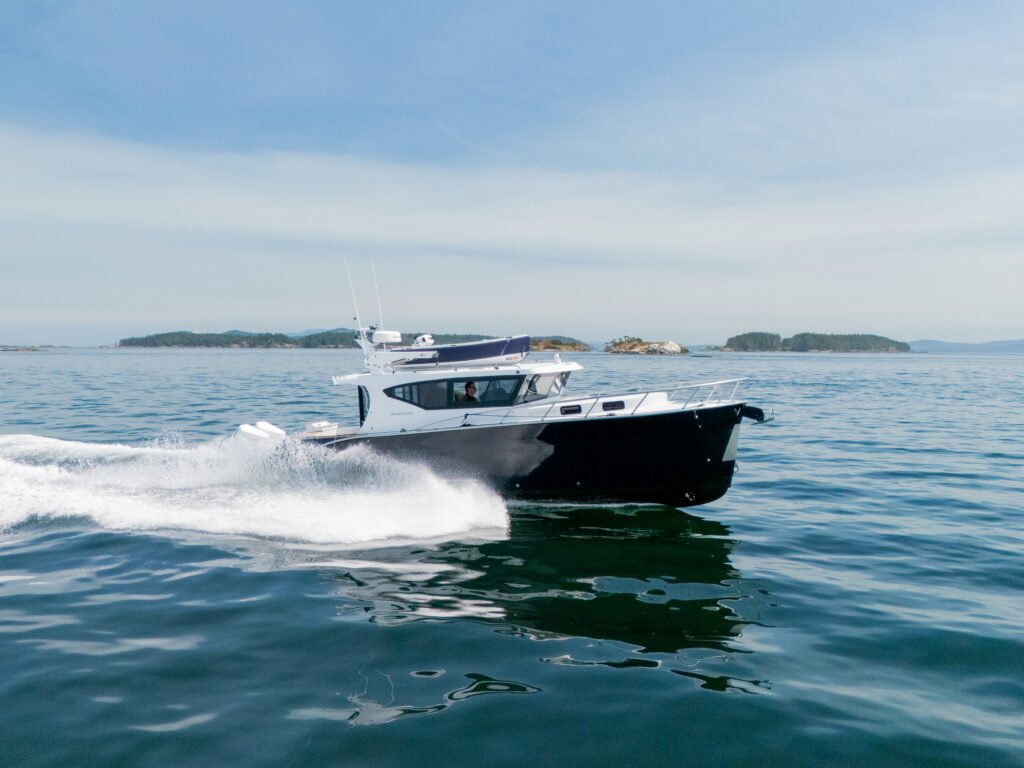
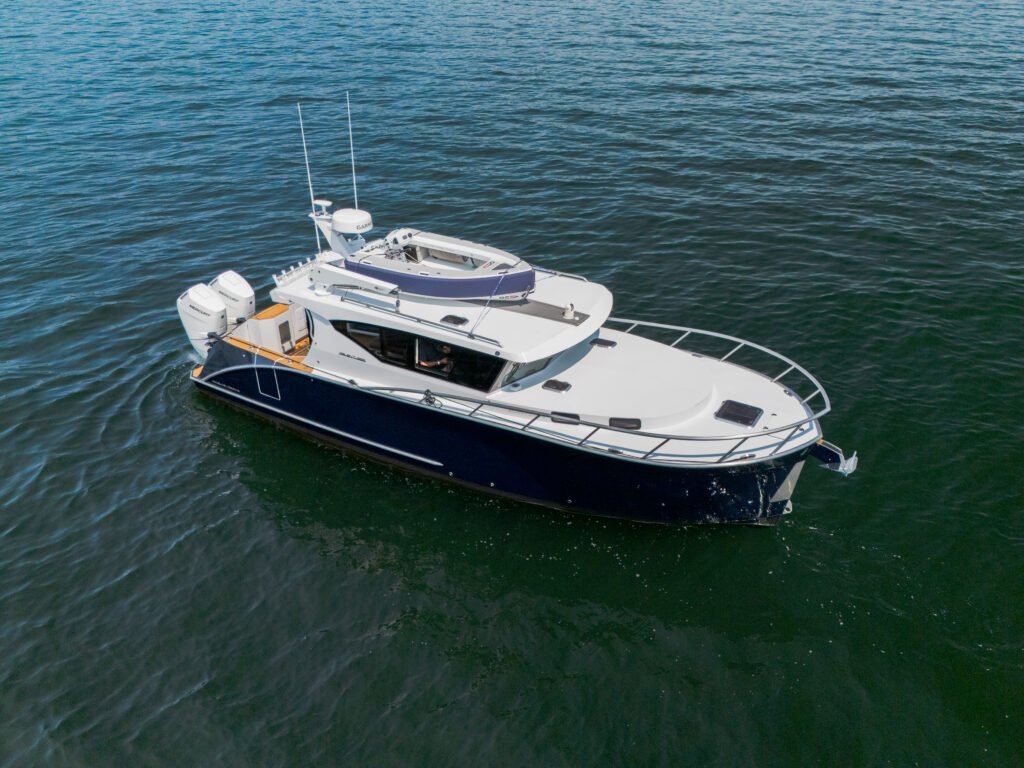
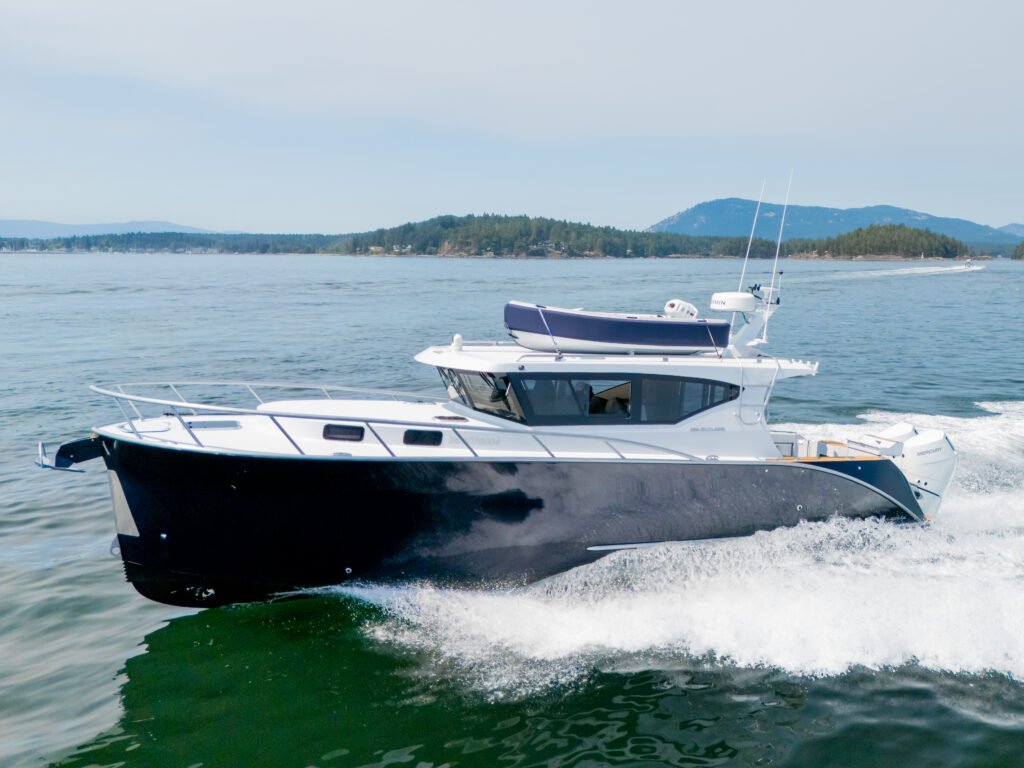
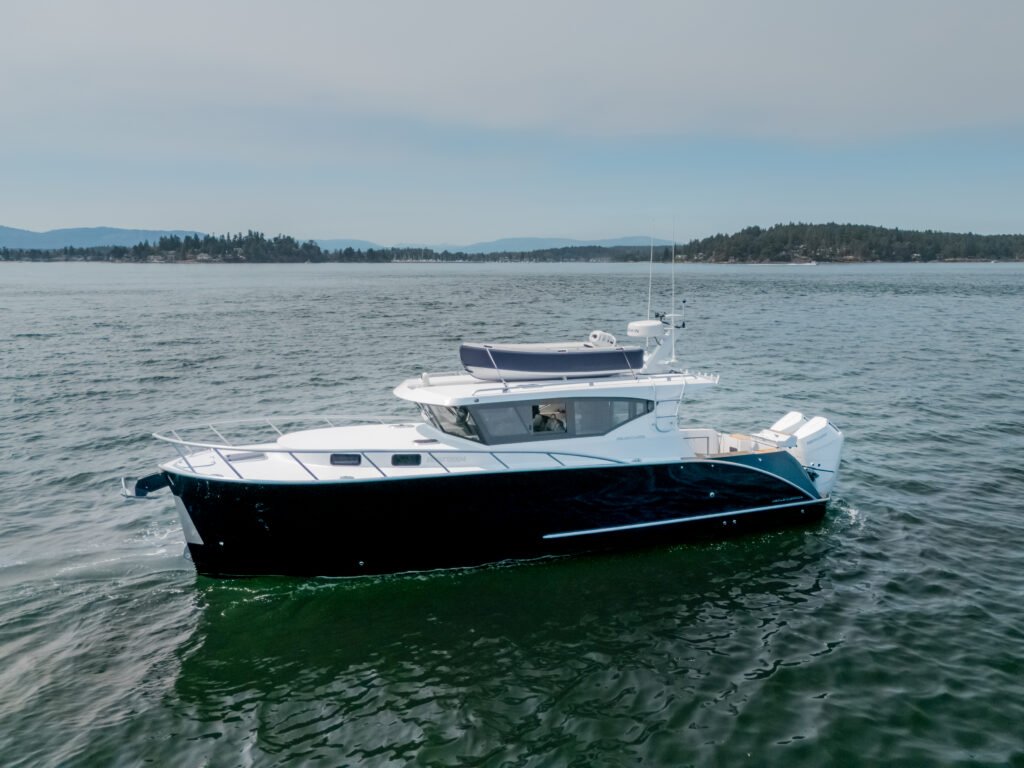
Although I had done some preliminary research on the Herley 36, I was unprepared for how stunning she looked, even sitting idle at her marina berth. Her plumb bow, of which I am a fan, her clean, curved lines, flared bow structure, rounded pilot housedesigned cabin and superb deep blue painted hull gave the impression that this was a luxury fibreglass boat, rather than a sturdy, go-anywhere aluminium vessel. Impressive!
Being fully aware that I was about to sea test a New Zealand-designed boat in waters that were over six thousand nautical miles away from where she was built, I felt it important to have an in-depth discussion with Gordon, an experienced seaman who, over the years, had owned eight previous vessels in wood, fibreglass and aluminium, ranging from 22’ to 43’, regarding the reasons why he chose the Herley 36.
MAIN REASONS FOR CHOOSING THE HERLEY 36:
• Gordon and his wife loved several of their previous boats, especially their Helmsman 38’. But, with a ‘special needs’ son, who was very active and had an impatient attention span, he found it was too slow compared with a fast 22-footer he had previously owned, which his son loved but his wife did not.
• Understanding that every boat is a compromise, Gordon set out to find a larger, faster boat and bought a 30’ alloy boat with twin 300 Hp outboards. It was more of a fishing boat than a cruiser, and Gordon decked it out for his son’s special needs. But still not “perfect”. Son liked it; wife did not.
• The search continued, and after much investigation, he found the Herley 36 on a local Canadian Facebook Marketplace site. After physically checking it out at a nearby marina, Gordon loved it at first sight, and while his wife is not quite the competent boatie that Gordon is, she conceded that, “I can see why you like it”. So, as ‘a nod is as good as a wink’, he proceeded with closer investigation and realised that the more he looked at the boat, the more he liked so many of its features. Gordon realised he’d found a boat his wife could enjoy, he could fish from, and, most importantly, that would meet his son’s special needs while cruising with the family.
With that background in mind, I asked Gordon about the other Herley features that appealed to him. It is important to note that Gordon is the second owner of this boat and that, I discovered through subsequent research, many of the reasons that the original owner bought the boat were the same as Gordon’s. This indicated to me that Herley Boats has a unique opportunity to fill a specific market niche in the Pacific Northwest. By describing the vessel’s features, largely through Gordon’s eyes, but also including my own impressions, hopefully the result will be a balanced survey of the boat.
EXTERIOR:
The exterior of the boat is bold and unique, with the plumb bow and low-profile pilot house design inspiring confidence that this vessel, featuring a flared, sweeping bow, is ideally suited for the PNW’s sea conditions and environment.
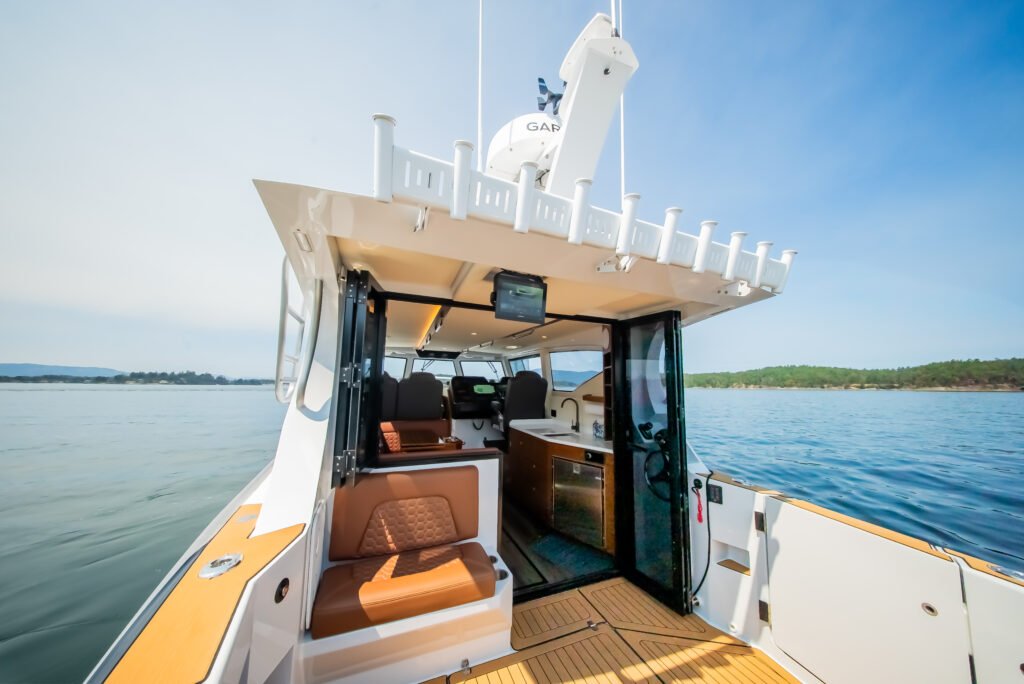
The pilot house design is extremely appropriate for the Salish Sea. It offers extra headroom, and the aft-angled windscreen is better at shedding rainwater as well as any spray that may come over the bow in rough sea conditions, while providing much better, anti-glare, forward line-of-sight vision.
In addition, the expansive pilot house roof has plenty of room, not only for navigational aids such as the collapsible Garmin radar plinth and FLIR camera, but also for accommodating the New Zealand-built OC tender and associated Davco davit.
The smooth curved lines of the hull, with its plumb bow fitted with a large towing eye and ‘log grabber’ (a heavy-duty, reinforced metal plate welded directly to the vertical stem of the boat’s bow and designed to absorb impacts and deflect floating debris) belie the fact that this is an alloy craft. The plumb bow not only cleaves smoothly through heavy seas, but provides more accommodation space in the forepeak, allowing enough room for a commodious owner’s cabin up forward.
The foredeck is totally uncluttered due to the fact that the Lone Star rope/chain drum reel anchor winch is stowed below deck, but still readily accessible. In Gordon’s words; “I like the flared bow look, with hull curves so pure that I initially thought this must be a fibreglass boat.” The only two exterior features that Gordon took issue with were the bow rail and the retractable cleats. That said, the bow rails are extremely substantial, which is a plus, but they are perhaps a bit low, even though this was done to avoid obstructing forward vision. But maybe the bow rail could be a bit higher, so vision would be between the deck and the rail while steering from the main helm station. Higher bow rails would also provide greater safety and security when working on the foredeck.
The retractable deck cleats are aesthetically attractive and do minimise ‘toe-stubbing’, and are okay for use with 5/8” or 3/4” rope, but if doubling a line or adding a bridle off the bow, there is not enough room. So, perhaps larger retractable cleats, or a combination of retractable and larger, fixed welded cleats? Morphing from exterior considerations to examining and discussing the interior features of the Herley 36, as we moved down the length of the boat alongside the marina berth, Gordon often repeated his appreciation of the continuous curves found everywhere on the boat – aesthetically pleasing and practical.
COCKPIT:
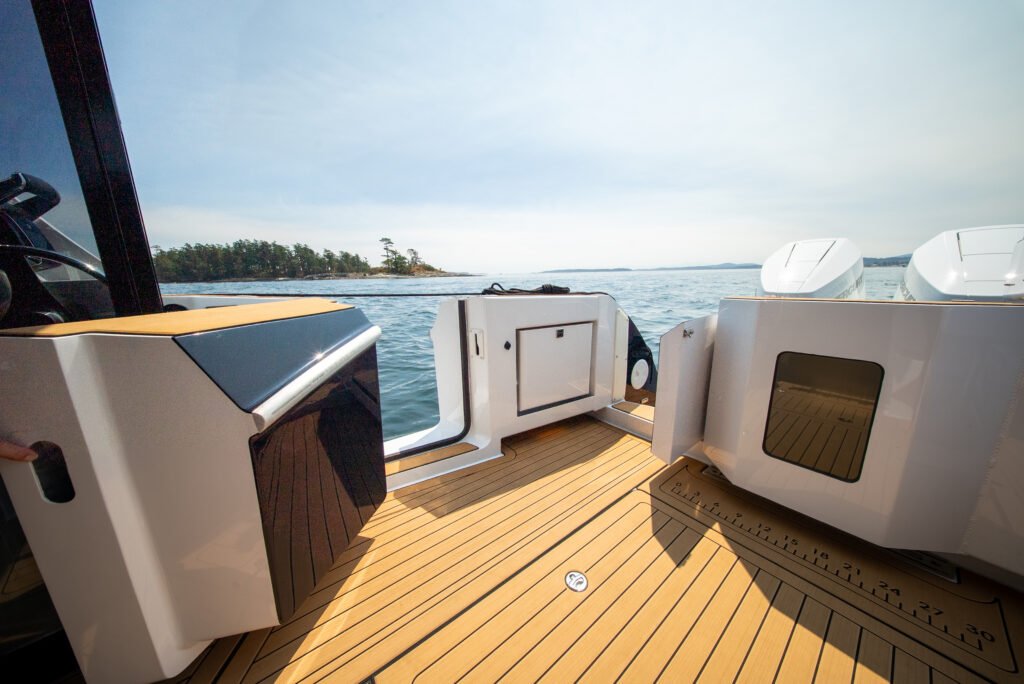
Boarding the boat from a marina berth or wharf is simple and safe, thanks to the wide side-entry door on the starboard side of the cockpit. This feature makes entering the cockpit and/or loading supplies from the marina berth or wharf easier and safer than using the stern cockpit door and the swim platform. Gordon emphasised that this side entry was a must for his son, not to mention that his wife loves it.
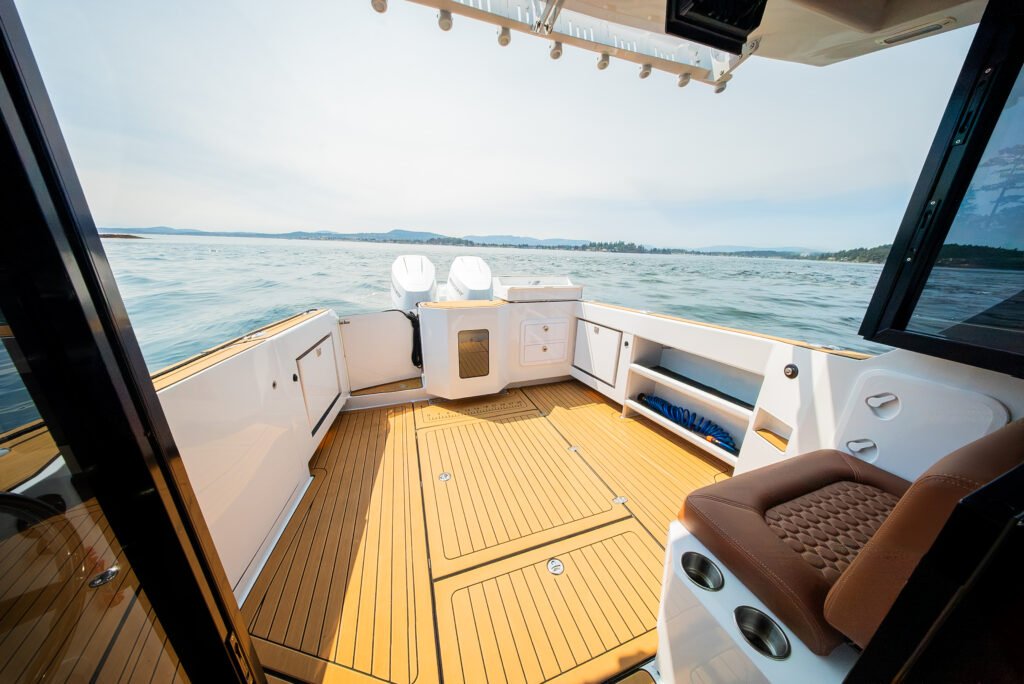
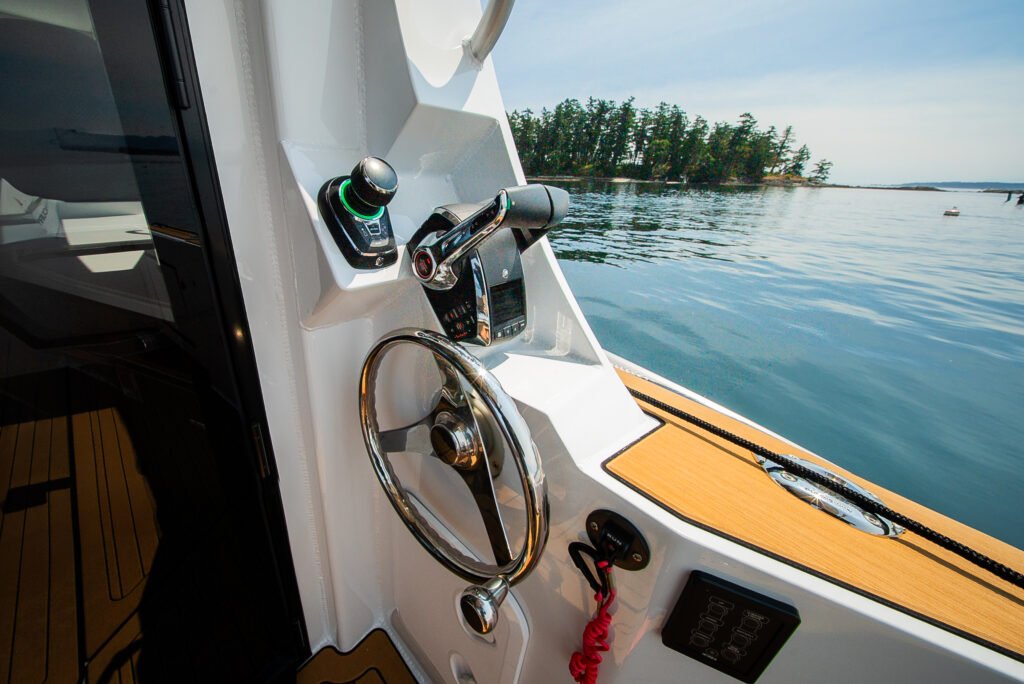
Entering the moderately sized cockpit, you immediately notice how well equipped it is and how carefully the design and layout are thought out. Although Gordon’s previous 30-footer had a slightly larger cockpit, the Herley’s cockpit was acceptable. The compromise between cockpit size and much more interior room, both in the main cabin and also in the accommodation/head area, was a good trade-off as far as he was concerned. I personally felt it was quite spacious for a 36-footer, with a dedicated sport-fishing platform, an integrated aft helm station with joystick manoeuvring controls, a live bait tank, bait station, insulated macerated fish bin, and electric rocket launcher. But importantly, in Gordon’s mind, two main cockpit features set the Herley 36 apart from all other boats he has owned; the cockpit helm station and the bi-fold cabin doors.
When using the cockpit helm station to manoeuvre the boat into or out of a marina, or when trolling, Gordon pointed out how the aesthetically pleasing grab rails mounted both port and starboard on the cabin coach were not only practical, but that the curved design, especially on the starboard side, allowed unhindered forward line of sight.
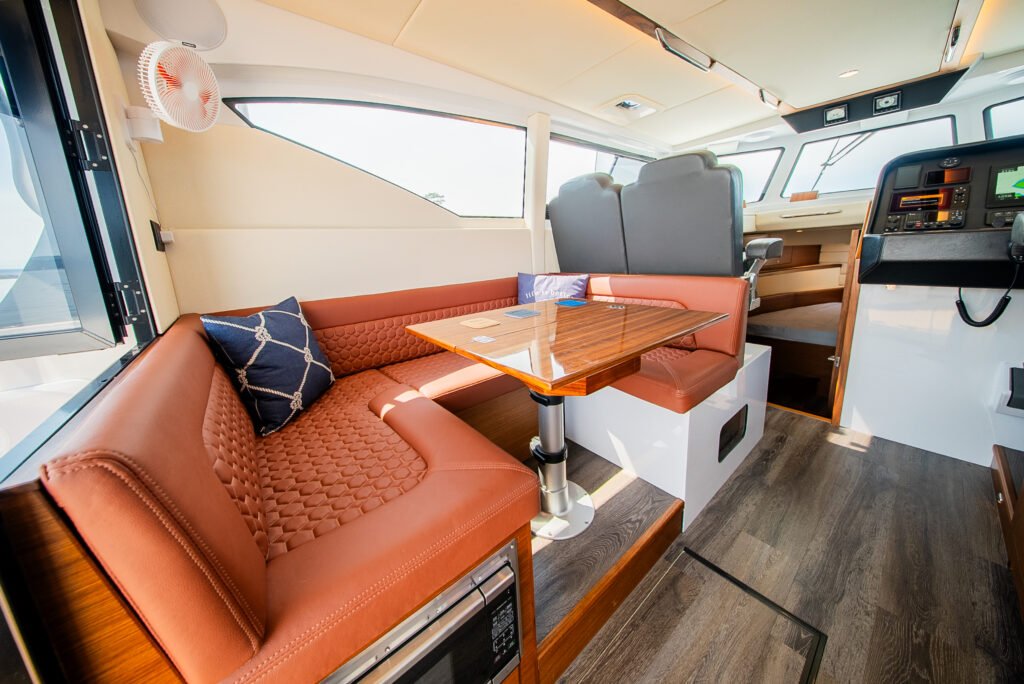
The 36 is equipped with two sets of main cabin bi-fold, safety glass, aluminium-framed doors. Full-height entry bi-folds on the starboard side of the cockpit, while on the port side, half-height bi-folds above a stern-facing bench seat over a locker. These doors provide easy entry into the main cabin and add extra ventilation and a feeling of openness when both sets are open. To list all the other features of the cockpit area would take up half this article, so I will let the accompanying captioned images do the talking instead. That said, Gordon mentioned a feature he really likes; the drop-down rocket launcher, which lowers with the touch of a button, giving even a shorter person easy access to insert or remove fishing rods. Job done, gently push up the rocket launcher assembly into the lock and go position. Clever!
MAIN CABIN:
It is worth noting that Gordon owns a large cabinetry company, making him a credible observer of quality and finish. So when he says that the Herley 36 interior finish is world class, take it as read.
The interior layout is practical and functional with a U-shaped settee/dinette to port, which can be converted to a temporary third bunk. The galley is located to starboard as you enter the cabin. This layout provides a good workspace, with a portable electric cooktop which is stowed beneath the counter when not in use. Gordon’s wife, however, would have liked more drawer space. The helm sits forward of the galley, while twin co-pilot/passenger seats sit in front of the dinette, offering comfortable seating and a good forward view while underway.
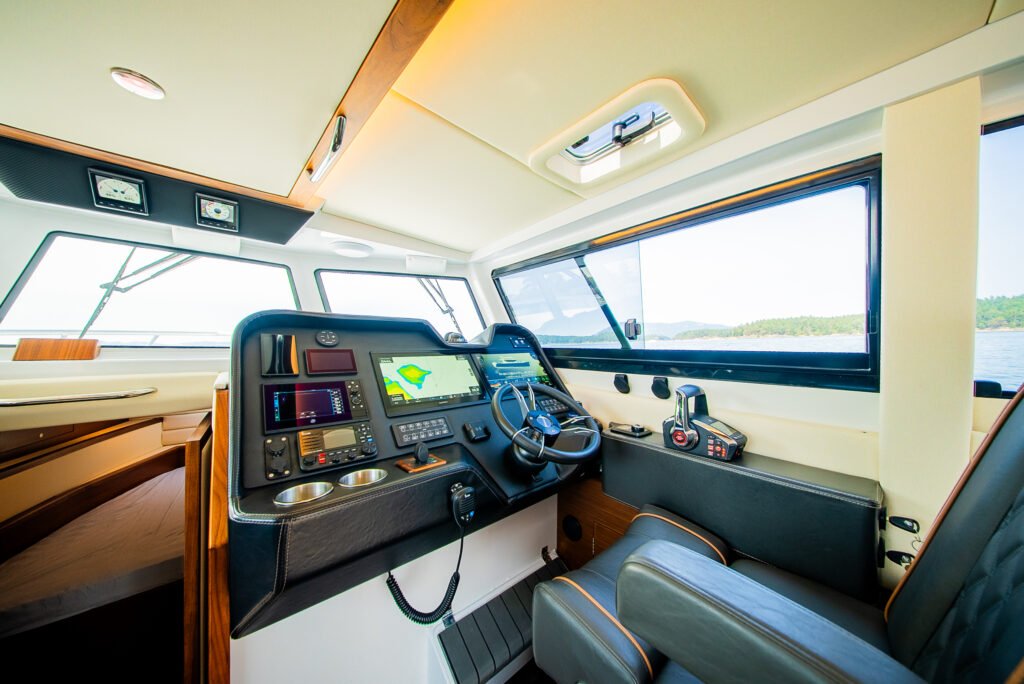
The helm station, with its array of MFD’s, controls and panels, could at first glance seem intimidating, but once seated on the hydraulically cushioned helm seat, it soon becomes apparent that everything is laid out intuitively, with all controls ergonomically situated and easy to use; with one small exception. The engine ignition key position is awkwardly placed aft of the throttle controls, making it difficult to slot in the engine starter key. However, Gordon reckons that this could easily be re-positioned elsewhere on the dash.
One improvement Gordon will make in the cabin is to the seating, both the helm and co-pilot seats. He feels they are too low and too closely positioned to the cabinetry behind them. His intention is to modify the height with about 3” risers and to move the seats forward slightly. Other than these few minor details (all readily remedied), the main cabin layout and functionality, with good lighting and excellent all-round visibility and ventilation, is extremely well thought out.
ACCOMMODATION AREA AND HEAD:
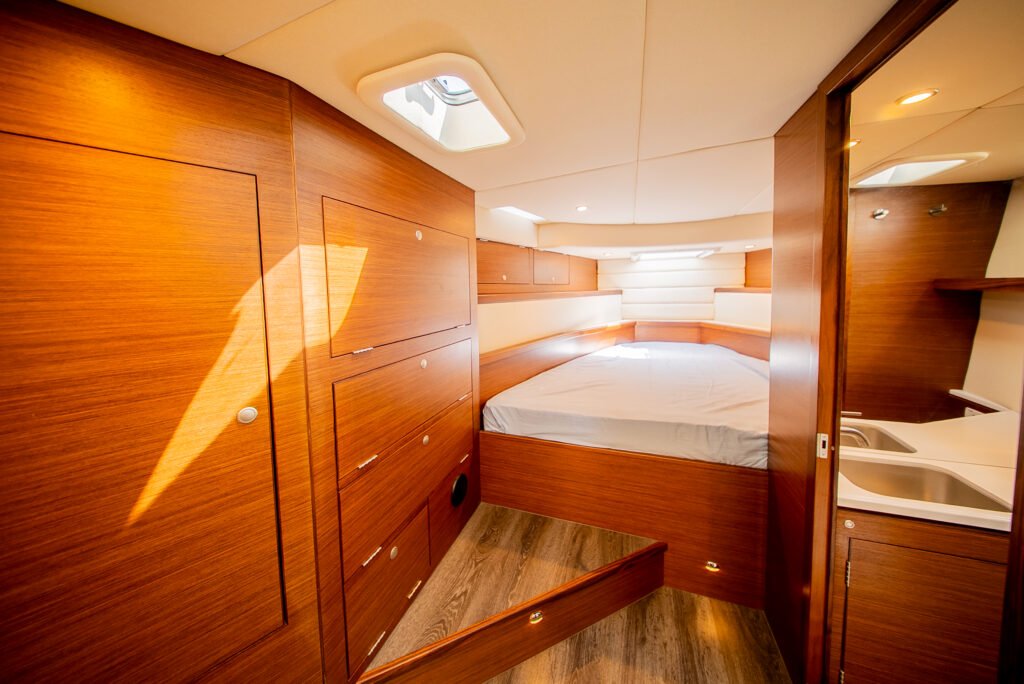
There is a two-cabin accommodation layout up forward, accessed via a central stairway, leading down from the main cabin. The owner’s cabin, fitted with a large queen-sized bed in the forepeak, is more than ample because the plumb bow design provides more room than a conventional hull. There is plenty of locker storage on both sides of the bed, and as you make your way to the second cabin, full-length cabinets and additional storage cupboards will be found.
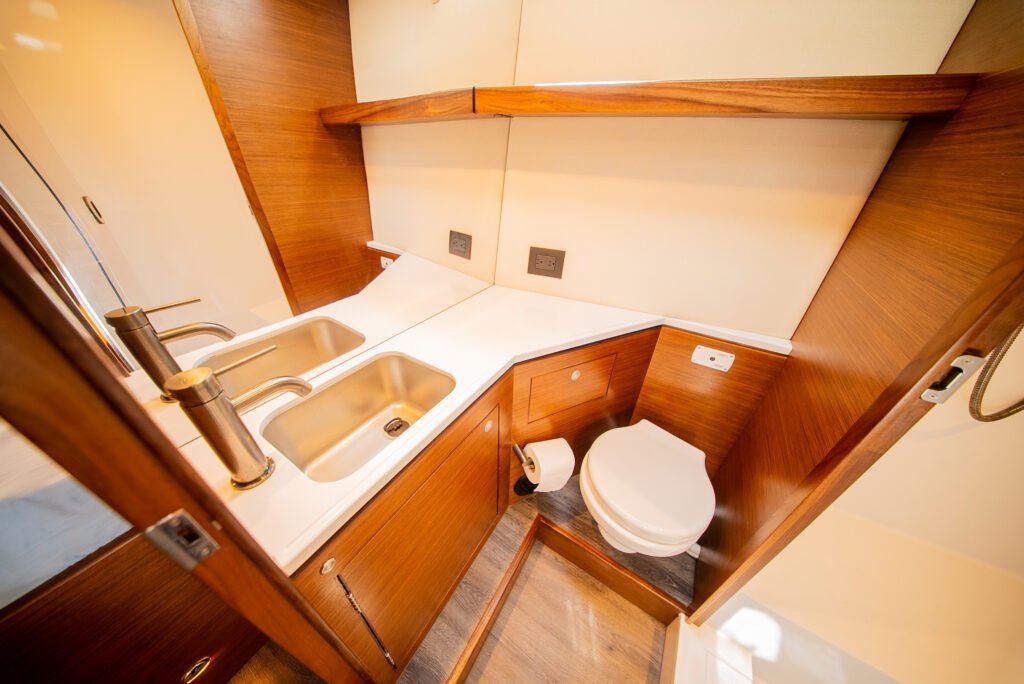
Descending the stairs to the owner’s cabin, you will find a large (for this length of boat) head to starboard with an electric macerator toilet and full-height shower, laid out to provide an uncrowded space with good ventilation and lighting. Gordon’s wife loves it! A clever use of space is the location of the second cabin, tucked under the main cabin and easily accessible as you turn left and aft upon entering the accommodation/head area. Although not full height, it contains a double bed, good lighting and ventilation and, best of all, it is Gordon’s son’s “happy place”.
PERFORMANCE:
Herley Boats has nailed it when it comes to marrying the propulsion units (twin Mercury V10, 400 HP outboards) to its efficient hydrodynamic plumb-bow hull design. Depending on sea conditions, the boat gets up on the plane at between 3000 and 3500 RPM. Push the throttles just a little further forward, and at 3700 RPM (ideal cruising speed) the boat glides along at 26 knots using a modest amount of fuel (1.25 NM/ Imperial Gallon). As we put the Herley 36 through its paces, we maxed out at an impressive 46 knots at 6000 RPM. Not something you would want to do too often, as fuel consumption dropped to about 0.7 NM/ Imperial Gallon.
Sea conditions were calm that day, and the smooth seas didn’t let us see how the boat would perform in rough conditions. However, Gordon mentioned that two days prior, in very stormy conditions and tumultuous waves, the boat cut through the water with only a mere hint of crashing and banging; the plumb, flared bow cleaving the waves and spraying the water well clear to either side. What water did come over the bow was quickly sloughed off the pilot house’s aft-angled windows. The three efficient windscreen wipers taking care of the rest.
After doing lengthy performance runs (refer data below), Gordon handed me the helm and, with his permission to ‘go for it’, I did! Pushing the boat at various speeds, through hard port and starboard turns, and trying to get a sense of performance in rougher conditions by hammering into our own created wake, I built confidence at the wheel, and my delight in how this boat performed was evident to anyone.
Spoiler alert. Having tested and reviewed the Herley Elite 8 several weeks earlier, and being impressed with its performance, I was pretty confident that I would not be disappointed in the 36’s performance. I wasn’t.
Upon returning to the marina, I was impressed with Gordon’s ease of handling the boat as he manoeuvred it back into its berth. Using the cockpit controls and utilising only the engines (even though a Vetus BowPro bow thruster is fitted and he does use it in high wind/adverse tide conditions), he slid the boat home with ease and alacrity. Although I was there to help with the lines, it was clear Gordon could have handled the mooring just as easily himself. Job done.
SUMMARY:
The Herley 36 is destined to successfully fill a unique market niche in the PNW. As previously mentioned, boaters in this region have numerous choices when it comes to planing, pilot house-designed aluminium boats. However, as good as the competitors are, most exhibit utilitarian, almost ‘workboat’ like designs, with hard angles and plain surfaces, unlike the Herley 36’s more luxurious appearance, pragmatic but stylish features and exemplary finish.
SPECIFICATIONS
LOA 10.85m
Beam 3.2m
Fuel 1000L
Water 70L + Watermakert
Draft 0.45m
Displacement (Dry) 6.5 tonnes
Powered By Twin Mercury 400hp V10’s
PERFORMANCE DATA
RPM KNOTS L/NM
1000 5.1 2.53
2000 9.44 3.5
3000 18.5 3.5
4000 29.6 3.76
5000 37.8 5.05
6000 46 6.31
HERLEY BOATS EXPORT ASPIRATIONS
Having now tested and reviewed two New Zealand-built Herley craft, one in New Zealand and the other, which was exported to the West Coast of Canada, I was curious how this Tauranga-based company managed to sell one of their top-line boats to a Canadian customer living on Vancouver Island. So, while I was still in British Columbia, I called Nick for a quick ‘fact gathering’ chat.
My first question. “Nick, did you always plan to export to Canada”? “No”, he replied. “So”, I said, “How did your export aspirations, especially to North America’s Pacific North West, come about”? Thus, the tale unfolded.
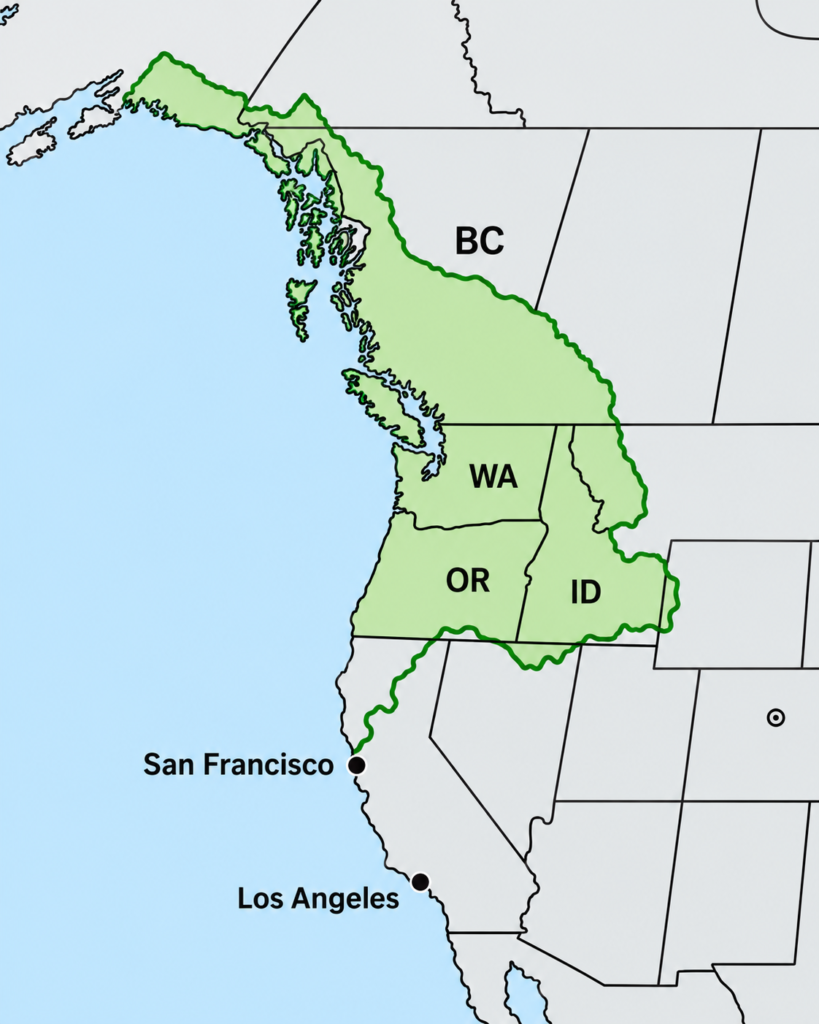
Back around 2008, Herley Boats, having established itself as a premium brand in New Zealand, started getting enquiries from Australia. Nick was not overly surprised, as many other New Zealand boat builders had been successful exporting boats to Australia over the past few decades. Herley was able to establish themselves on the Australian eastern seaboard over the following years, with boats and support eventually extending as far away as Western Australia. However, North America, particularly the PNW region, had only been on the fringe of Nick’s marketing radar.
Fortuitously, an experienced Canadian boater, living on Vancouver Island, not able to find what he wanted from the locally available choices, had recently begun trolling the internet looking for a boat that would suit his particular requirements in a mid-sized (30’ to 40’) aluminium, pilot house, planing hull craft. Hitting on the Herley Boats’ website, he realised he may have found exactly what he was looking for in an upmarket aluminium craft. One that could be built with all the ‘bells and whistles’ he wanted and finished to a much higher degree of quality than locally built aluminium vessels. A Herley 36 was decided upon after discussions between Nick and the Canadian customer and, about two years ago, the first Herley boat was exported to the PNW.
Then, earlier this year, Nick received an order for a Herley 45 (currently nearing completion in Tauranga) which will be shipped to Washington State in time for the February, 2027 Seattle Boat Show, after which it will be delivered to the American customer. With a number of other PNW clients now lining up with genuine expressions of interest, Nick realised that this was a market worth pursuing. The combined population of Vancouver, Victoria and Seattle cities alone being about 8 million people – more than the entire population of New Zealand!
Although Nick has started to do some promotion in the region, existing ‘word of mouth’ referrals have already enabled him to ease into this market. However, he was quick to recognise that although Herley boats are a notch above what is currently available in this market, customer confidence is paramount. To this end, Nick is collaborating with existing PNW boat yards to assist with ongoing maintenance and warranty backup. Three yards have already signed up. In addition to offering alloy boats that have already shown to be more luxuriously finished compared to similar competitor boat builders, Herley vessels are also able to compete pricewise, due largely to lower New Zealand labour rates compared to Canada and the USA. But also, because of the advantageous NZ/CDN dollar exchange rate – especially the NZ/ USA dollar exchange rate. So, despite current ‘Trump Tariffs’ and trans-Pacific shipping costs, Herley Boats is poised to become a major player in this lucrative and aquatically orientated market. The company intends to continue their focus in the Pacific North West, with particular emphasis on Vancouver, Victoria and Seattle. Nick feels that Herley offers a type of boat that is uniquely qualified to suit this market, while offering a more up market product with a higher degree of finish compared to existing and traditional, regional aluminium boat builders. Herley Boats is aiming to fit a perceived (and I feel in truth) existing market gap.