SHE’S STILL THE ULTIMATE LADY
When Ultimate Lady was launched in 1998, she boldly brought wave piercing to recreational game fishing. Rebecca Hayter covered the story and, nearly 30 years later, asked designer Craig Loomes of LOMOcean Marine how his highly unusual approach to Ultimate Lady had worked in practice. He suggested she fly to Tahiti to see for herself.
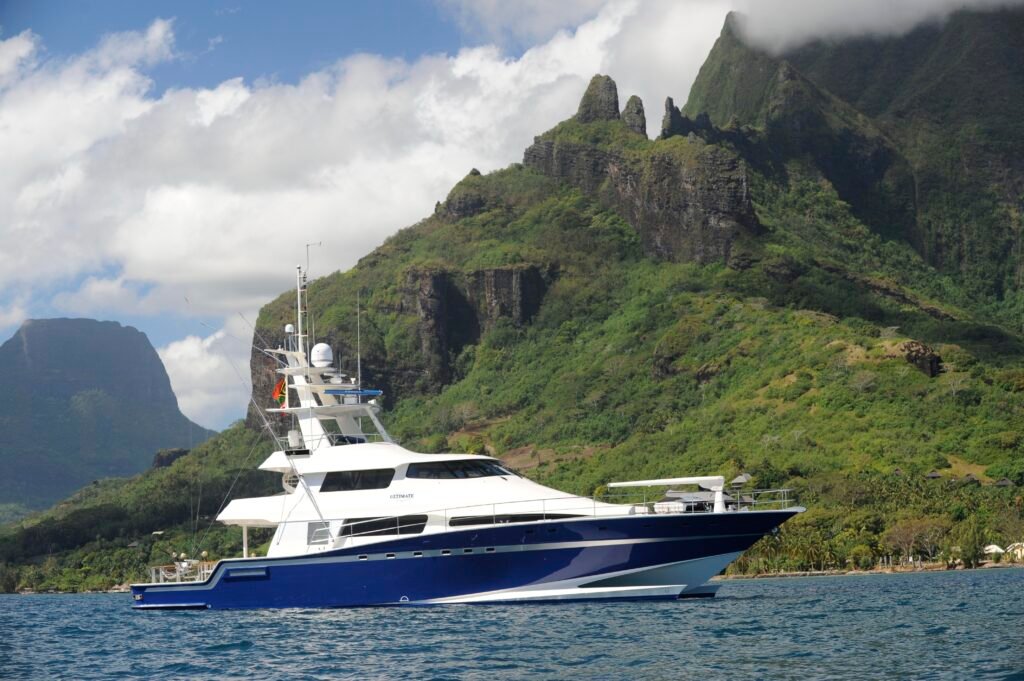
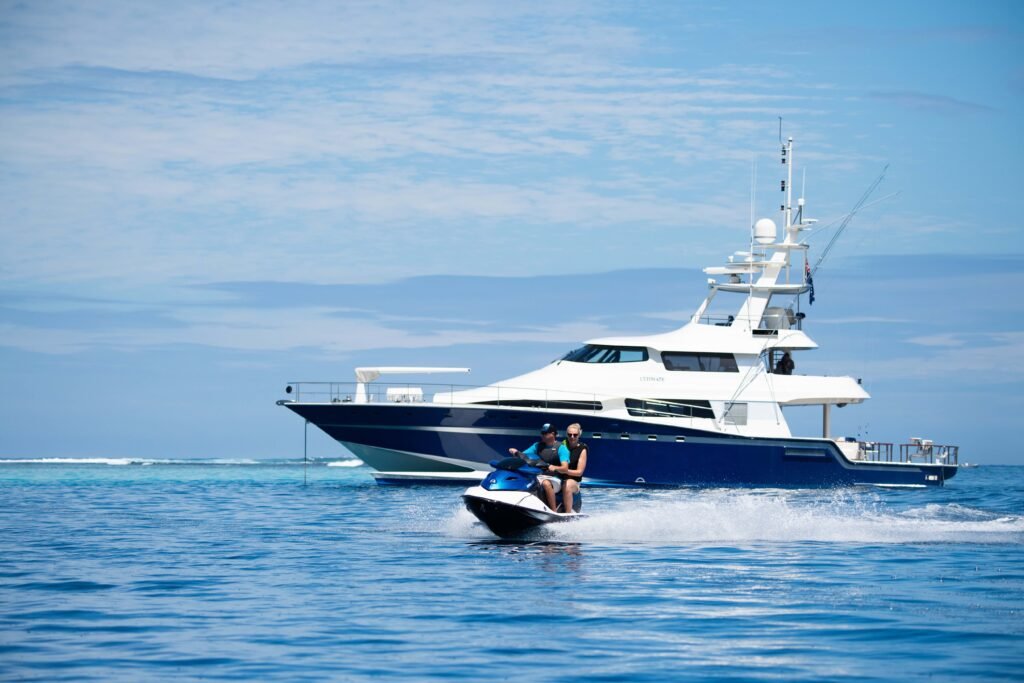
Ultimate Lady doesn’t make waves, she pierces them. She is widely regarded as the world’s first recreational wave piercer and the first wave piercer to be built in composite. After nearly three decades with the same owner who just loves game fishing, she represents multiple successes.
The pinnacle occurred on 4 July 2025 when the local mayor and police arrived at Marina Taina, Papeete to investigate an event that had never before happened in Tahiti: a local boat had landed a blue marlin that might win a world cup in game fishing. That boat was the distinctive, three-tiered Ultimate Lady, 28m loa and 10m beam, which had caught a blue marlin with owner Fred Lewis in the game chair, his wife Darryle driving the chair and Captain Tom Francis at the helm.
The officials were there to satisfy strict protocols required by the International Game Fish Association (IGFA), including a weighin on officially calibrated scales. The Blue Marlin World Cup is a one day, one species, one winner event at destinations around the world. From 0830 am to 430 pm in their respective time zones, 167 teams representing nine countries had competed to catch the biggest blue marlin on the day.
By the time Ultimate Lady docked, most other countries had passed the 4.30 pm cut-off, but 4500 miles away in Louisiana, USA another game fishing boat was making its 100-mile run back to port with a blue marlin onboard. Was it bigger than Ultimate Lady’s? Well, everyone would have to wait for the weigh-in.
It was 30 years minus two weeks since car entrepreneur Fred Lewis had phoned Auckland designer Craig Loomes with a request for a new boat. Fred had owned several game fishing boats, including a Loomes design. Game fishing with friends on board was and remains Fred’s happy place. He had fished the Ranfurly Banks off East Cape and yearned to fish the Wanganella Banks west of the Three Kings Islands as well as destinations around the Pacific Ocean. He wanted a new boat for the task and asked Craig to submit a concept.
Fred’s wish-list included a spacious, luxurious catamaran of around 26m – later extended to 28m – that would provide a stable platform in blue water conditions. He wanted excellent fuel efficiency on long offshore passages. As a game fisher, it needed to be manoeuvrable for landing big fish and have a low cockpit to bring them onboard – attributes not usually associated with big boats. Some owners solved this quandary by having two boats: a mothership towing a game fisher of around 15 metres. But Fred wanted all these qualities in one boat. Oh, and his new boat must be pretty, not at all like a catamaran.
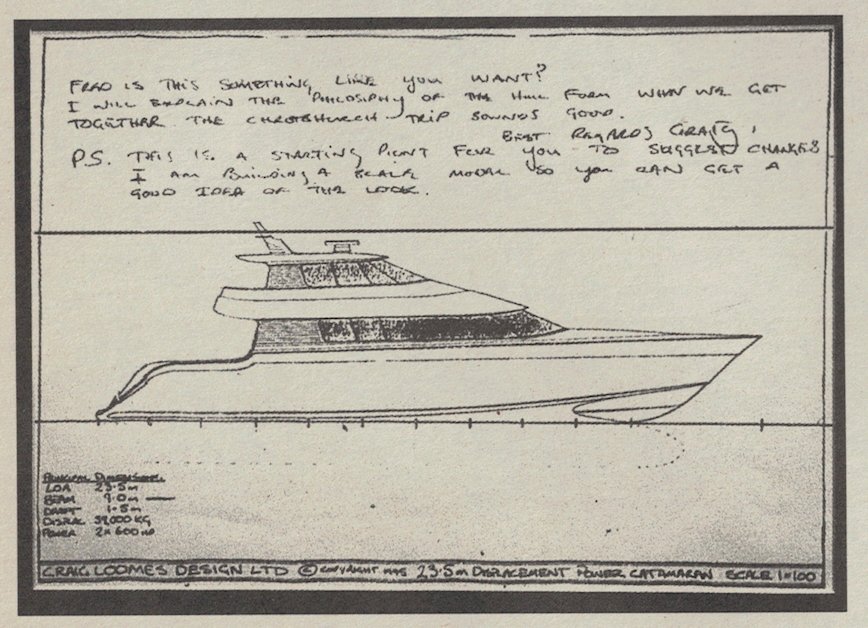
That final requirement had already eliminated another yacht designer, but Loomes said he could design a catamaran that looked like a monohull. The next morning a fax of his pencil drawing arrived in Fred’s office. Kids, ask your parents what a fax is.
Loomes’ pencil lines drew a stately, three-deck superstructure: a high, regal bow and a sheerline that swept gracefully to low lying transoms. The key element that blended catamaran functionality with monohull aesthetics were two, low profile pontoons protruding either side of the bow at the waterline. For’ard, the boat was a monohull with training wheels; aft, it was a catamaran with twin hulls. Loomes had just introduced his client to the wave piercer concept.
It was an effective lure, but highly unusual. In September 1995, the Australian Maritime College in Launceston, Tasmania tank-tested Loomes’ wave piercer and declared it the most efficient hull ever tested at the facility. It also predicted the wave piercer would be more comfortable in sea conditions than a similar sized monohull. Fred was hooked. ‘The concept when we saw it, we said, this is going to be really good,’ he says.
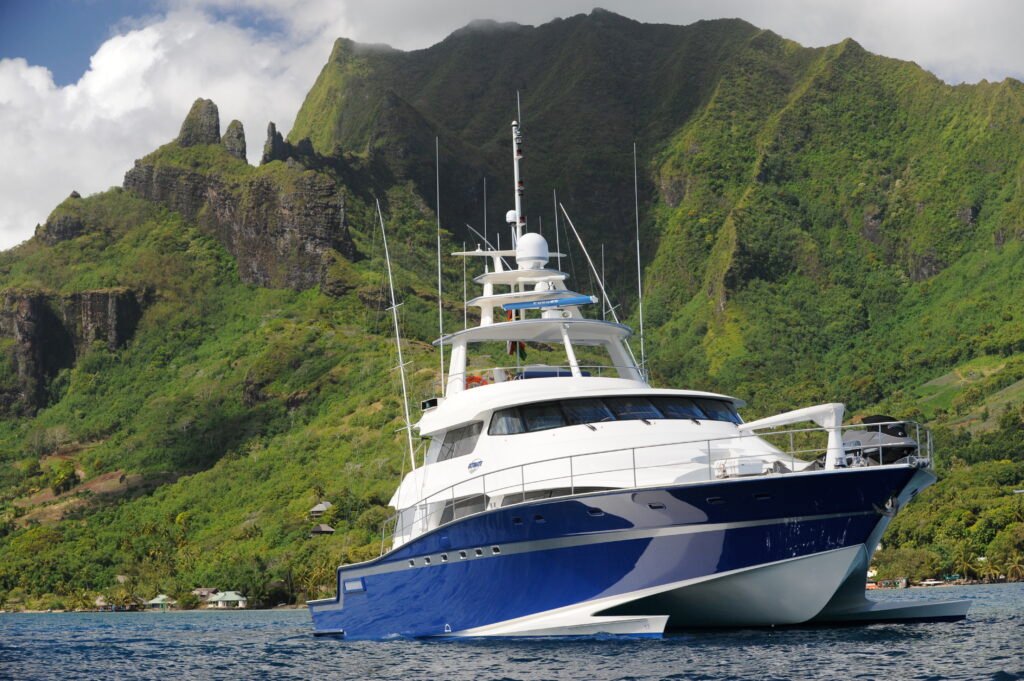
Three years later, Ultimate Lady was launched at Pine Harbour, Auckland. ‘What Craig did with this boat was quite unbelievable,’ Fred says. ‘He said it would do 31 knots. We put her in the water and the engineers were running through the tests. After about an hour, I said, ‘Well, we’ll open it up.’ It did 31 knots. And that’s very unusual for a boat.’
The following year, Ultimate Lady won Best Power Boat in the 23m-32m range at the International Superyacht Society Awards.
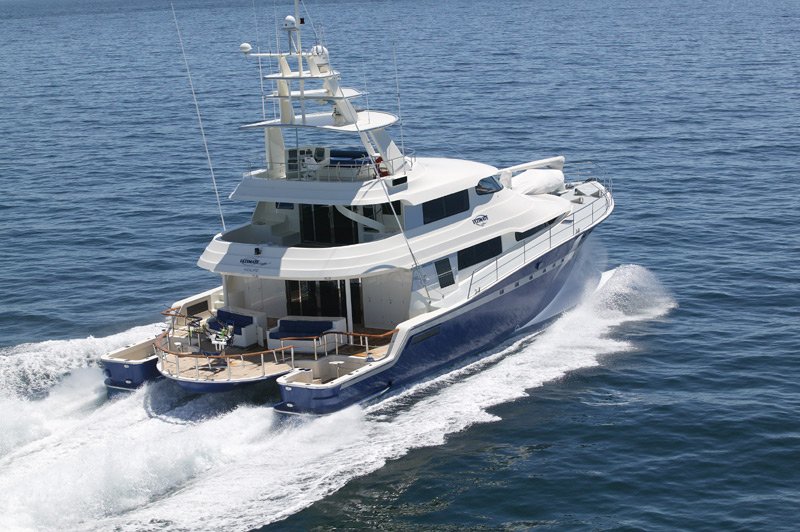
GAME FISHING THE DREAM
The man inspires the boat; the boat inspires the man. Initially, Ultimate Lady was based at the Viaduct Harbour, Auckland, where she took her place among the superyachts. Later, she was based at Port Vila, Vanuatu and, for the last 15 years, in Tahiti. Fred and his wife Darryle visit regularly for game fishing excursions and are well integrated with the local community. During my visit, we attended a birthday party of a local dignitary, high up in the hills above the bay amongst tropical bush. French elegance, Tahitian food and delicious hospitality were in abundance, along with frequent kisses on both cheeks as people I had never met greeted me as they passed.
At 84, Fred intends to continue the game fishing lifestyle for as long as he can, especially after two years of disruption due to Covid. ‘At my age,’ he quips, ‘two years is a long time.’
It is Captain Tom Francis’s job to ensure Ultimate Lady is readily available for that lifestyle. As an apprentice boat builder, he worked on Ultimate Lady’s construction, has been at the helm for 24 years and is expert in the spotting and manoeuvring required to land a gamefish.
‘After covid, I pointed out to Fred that if he wanted trouble-free boating for the last years of his boating life, we need to make some decisions,’ Tom says, ‘because there was a 12-month lead time on new engines, so if we waited for the engines to have a problem, we’d be waiting 12 months after that, with no boating. We had to be proactive.’
By 2022, Ultimate Lady’s original 1200 MAN (882kW) V12 engines, with vee drives, had clocked up 36,000 hours including many long-range voyages around the Pacific. ‘They were old mechanical engines, very smoky and rattly,’ says Tom. In consultation with Jesse Joe-Low of Diesel Marine NZ, Tom and Fred opted to replace the engines, drive trains and gearboxes rather than rebuild, since rebuilds often bring unexpected delays.
They considered taking Ultimate Lady to Auckland, NZ for the repower, but Fred wanted to keep the boat in Tahiti so they brought Auckland to Ultimate Lady. ‘I often say to Fred, do you want the job fast, good or cheap?’ says Tom. ‘You can only have two of them. If it’s a fast, good job, it won’t be cheap. If it’s good and cheap, it won’t be fast. If you want a cheap, fast job, it’s not going to be good.’
They opted for fast and good. That came with a commitment to keeping it simple wherever possible. Diesel Marine NZ in Auckland oversaw the entire installation.
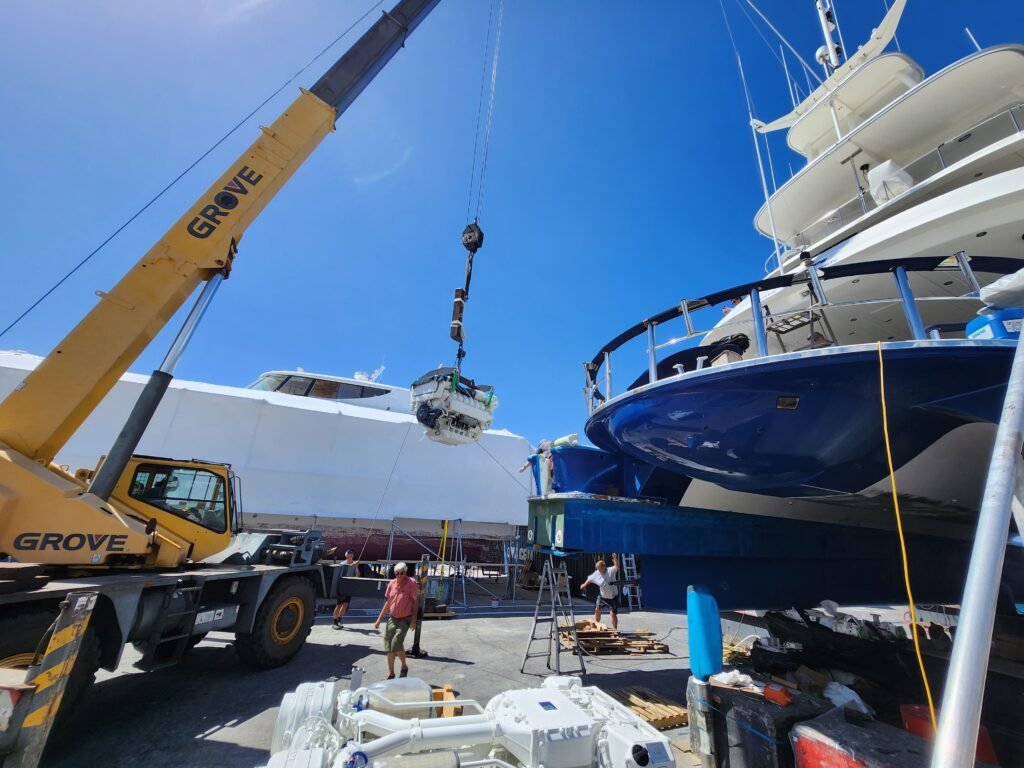
Engines have evolved significantly since 1998, so the repower could have used smaller, lighter engines to deliver the same power as Ultimate Lady’s original engines in their prime, but they would have required significant modifications, such as moving the engine mounts 300mm.
The original engines were light duty 1200hp, and the new 12 cylinder MAN engines were 1900hp on light duty. By de-rating the new MAN engines to medium duty, the team ensured the same horsepower output without requiring bigger propeller shafts.
The new engines came with a weight penalty, but it was partially offset by new carbon fibre Centalink propeller shafts manufactured by CENTA.
The extraction was relatively simple. Ultimate Lady’s engine bays are well aft beneath hatches in the cockpit; the team removed the hatches and the original engines in a day. The new engines, parts and tools arrived by shipping container from Auckland. Engineers, boatbuilders and electricians – including several who had worked on Ultimate Lady over the years – arrived by air and stayed in local accommodation.
‘It’s a tricky management process,’ says Tom. ‘Everyone’s working in an environment that’s three times as hot as what they’re used to. They’re working in a foreign workshop and they’re away from home.’ The tradies’ accommodation was a significant cost factor.
THE RESULT?
‘Improved fuel efficiency is on everyone’s mind whether you’re a charter boat or a private boat, or a megayacht,’ says Tom, ‘and the engine sales people sell you on that, but once we had these engines in, I was so amazed with the torque curve. You look at a torque curve on a piece of paper and yeah, sure, great, but no one really understands it until you get the machines in the boat.
‘You’re used to driving the boat [with the original engines] and all of a sudden with the new engines it comes alive, so the new engines really gave us more manoeuvrability down low. It’s hard to imagine on a big boat like this but it made the boat jump out of the water a bit more. So we have much better torque down low which is great for our game fishing.’ I’d seen this to a lesser degree as we returned to port from the open sea, and Tom navigated the channel, crisscrossed by paddleboarders, kayakers, wind surfers and kite surfers, at ultra-slow speed and with full manoeuvrability.
Vibration and sound levels are also reduced, thanks partly to improved installation technology. ‘When the boat was built, I don’t think they had laser alignment at this level and both gearboxes were 10mm out in terms of lining up with the shaft so we have a huge improvement in reduced vibration,’ Tom says. ‘We never used to be able to hear the steering hydraulics but now you can hear their hum.’ He is loving the modern touch screen displays and the ability to monitor every possible aspect of engine data such as temperatures, pressures, as-it-happens fuel consumption and maintenance regimes.
The following year, it was the generators’ turn for replacement. The Northern Lights M439T 45kW generator had done 76,000 hours, and the smaller M964 24kW genset was close behind. On a trip to the Marquesas, both were generating well below par and it was necessary to run both generators simultaneously to run the boat. When two Spanish Solé generators became available, they were snapped up and installed in three weeks, in time for Ultimate Lady’s fifth voyage to Australia for game fishing. Cruising offshore, the boat usually cruises at around 10-12 knots.
That trip, too, was easier thanks to Ultimate Lady evolving with the times. On previous voyages, the crew had been pretty much isolated from the outside world for 20 days, despite the boat’s four-tiered antenna mast and its antennae for Sky television, cable television, satcom, SSB, fax, scanners for secondary and primary radar and four decoders to enable TV watching around the Pacific.
These days, Ultimate Lady’s silhouette is much clearer, thanks to modern comms, especially Starlink, and her crew had connection all the way to Australia. ‘It’s not only for the weather,’ Tom says, ‘but for family and friends, entertainment. It makes a huge difference.’
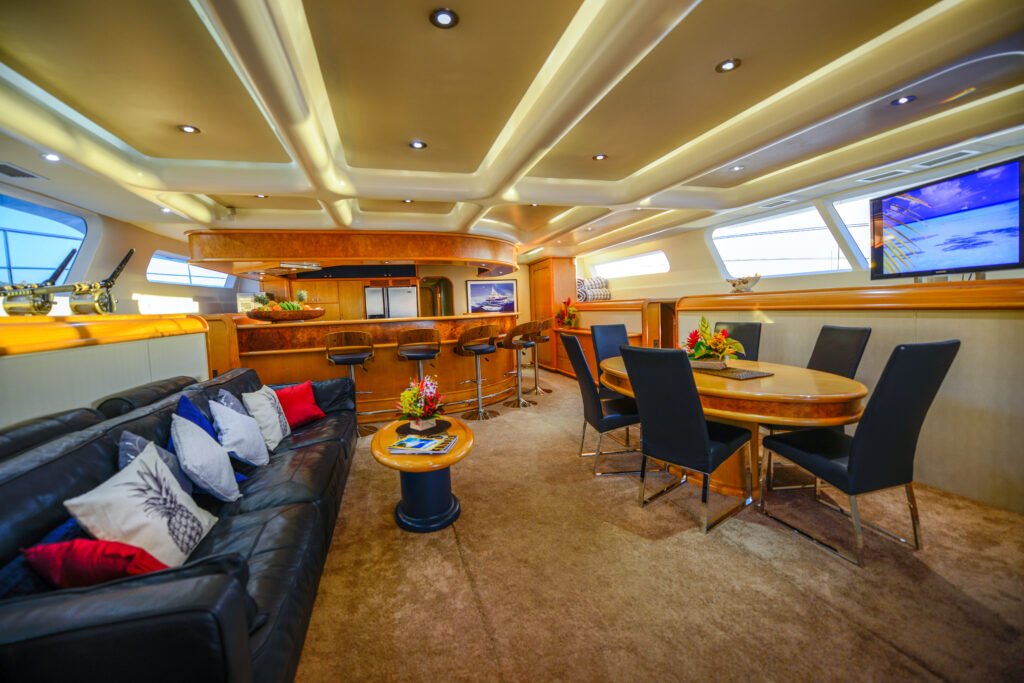
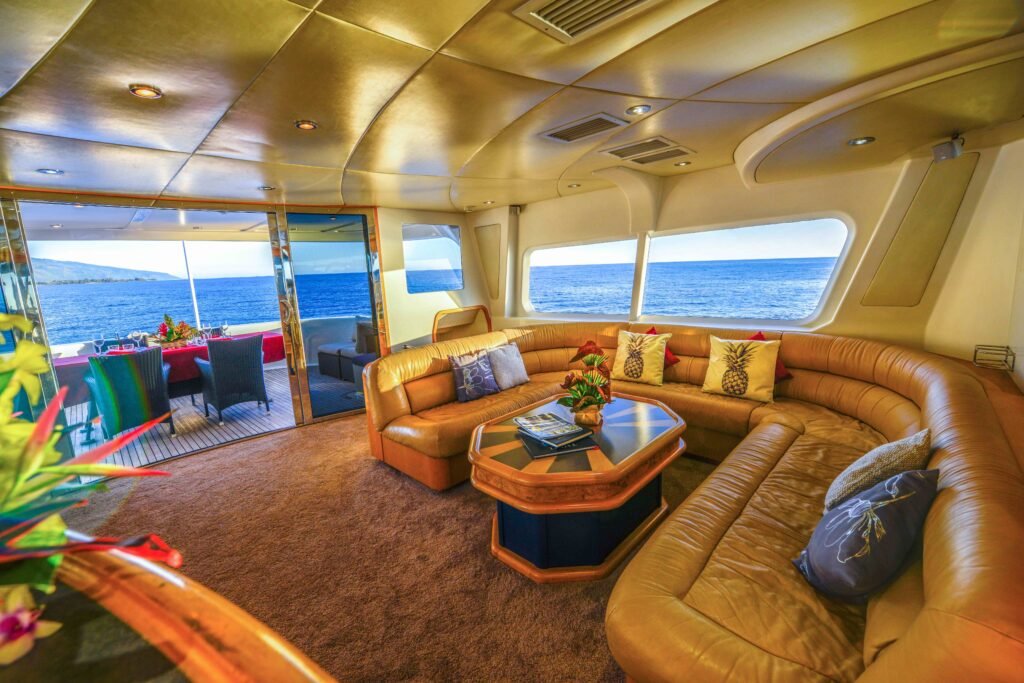
Although I wrote about Ultimate Lady when she was launched in 1998, I had never stepped onboard until my visit to Tahiti. Tom kindly allocated me the for’ard stateroom, a massive island berth with separate and spacious bathroom and shower. I had already promised myself that I would be a tidy guest and unpack straightaway – but I couldn’t. All lockers were chocka with loaded game fishing reels.
The third day of my visit was my introduction to game fishing. With a sloppy sea and limited time, it was decided to target the area off Papeete where an ocean swell, overcast sky and plenty of birds working boded well for a hook-up. I was dazzled by the plethora of lures, the deployment of outriggers and the various techniques and gear that kept the lures performing according to the conditions. Occasionally Josh Hale, the deckhand/cook, retrieved another favourite lure from his store and around mid-afternoon a skipjack tuna came onboard, probably the biggest fish ever caught in my presence, although I kept that to myself.
The fishing was quiet, but it was quite lovely to be sitting back with my glass of coconut water, which was just perfect in the heat, and a good opportunity to ask Darryle about Ultimate Lady and the Blue Marlin World Cup, which they have competed in around 15 times.
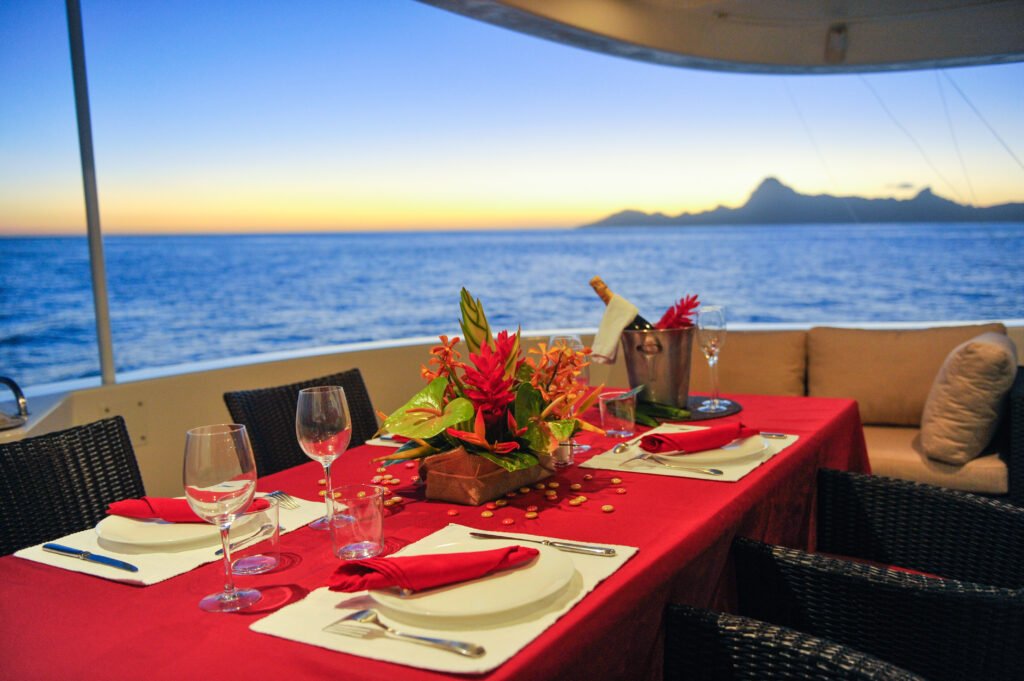
The lead up to 4 July had been disappointing for Ultimate Lady, Darryle says. ‘We had beautiful seas, but lots of sharks and no hook-ups.’ After vigorous debate they decided to fish Tetiaroa, which they had fished previously, including for a 4 July World Cup. ‘It was raining and cold and quite a big swell running. Hopes weren’t too high.’
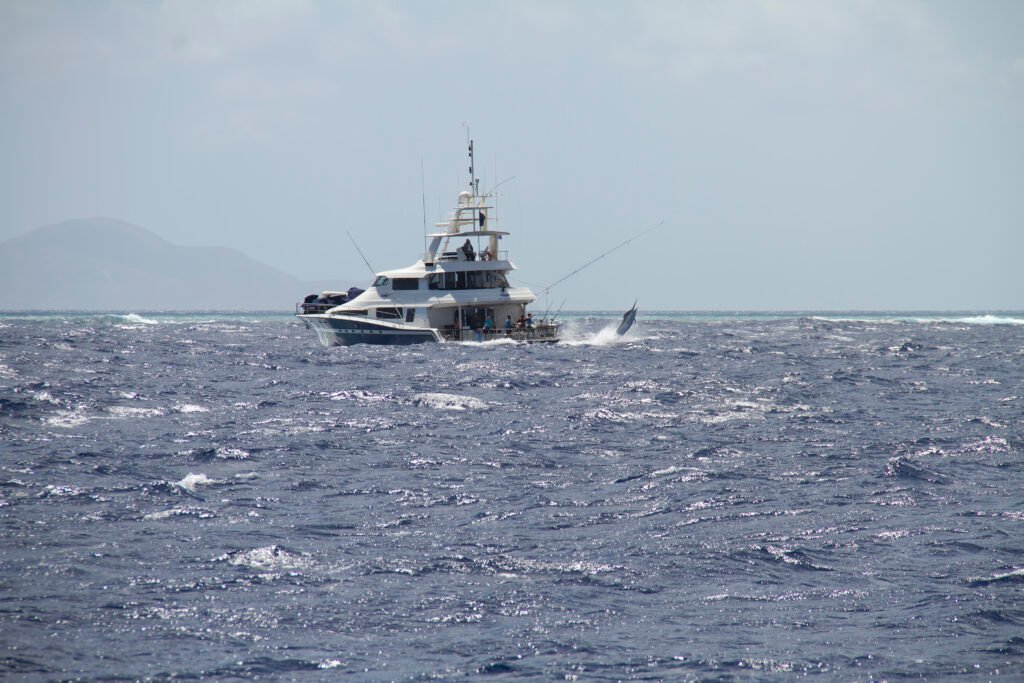
Just after midday, a blue marlin appeared off the stern, ignored most of the lures behind Ultimate Lady and took a 20-year-old pearl head Super Plunger made by Joe Yee, well known in game fishing circles.
Immediately after hook-up, Fred took the rod and got into the chair. Darryle took her place behind him to steer the chair, to ensure minimal stress on angler and gear by keeping the rod and line facing out the back. ‘You have to be on to it because you’ve got to keep your angler comfortable and when you get a lot of weight on, the stress on the tip is huge,’ she says. Along with Josh, the crew included local Tahitian friends Daniel Siu and Vidal Loux. Tom was helming from the top helm station.
Forty-five minutes after hook-up, the team boated the marlin, much to the disappointment of several sharks who were hanging about like pets at the fridge door. ‘Even with the transom door open to bring her onboard, the tail was sticking out the back and the sharks were coming up to try and chomp that,’ Darryl says. Had they succeeded, it would have been instant disqualification.
Back at the dock, Ultimate Lady’s marlin weighed in at 689 pounds, coincidentally the dialling code for Tahiti. Several hours later, the Louisiana boat made port and its blue marlin weighed-in at 80 pounds lighter. In game fishing currency that day, 80 pounds equated to US$1.3m in prizes. With formalities complete, Ultimate Lady gifted the marlin to a local church for distribution among local families.
THE SUCCESS OF ULTIMATE LADY
When Ultimate Lady was launched, it seemed that her striking looks and sea-kindly ways would spawn a generation of recreational wave piercers. Fred seriously considered setting up production and received some strong interest, but ultimately it came down to cost and he wasn’t comfortable with the risk.
And for Fred, Ultimate Lady was never about money. Her distinctive styling still cuts a dash in any marina. She has game fished successfully in comfort at destinations around the Pacific and her accommodation for 14 allows for happy, long term crew and sharing the boat with friends. ‘I’ve had other boats,’ Fred says. ‘They come and they go. But this one, no. I’m going to hold on this one until I die. It’s been really good. I think one of the biggest pleasures I’ve had is my schoolmates on the boat.’
Without doubt, it’s a world record for the longest ownership of a recreational composite wave piercer. When I finally met Ultimate Lady in person, I could see why.