




MARITIME ARTISTRY IN NEW ZEALAND’S BAY OF ISLANDS
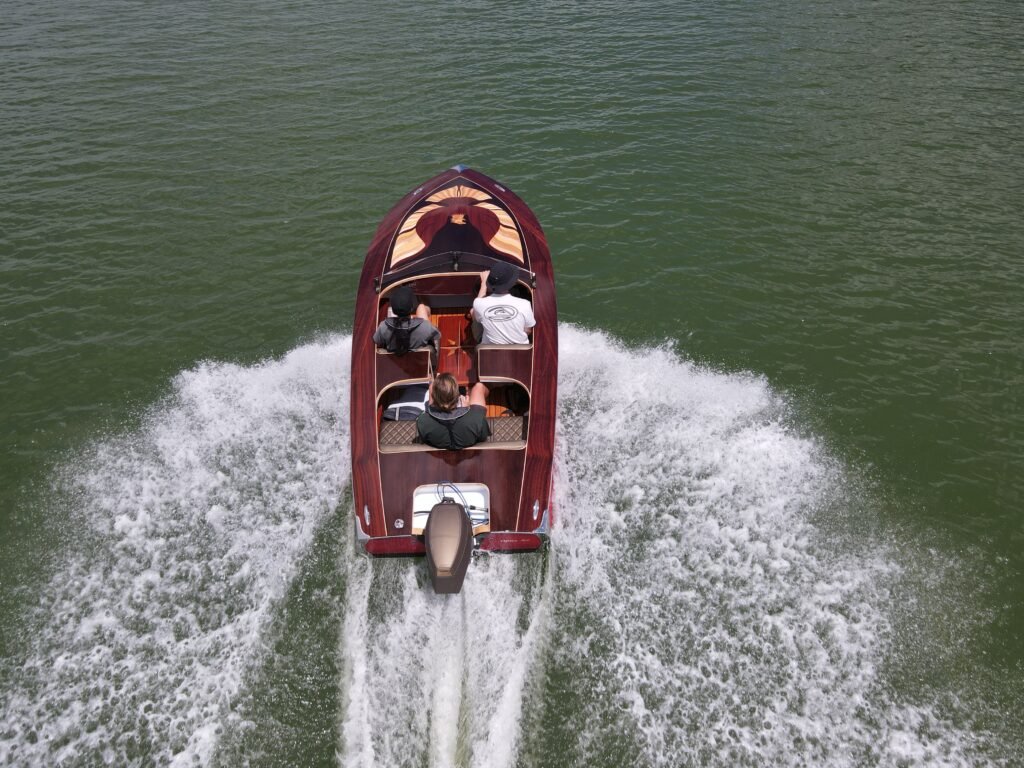
Several months ago, Pacific PowerBoat editor Doug Dukeson heard from Tess, an old colleague at Cater Marine in Opua, regarding an eye-catching home-built ‘Retro’ craft recently launched in the Bay of Islands. A young builder had spent five years constructing a 14’ classic wooden runabout from Glen-L Zip Boats plans, but what really caught Tess’s attention was the beautifully inlaid ‘Firebird’ motif on the forward deck. Sensing a good story, Doug reached out to the builder, Matthew Rigden, and arranged a review. In early November, I travelled to Opua to take a closer look at this unique vessel.
However, before telling you about ‘Firebird’, first a bit about the company behind this boat design. The Glen-L Zip is an icon in the world of wooden boat building. Designed in the 1950s by Glen L. Witt, this 14-foot runabout has captivated boating enthusiasts for generations with its classic lines, do-it-yourself spirit, and versatile performance, offering the perfect blend of nostalgia, craftsmanship, and fun on the water.
The Origins of the Glen-L Zip
Glen-L Marine was founded by Glen L. Witt, a naval architect with a passion for making boat building accessible to the public. The Zip was one of his early designs, intended to provide an affordable and attractive alternative to factory-built runabouts. Its distinctive “barrel-back” styling and compact size quickly made it a favourite among DIY boat builders, especially in the United States, Australia, and New Zealand.
Design and Specifications
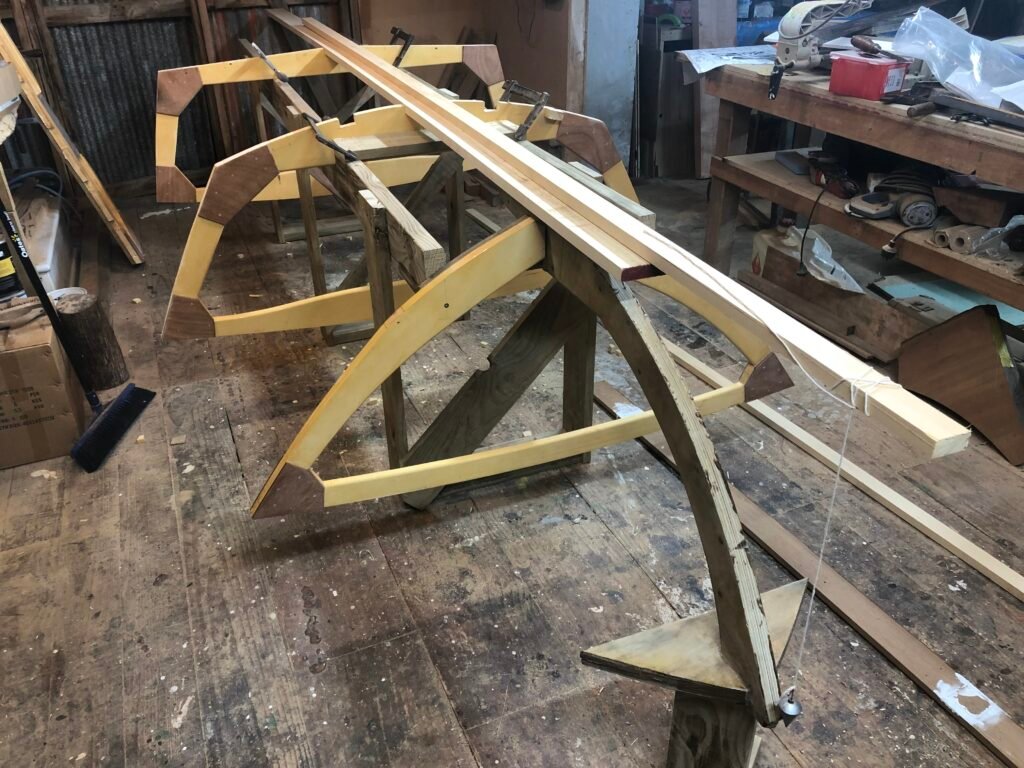
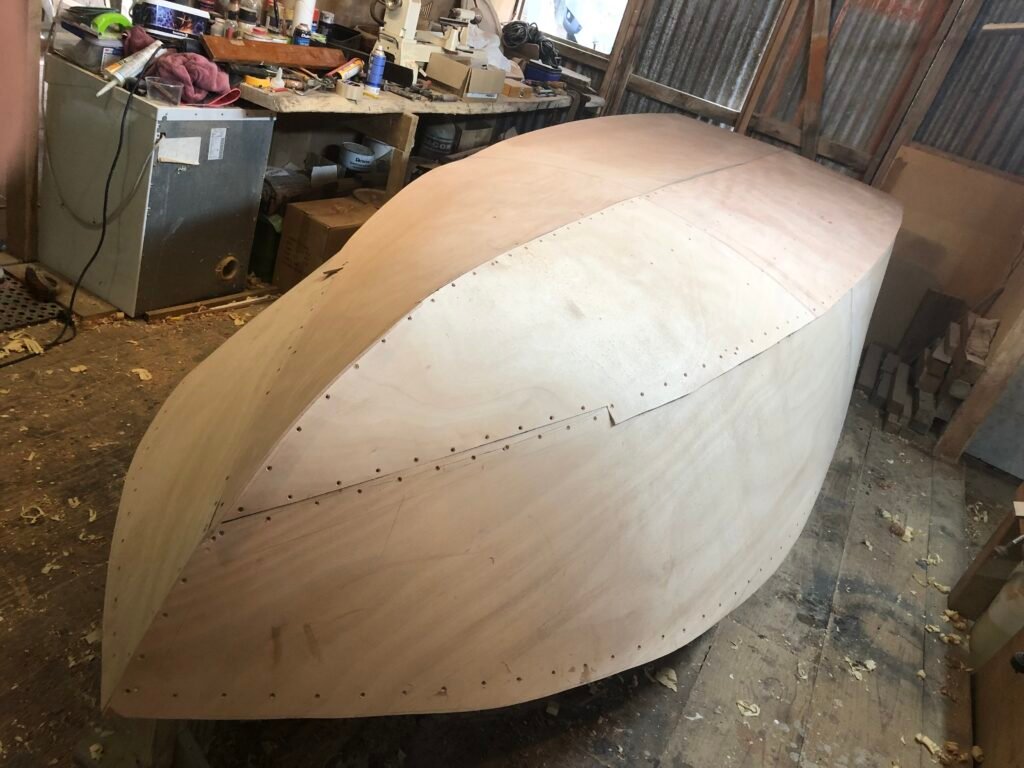
The Glen-L Zip measures approximately 4.27 metres (14 feet) in length, with a beam of 1.75 metres (5 feet 9 inches). The plywood on frame hull construction features a classic runabout shape, with a gentle curve at the bow and a broad, sweeping transom. With a recommended outboard between 18 – 40 hp, it is designed to seat up to four people comfortably, making it ideal for family outings, fishing trips, or leisurely cruises on lakes and rivers. Glen-L Marine provides detailed plans and kits, including fullsized patterns, step-by-step instructions, and material lists. The construction process typically involves building a frame from marine-grade timber, applying plywood panels to form the hull, and then finishing with fibreglass cloth and epoxy for added durability. For ‘Firebird’, Matthew used 6mm marine plywood to form the hull and 5mm timber for the decks, but much thicker plywood was used for the transom construction, with everything then fibre glassed over with 400 gm double bias cloth.
Boat Review
Arriving at Opua Boatbuilders I met the company owner, Graeme Rigden, Matthew’s father. After introductions to Graeme’s small crew, including Matthew, we set about planning the day’s outing on Matthew’s laboriously hand-crafted creation. My obvious first question was ” How did this boat come to be?”
Matthew, a quiet, unassuming young man, who had completed his boat building apprenticeship in 2022, relayed his story in a laconic, somewhat understated fashion, explaining that coming from a boat building family, he always had an interest in boats. During his apprenticeship, while leafing through an old boating magazine, he happened upon an article about the Glen-L Zip craft. The design appealed to him and he thought; “What the hell, why not purchase the plans and build the boat in my parent’s garage/workshop while serving my apprenticeship?” It didn’t hurt that building the craft helped him with several of his apprenticeship assignments. The plans came with full size frame templates, thus avoiding the need for any lofting. The majority of the work was done in the workshop at home, and it was only transported to the Opua Boatbuilders workshop in the latter stages for the finishing touches and so that other local trades could have better access to it (for the upholstery, stainless work, hooking up the outboard, and a little wiring).
That was six years ago, just as Covid was about to hit the world and New Zealand. In reflection, not a bad time to be engaged in such a project. And so, it began and grew, with the transom knee and breasthook being laid on April 14th, 2019. Although begun prior to the pandemic the boat was finally launched at the Opua boatyard ramp on October 10th, 2024, with mum Natalie, doing the christening. Understandably, the champagne bottle wasn’t broken on the boat, but they did pour a requisite amount of ‘good luck’ libation over the bow. The Firebird, created in Matt’s spare time, took about 800 hours to build, according to his meticulously detailed diary.
Listening to Matthew relay his story, I couldn’t help thinking to myself (based on my own life experiences); “Would I have started this project knowing then what I know now?” But then again, how many of us have had the same thought, but then realised afterwards, that you may never have accomplished your dream if you’d had that fore knowledge? And a dream it was for Matthew, but his dream was not just to build an iconic ‘classic’ design boat, but to also turn his vessel into a work of art.
Which then begged my next question; “Why and how did the exquisite, multi-wood inlaid ‘Firebird’ motif on the boat’s forward deck come to be?” Matthew explained that he had seen a 1970s era Pontiac Firebird, with the Firebird motif emblazoned on the car’s bonnet, while watching a TV show and thought the design would fit well onto the bow of a boat. This motif, the symbolic Phoenix or Firebird emblem, was often shown on the bonnet of these Pontiacs. It represents rebirth and is a nod to the original design inspired by Hopi Native American jewellery.
But rather than just ‘paint’ the Firebird on the foredeck of his boat, Matthew decided to depict it with an intricate inlay of several different woods. Having figured out the design and what woods to actually choose, he then hand cut the woods with a jigsaw and router trimmer, finally sandpapering and glueing the Firebird inlay by himself. The timbers used in the deck are sapele mahogany, maple, kauri, wenge, jarrah, hoop, silky oak. The motif and the decks were finished with about 10 coats of Durepox Clear, a 2-pack epoxy urethane clear coating formulated for Marine markets. Not wanting an all-wood look, the hull is painted in vibrant red Acrythane, a brand of two-component acrylic urethane paint known for its high durability and weather resistance. The bottom is coated with black Durepox. The overall result is spectacular and sets this Glen-L Zip apart from others that have been built globally.
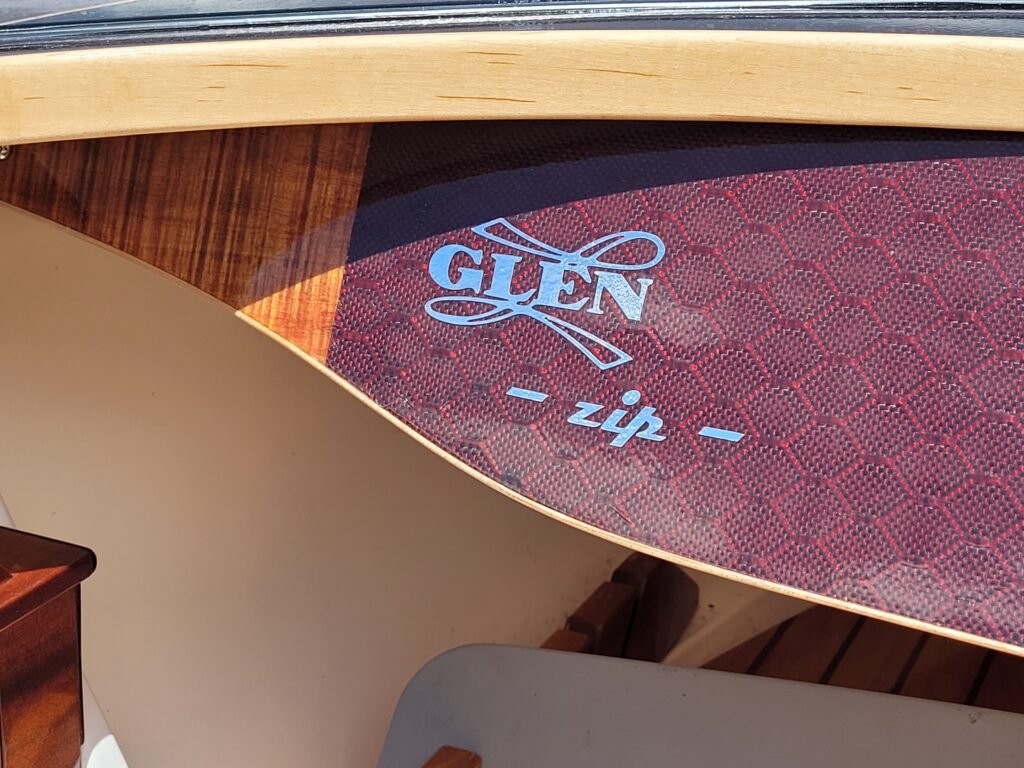
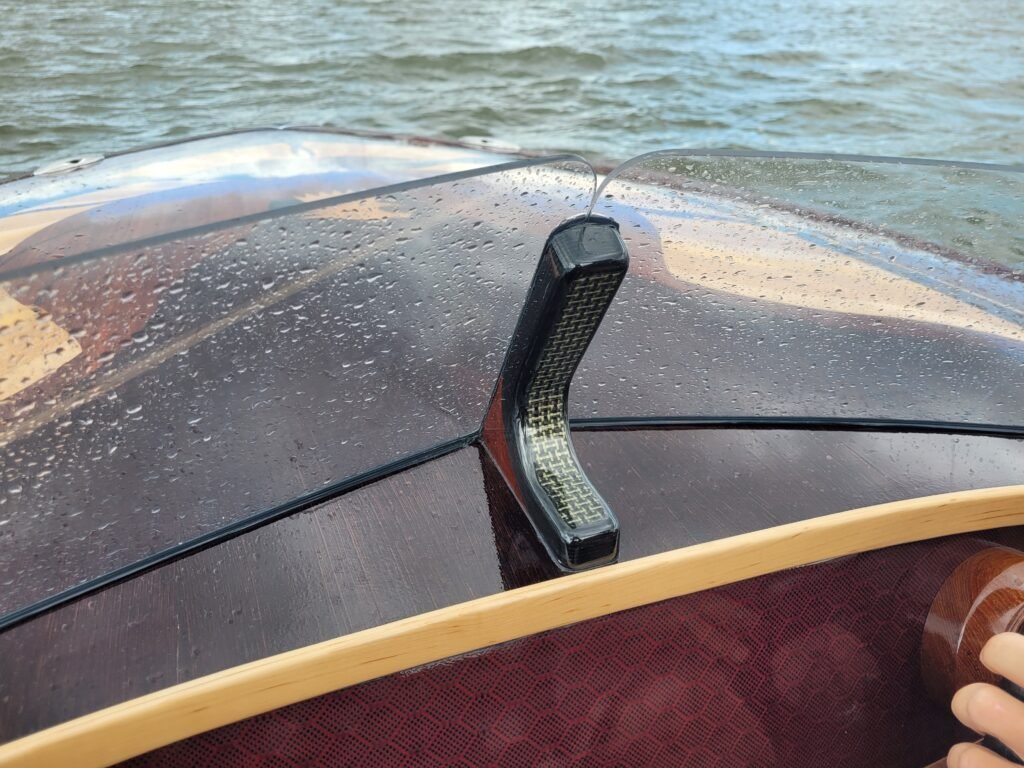
Not content with solely building a Glen-L Zip, Matthew went to extra lengths to make his creation even more unique. And as the saying goes; “The devil is in the detail”. On this vessel, if one takes the time to carefully examine these details, you gain an even greater appreciation of what Matthew has crafted. For example, the windscreen supports are constructed using Kevlar carbon fibre – 50 layers over a mold. The dashboard is comprised of coloured carbon cloth, with a hexagonal pattern. These exotic materials give a subtle extra touch to the overall aesthetics while enjoying one’s on-water experience. On that note, let’s now talk about putting this craft through its paces in Opua Bay.
Performance and On Water Experience
With a lightweight hull and capable planing design, the Glen-L Zip is nimble on the water. Paired with a recommended outboard engine of between 18 and 40 horsepower (Matthew’s Firebird is equipped with 30 Hp Yamaha 2-stroke, short shaft outboard, purchased second hand), the boat can reach speeds suitable for water sports, fishing, or simply cruising. Its shallow draft and responsive handling make it well-suited to lakes, rivers, and sheltered coastal waters. Although Matthew’s boat is not equipped with any instrumentation, after a few runs and using my cell phone’s GPS, I estimated that the Firebird tops out at just under 30 knots.
My experience driving the boat mirrored reporting by many other owners of Zip boats; that the Glen-L Zip provides a smooth ride, even in moderate chop, and its classic styling draws attention wherever it goes. The open layout and comfortable seating make it a practical choice for family outings. A term often used in regard to this sort of craft is that it is a picnic day boat. However, when it comes to a Zip boat, practicality is not the main consideration. The main thing is fun. And this boat is fun! Not only to drive and be out on, but also because you know you are part of an eye-catching piece of art as well as being a functional boat.
On the day we went out, although somewhat sheltered from the brisk SW wind, there was still a reasonable chop out on the more exposed part of the bay, and although the boat handled it well, we did take a fair amount of spray over the bow. The rakish windscreen, while providing good wind deflection, was not up to the task of keeping us dry when we hit some of the larger waves at speed.
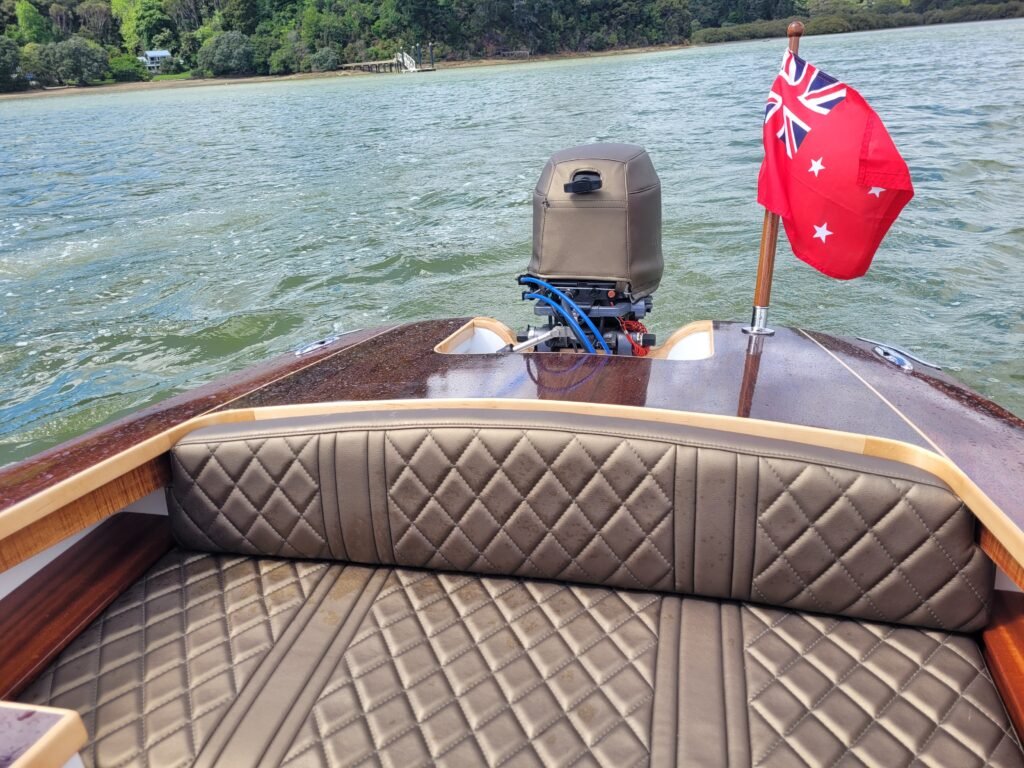
Matthew has configured the Firebird with a four-seater layout, although a two-seater configuration is not uncommon. Needless to say, at only 14 feet long, the four-seat arrangement is snug but not uncomfortable and, much like a sports car, you sit low in the boat, legs extended somewhat parallel to the floorboards. Also, like a sports car, this craft wraps itself around you, offering a feeling of security, even though you are skimming along, barely above the water’s surface.

Customisation and Community
A hallmark of the Glen-L Zip is the level of customisation possible. Builders often tailor the deck layout, trim, upholstery, dashboard, and paint scheme to reflect their personal style. Some opt for period-correct hardware and finishes, while others incorporate modern conveniences such as LED lighting, sound systems, or updated steering mechanisms.
In Matthew’s case, he wanted to add his own personal touches and avoid, if possible, buying anything he couldn’t make, only shopping for materials when this was the only option. So, for example, the steering wheel and the few switches for things like the under-seat lighting, are purchased items, as are the retractable mooring cleats but the teak flagpole on the port stern quarter was made by Graeme on his home lathe. Some things I particularly noted and admired were the compass rose motifed floorboard between the seats and the beautifully crafted and finished lockers beneath the gunnels. There were some other timbers used in the build as well, including yellow cedar (for the frames) and Siberian larch. A nice little touch, is the soft white ‘mood’ night lighting under the seats, diffused through the Perspex seat base surrounds. Matthew has not installed any instrumentation, other than a Volt metre, but is considering a ‘retro’ speedometer and perhaps a fuel gauge. Currently a 22-litre portable petrol tank sits up forward under the foredeck, held in place by a strap and the practical footrest for the captain and co-pilot.
As we wrapped up our day out on the water and concluded our discussions, Matthew made special mention that the project could not have been done without the generous help of a number of local Opua companies. Electrics were handled by Marine Electrics and Gerd Piroth. Upholstery and the matching outboard cover were crafted by Opua Canvas. The stainless-steel work done by Fisheye Fabrication, while Seapower worked on the outboard motor modifications and controls. Cater Marine supplied materials and parts. So, very much an Opua Marine Community involvement. Not unlike the global Glen-L community, which is active and vibrant, with forums, clubs, and gatherings where builders share advice and showcase their work. In New Zealand and Australia, the Zip is a popular choice for classic boat rallies and regattas, where owners display their craftsmanship and enjoy camaraderie with fellow enthusiasts. So far Matthew has displayed the Firebird at the Whangarei Maritime Festival 2024, the St Arnaud Antique and Classic boat show, also known as the NZ Antique & Classic Boat Show, which took place on Lake Rotoiti in March 2025, (where it won people’s choice award), and then again at the 2025 Whangarei Maritime Festival. He hopes to get to Rotoiti (Rotorua) again next year as well as displaying at the March 2026 Auckland Boat Show, incorporating the Classic Boat Show.
Before departing Opua, I couldn’t help myself and asked Matthew what he reckoned this all cost? His answer? “I didn’t keep much of a record about what materials I used and how much they cost. Actually, I’m not sure I want to know! But if you include the trailer and outboard, it must easily be $25 – $30k.” Note, that estimate doesn’t include Matthew’s labour! Wondering what the sale value might be, Matthew simply said, “I don’t want to sell it, but it’s insured for $50,000.” However, my opinion about this craft’s worth, is like the Mastercard slogan; “Priceless”.
Conclusion
Having now seen, experienced, driven and enjoyed Matthew’s Firebird Zip boat, I can personally say that the Glen-L Zip stands as a testament to the enduring appeal of classic wooden boats and the satisfaction of hands-on craftsmanship. For anyone interested in building a small runabout that combines vintage aesthetics with modern performance, the Zip is an ideal project. With detailed plans, a supportive community, and timeless good looks, the Glen-L Zip continues to inspire new generations of boat builders around the world. Just ask Matthew.

