
WHERE CRAFTMANSHIP MEETS TECHNOLOGY
Inside the Grand Banks and Palm Beach Motor Yachts factory in Malaysia
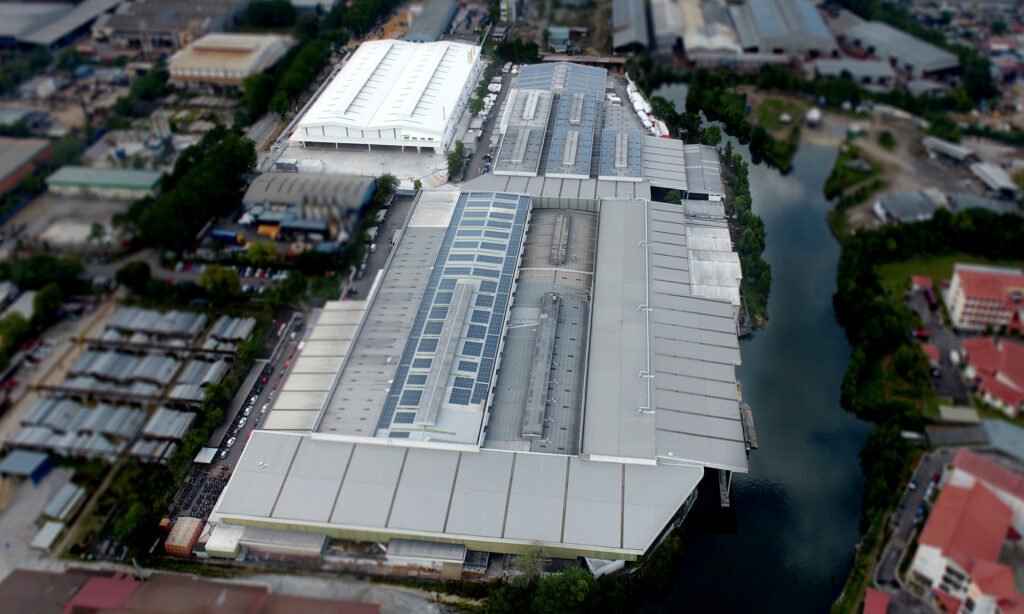
Sometimes the most memorable stories begin with an opportunity too good to miss. While holidaying in Singapore, we realised we were only a short hop across the border from the Grand Banks and Palm Beach Motor Yachts factory in Pasir Gudang, Johor. On the map, it was barely 40-odd kilometres away. In practice, allowing for the border crossing, the journey took around 50 minutes, but it was a small investment of time for the chance to see one of the marine industry’s most impressive boatbuilding facilities at work.
Grand Banks is one of the most recognised names in long-range luxury motor yachts, while Palm Beach Motor Yachts has developed an equally strong following for its sleek, performancefocused designs. Although each marque has its own distinct character, both are built at the same impressive Pasir Gudang facility, where traditional craftsmanship works alongside advanced composite construction, carbon-fibre infusion and robotic engineering.
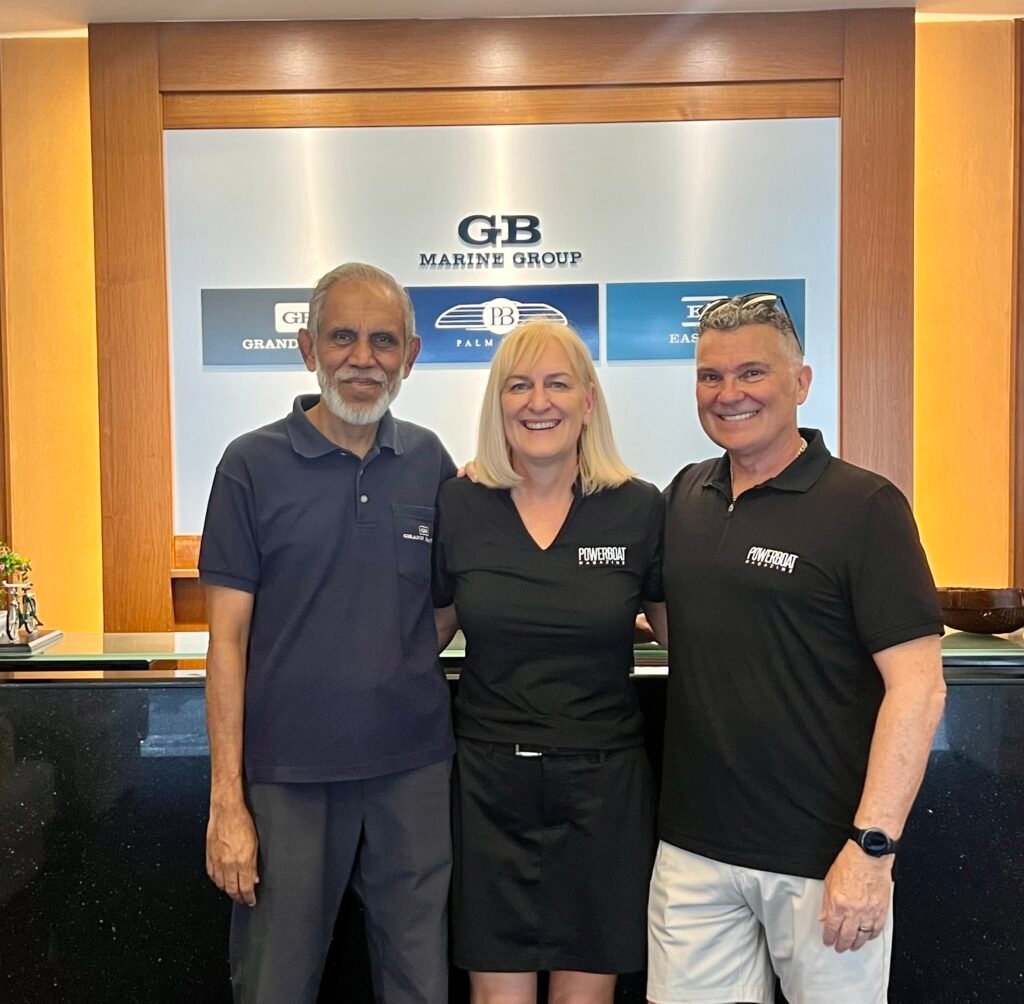
We were welcomed by Hank Compton, managing director, and Mohidin Pitchai, production manager, who guided us through the operation and gave us an insight into the people, processes and technology behind the boats.
The facility’s scale quickly became apparent. Around 1,000 people work at the Malaysian operation, with approximately 800 directly involved in production and a further 200 providing management, design, engineering and other support services. Across the wider company, the global workforce numbers around 1,200.
Our timing was particularly interesting. Grand Banks Yachts had just reported record FY2026 revenue of S$173.2 million, up 6.7 percent from the previous year. It secured 18 new-boat orders during the year and held a net order book of S$136.4 million at 30 June. Those figures gave some commercial context to what we were seeing. The Pasir Gudang transformation forms part of a major two-year investment programme covering manufacturing, new models, customer facilities and global expansion. This was not simply a factory being tidied up; it was a business preparing for the next generation of larger, more sophisticated yachts.
It is a substantial team, yet annual production is just 20 boats. That figure says a great deal about the complexity and labour involved in each vessel. These are not production-line boats turned out in large numbers; they are highly engineered, extensively finished motor yachts that require thousands of individual tasks, careful coordination, and a considerable amount of hand craftsmanship.
BUILDING FROM THE MOULD UP
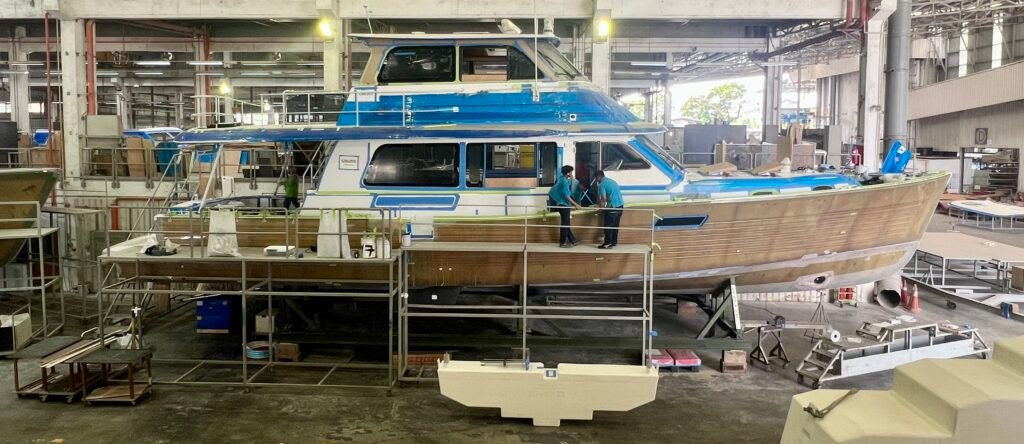
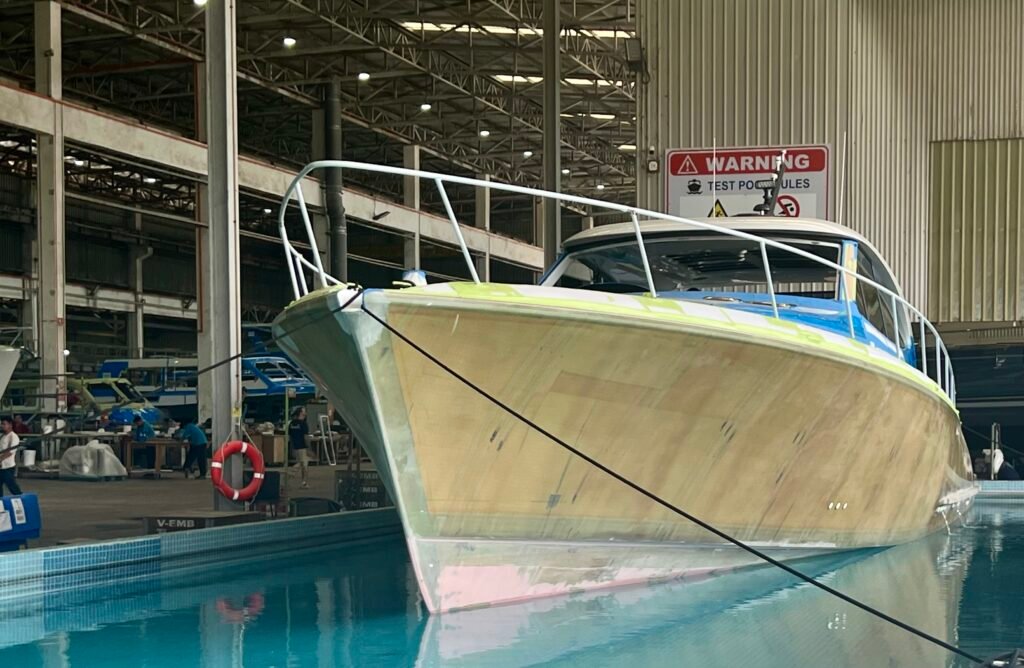
One highlight of our visit was seeing the new Palm Beach 107 take shape. Even in build, the flagship’s scale and presence were unmistakable. It also provided an excellent view of the split-mould construction method used for a boat of this size.
Rather than relying on one enormous conventional mould that would make access, release and handling exceptionally difficult, the structure is produced using mould sections that can be separated. This split-mould approach gives the production team better access during manufacture and allows a large and complex component to be released in a controlled manner.
The Palm Beach 107 demonstrated just how far composite construction has evolved. Materials, resin ratios, structural loads and weight distribution all need to be tightly controlled. The new facility is designed around optimised resin infusion, with precise ratios of resin to E-glass, unidirectional and multi-axial fibres. Carbon fibre is used strategically to increase strength and stiffness while reducing weight, important for efficiency, performance and range.
We also saw the new Grand Banks 62, hull number three, progressing through the factory. This particular boat is destined for New Zealand and is expected to arrive in December, giving our visit a special local connection. Look for our full review of the GB62 in the March/April 2027 issue of PowerBoat Magazine.
ROBOTS CREATING THE NEXT GENERATION
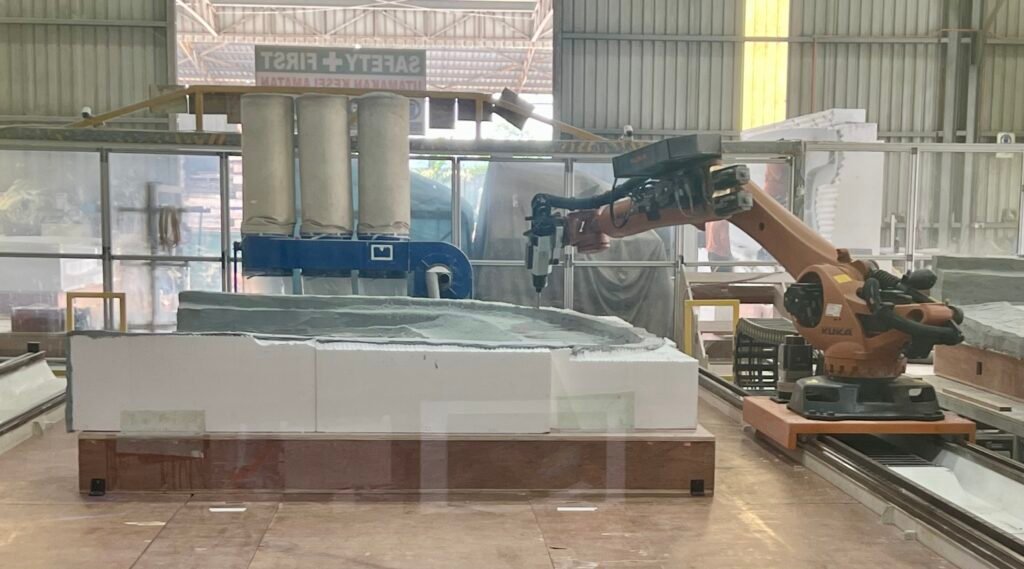
That combination of technology and practical boatbuilding was particularly evident in the new development department. Here, an eight-axis robotic milling machine creates plugs and tooling for new models and components.
During our visit, the robot was producing the three-piece Skylounge liner for the Palm Beach 107. Watching it work offered a glimpse of how digital design becomes a full-size physical component. Information created by the design and engineering teams can be translated into precise, repeatable shapes, with the robotic mill removing material to form the plug from which the final mould will be produced.
For a component as large and detailed as a Skylounge liner, accuracy is critical. Curves, joins, openings and mounting surfaces all need to correspond with the surrounding structure. Robotic milling allows the company to create complex shapes with a level of consistency that would be extremely difficult and time-consuming to achieve entirely by hand.
It does not replace the boatbuilder. Instead, it gives the craftspeople an accurate starting point. The surface must still be checked and finished, the mould produced, and the final component laminated, fitted and detailed. It is a partnership between digital technology and human experience.
THE HUMAN TOUCH
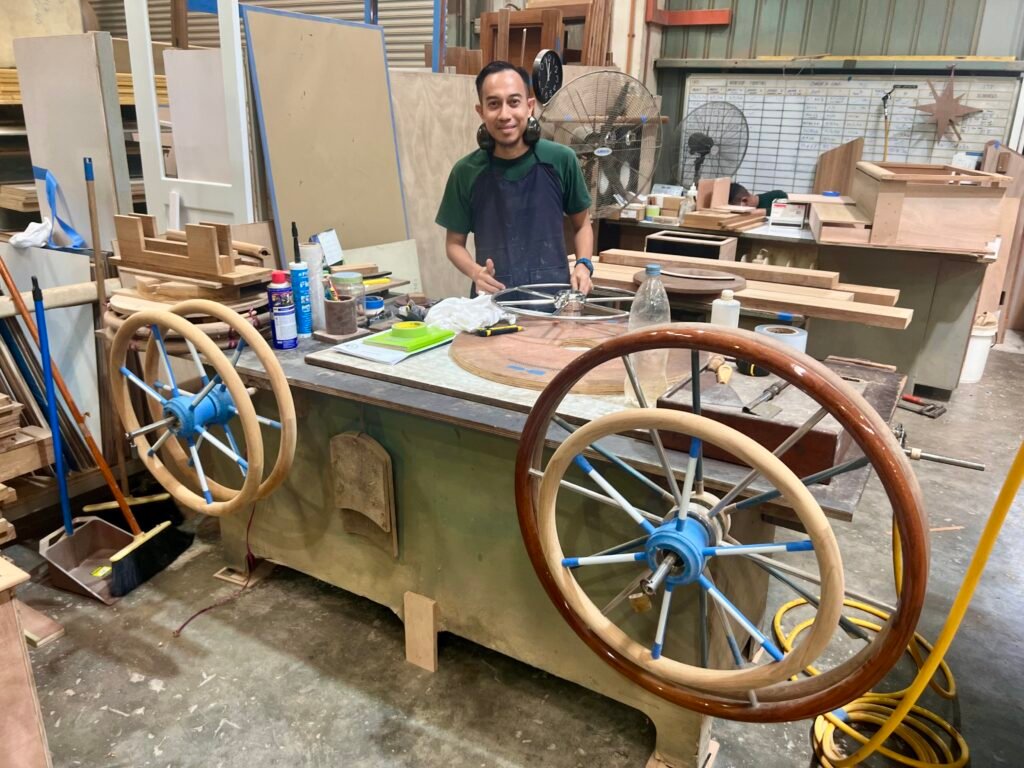
For all the advanced equipment on display, there was no shortage of traditional craftsmanship. Nowhere was this more obvious than in the varnishing department.
The depth and clarity of a beautifully varnished timber surface can look effortless aboard the finished yacht, but the process behind it is anything but. We were told that nine coats of varnish are applied. Each layer adds richness and protection to the final finish, with careful preparation required between coats.
It is painstaking work and reinforces an important point: technology may improve accuracy, but a luxury yacht is still defined by its hands-on details. Owners may never see the robot or the infusion process, but they will notice the timber grain, aligned cabinetry and consistent finish every time they step aboard.
Walking through the various production areas, we saw a workforce covering a broad range of disciplines, from composite technicians and engineers to cabinetmakers, painters, electricians, plumbers and systems installers. Bringing their work together in one finished yacht requires not only skill, but a shared understanding of the standards expected from both Grand Banks and Palm Beach.
MAKING BETTER USE OF MATERIALS
Sustainability is an increasingly important consideration in manufacturing, and composite boatbuilding presents particular challenges. We were therefore interested to learn that 99 percent of the facility’s foam offcuts are recycled.
Foam is used extensively in modern composite construction, and cutting cores and panels inevitably produces leftover material. Diverting almost all of those offcuts into recycling is a significant achievement for an operation of this size. The environmental push extends to the roof, which carries a substantial solar array. We were told that it reduces the factory’s reliance on the grid and can produce enough surplus electricity to feed power back into it.
TESTING BEFORE LAUNCH
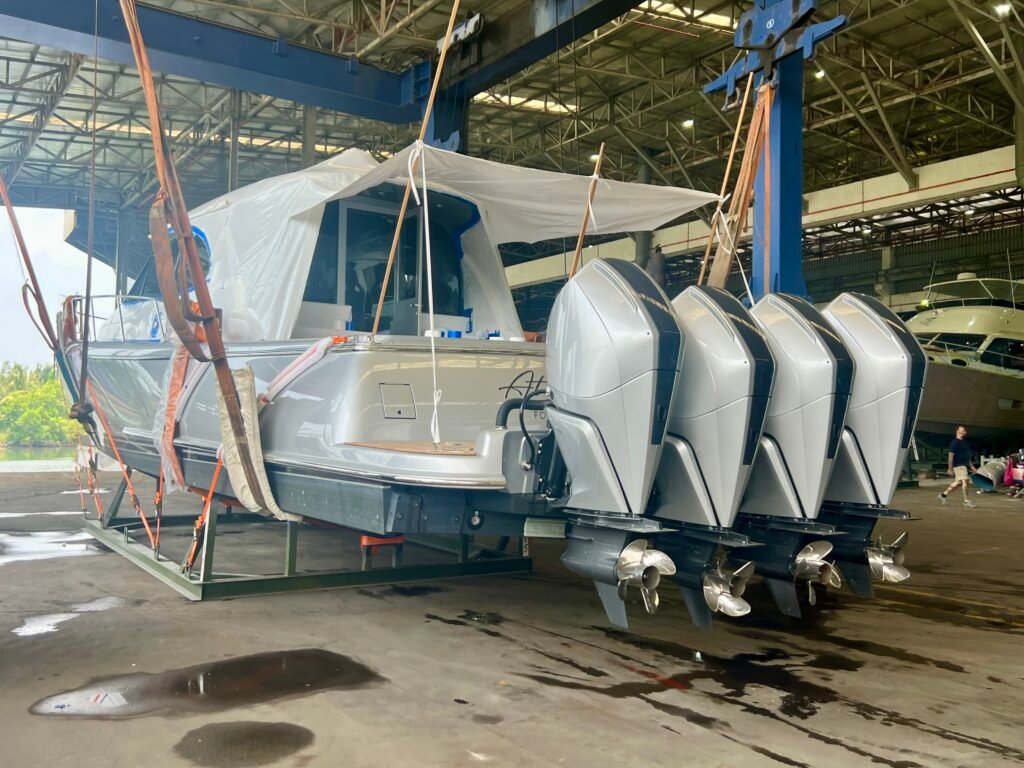
At the far end of the production journey is the factory’s run-up pool. This allows major onboard systems to be commissioned and operated before the yacht leaves the facility. Engines, generators, watermakers and associated equipment can be run under controlled conditions while technicians monitor their operation and address any issues.
Once those checks are complete, the yacht is launched directly into the river beside the factory. It then remains there overnight for two nights, providing a further opportunity to monitor the vessel afloat and ensure its systems perform as intended in the water.
WORTH CROSSING THE BORDER FOR
What began as an opportunistic side trip from Singapore became one of the highlights of our travels. The Pasir Gudang factory is impressive not simply because of its size or technology, but because it brings modern engineering and traditional boatbuilding skills together under one roof.
From the split-mould construction of the Palm Beach 107 and the robotic milling of its three-piece skylounge liner to nine coats of varnish applied by hand, every stage demonstrated a different aspect of contemporary luxury yacht production. Add 1,000 people, extensive in-house capability, recycling and thorough commissioning, and the scale of the commitment becomes clear.
Producing only around 20 boats a year may seem modest for such a large facility, but after seeing what goes into each one, the number makes perfect sense. Every Grand Banks and Palm Beach motor yacht leaving Pasir Gudang represents an extraordinary concentration of design, technology, materials, labour and craftsmanship.
For us, it was a fascinating behind-the-scenes look at how some of the world’s most distinctive motor yachts come to life, and proof that sometimes the best holiday detours are the ones that lead through a factory door.