DISTINCT BY DESIGN
On the first day of New Zealand’s winter solstice, I received a call from Doug Dukeson, the editor of this magazine, asking if I could carry out a boat test the following day. Doug usually gives me more notice, but this time a brief opportunity had arisen. Nick Herd, owner of Tauranga-based Herley Boat Builders, was delivering their new Herley Elite 8 to its Auckland owners, leaving just one day to review the boat before handover. Fortunately, both our photographer/videographer and I were available at short notice. Better still, the Hauraki Gulf turned on a superb winter’s day to put the Elite 8 through its paces.
INTRODUCTION
With little time for background research, all I knew was that I was about to test an 8-metre aluminium boat from a Tauranga builder. I’d heard the Herley name but must confess, knew little about the boats.
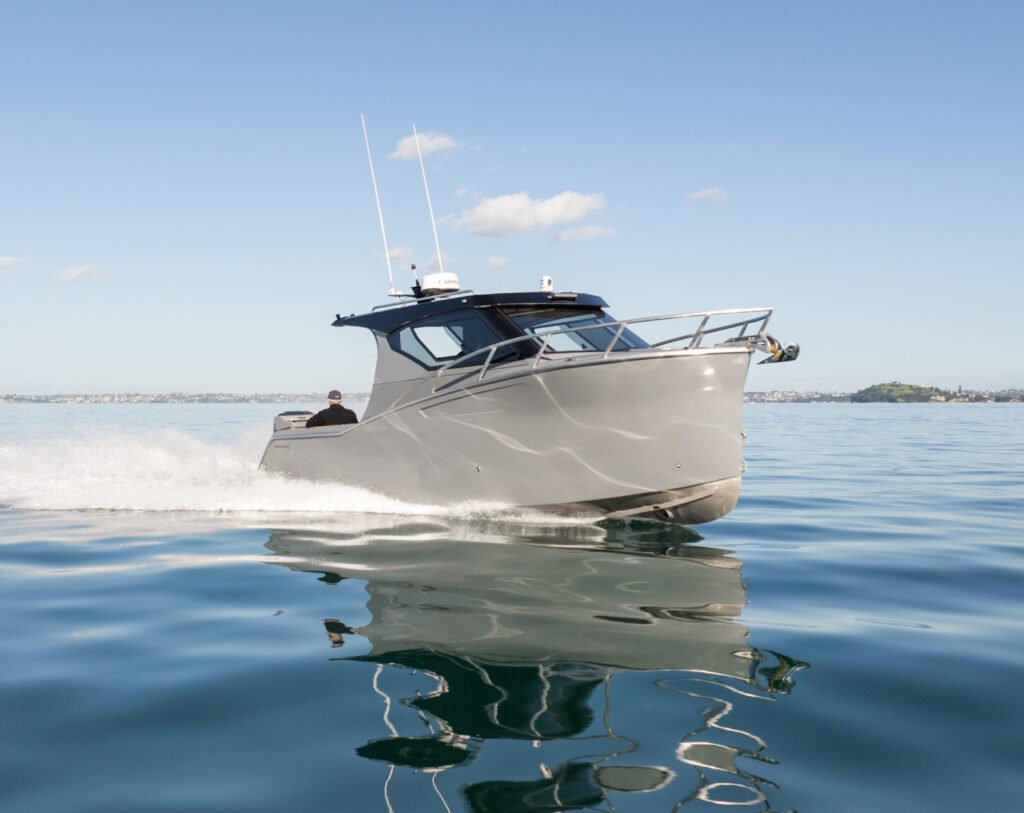
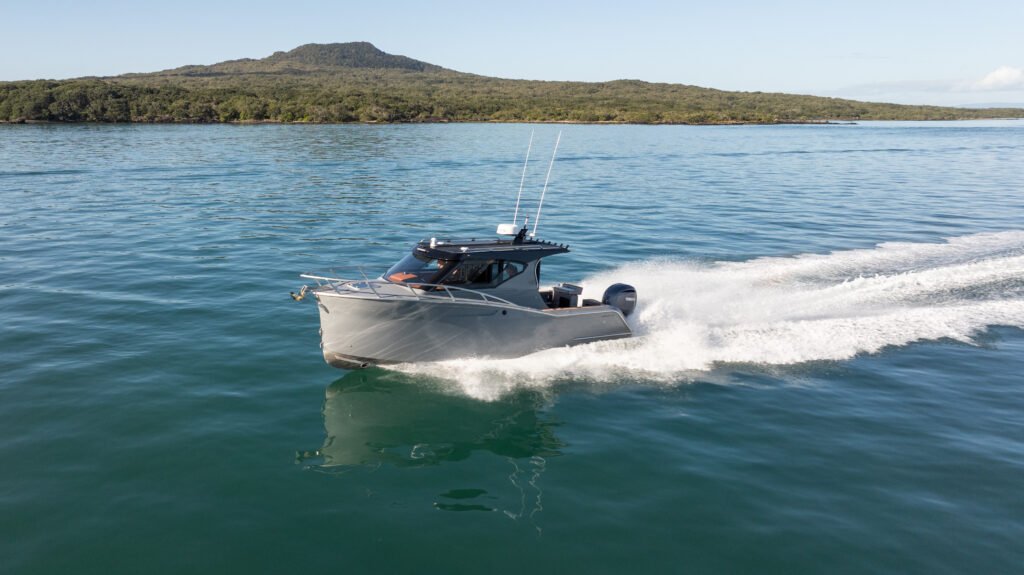
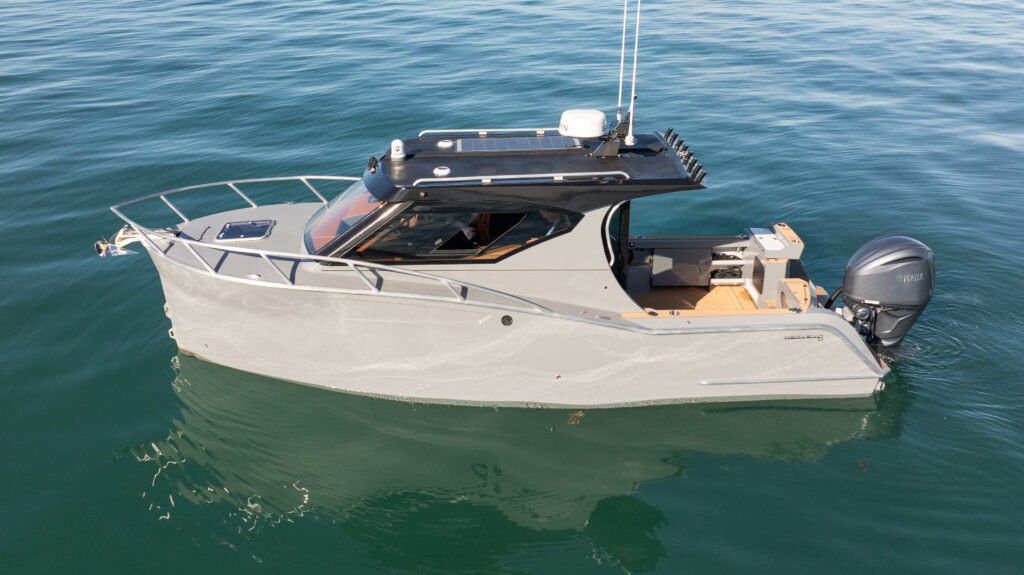
Meeting at Orakei Marina, two features immediately caught my eye: the plumb vertical bow and the impressively high bow sheer. I immediately got the impression that this boat looked like it meant business.
Our photographer, Lissa, had already spent a couple of hours on the water with Nick, capturing the still images. After a quick introduction, we headed back out so I could put the boat through its paces while we gathered the drone footage. Motoring out of Orakei Marina, Nick told me about the boat, his company and his journey into boatbuilding. I’ve spent most of my life around the marine industry and have learned to trust my instincts. It didn’t take long to realise that both the boat and the man behind it shared the same understated confidence and attention to detail. As you’ll see throughout this review, those first impressions proved well-founded.
BACKGROUND
Nick started Herley about 10 years ago with his then business partner, after several years as a design engineer and then production/project manager at New Plymouth superyacht builder Fitzroy Yachts. When Fitzroy closed in 2014, he decided it was time to build boats his own way.
Drawing on experience gained at Fitzroy and other major New Zealand boatbuilders, along with university design studies at AUT and a boatbuilding apprenticeship, Nick had clear ideas about what he wanted to create. He and his team believed there was room for boats that combined the best features of trailer boats and larger powerboats while paying closer attention to the finer details. And so Herley was born.
FIRST IMPRESSIONS
I boarded the Elite 8 with no preconceived ideas, determined to assess it on its own merits.
From the outside, it feels more like a small ship than a trailer boat. The high, flared plumb bow inspires confidence, suggesting it will slice cleanly through rough water while throwing spray well clear of the foredeck and cabin. Inside, the quality of finish is immediately obvious. Everywhere you look, there’s evidence of careful thought and craftsmanship, making it difficult to begin my evaluation. So, to paraphrase what the Caterpillar said to Alice, “I will begin at the beginning and end at the end.”
As we motored towards Rangitoto Island, Nick explained that while this Elite 8 was one of Herley’s two standard 8-metre models, the other being the Herley 8 Captain with a pilothouse layout. This test boat had been tailored for its new owners. Two brothers, one particularly tall, wanted extra headroom and improved ergonomics.
“Did that mean raising the cabin roof?” I asked.
“Not at all,” Nick replied. “We just customised a few things.”
More on that shortly
Stepping aboard over the high bulwarks into the SeaDeklined cockpit reinforced the feeling of security I’d first noticed from the dock. Looking forward into the helm area, I was struck by the tasteful combination of tan marine vinyl and teak. It creates a feeling of quality without trying too hard. First impressions do count.
Now let’s look at how all those elements come together. Good design always puts purpose first, and the Elite 8 is an excellent example of form following function. The owners appreciated the standard design but also selected several options and requested a few practical changes, including raising the wheelhouse grab rails to better suit their needs.
COCKPIT
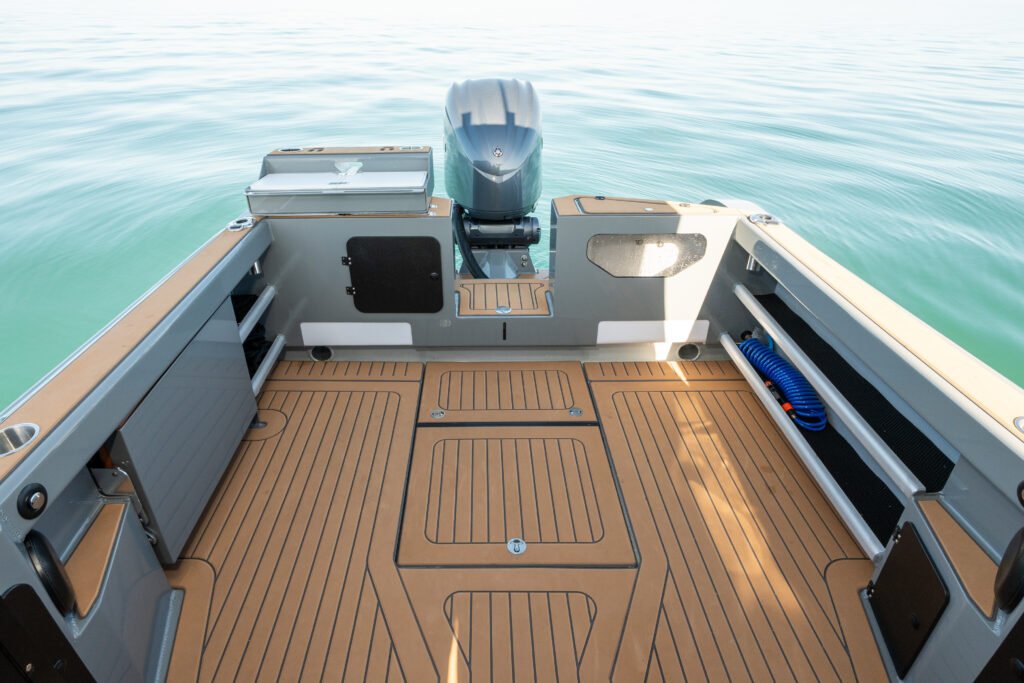
The Elite 8’s cockpit isn’t the largest you’ll find on an 8-metre boat, but that’s by design. Nick and his clients wanted a balance between cockpit space, a roomy helm and cabin, a comfortable forward cabin and practical use of the exterior deck and cabin roof.
As mentioned earlier, the cockpit is protected by high bulwarks that provide reassuring support when you’re braced against the side playing a decent snapper.
At first glance the cockpit appears quite Spartan, but a closer look reveals that everything is exactly where it should be, along with a few clever innovations. Standard equipment includes a circulating saltwater bait tank, a 425-litre underfloor fuel tank, an under-sole locker large enough for dive tanks, a coiled saltwater washdown hose, central transom access to the swim platform, storage lockers and plenty of rod holders.
The standout feature is the bait station. Yes, every fishing boat has one, but Herley’s is different. In its stowed position it sits neatly on the starboard transom where it’s still fully usable. If you prefer it centred across the stern, simply swing it across on its hinged aluminium arms. It’s a simple idea, but one I’d not seen before.
Equally clever is the folding starboard cockpit seat. It stows flush into the coaming when not required, then folds down in seconds to provide comfortable seating. Another practical touch is the pair of saltwater handwash fountains mounted on the gunwales and activated by time-release push buttons. Excess water drains quickly through large transom outlets feeding a full-width drain channel, while twin 1100GPH bilge pumps take care of anything that’s left.
The central transom door leads to a well-equipped swim platform accommodating the 300hp Yamaha outboard, a fold-down three-step diver-friendly boarding ladder, a hot-and-cold freshwater shower and a neatly stowed auxiliary outboard bracket. Like much of the boat, it’s tidy, practical and well executed.
Before stepping into the cabin, it’s worth noting the compact galley concealed within the port side. A pull-out drawer above a 70-litre chilly bin contains a stainless-steel sink, freshwater tap and portable butane cooker. Nick prefers this simple KISS approach over carrying LPG aboard. Cooking complete, everything slides neatly away.
MAIN CABIN AND HELM
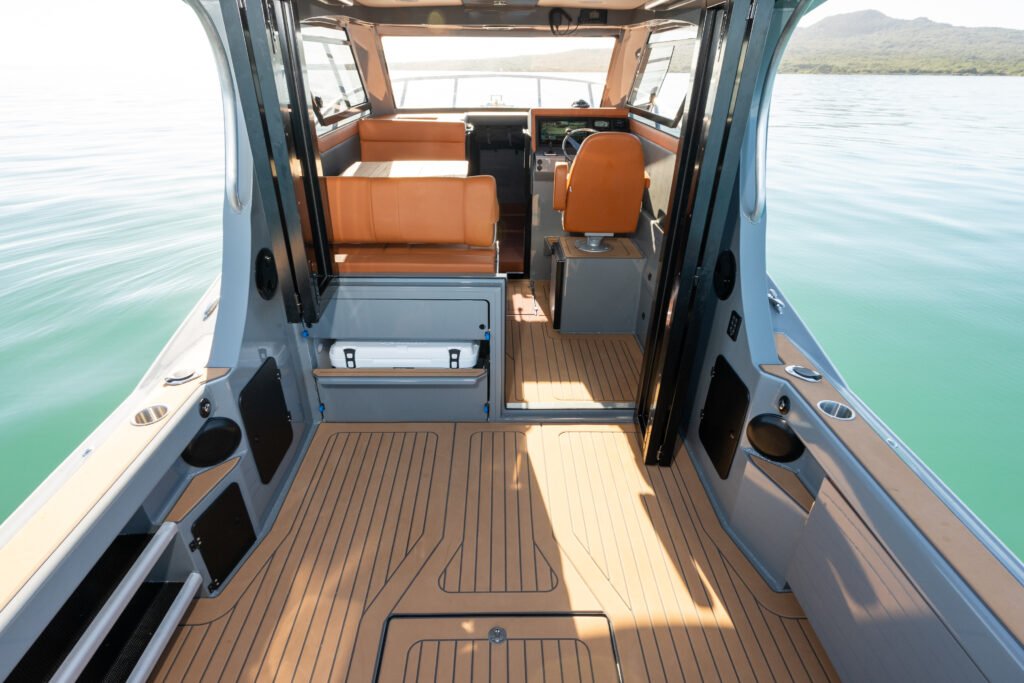
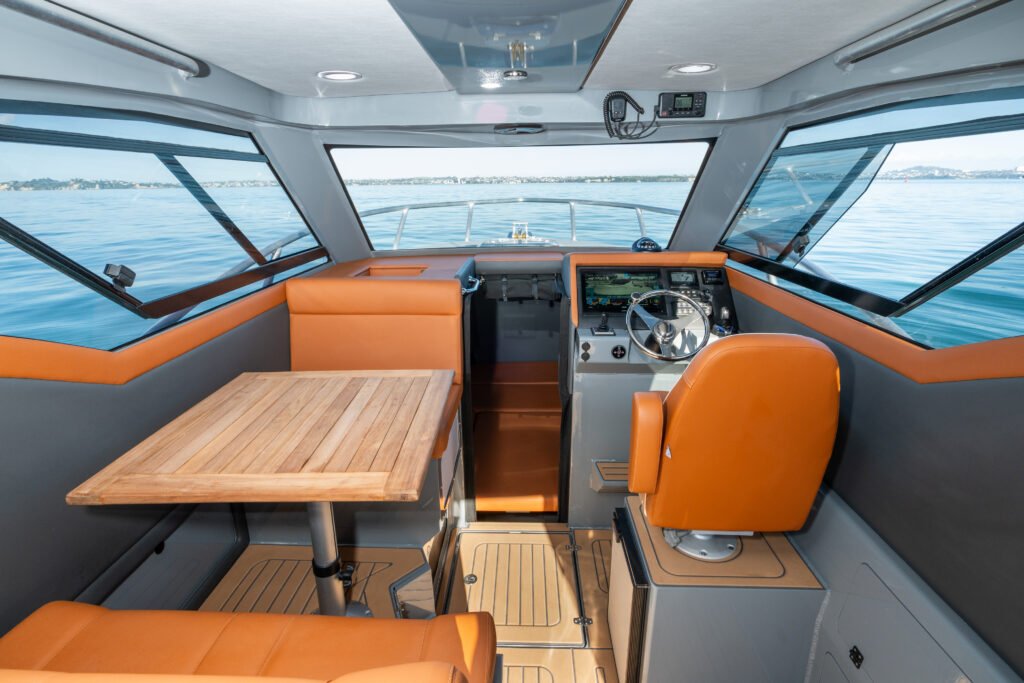
Entering through the wide starboard bi-fold door, you’re immediately struck by the tasteful combination of tan marine vinyl upholstery, matching dash trim and polished alloy finishes. The tan theme continues into the forward cabin, while a half-height bi-fold window above the galley provides extra ventilation when the main door is closed.
The wheelhouse has been thoughtfully laid out. To port, a raised dinette with a teak drop-down table converts into a berth. The aft seat back flips either way depending on whether you’re dining or simply relaxing. The forward seat is a little snug for two, but perfectly usable.
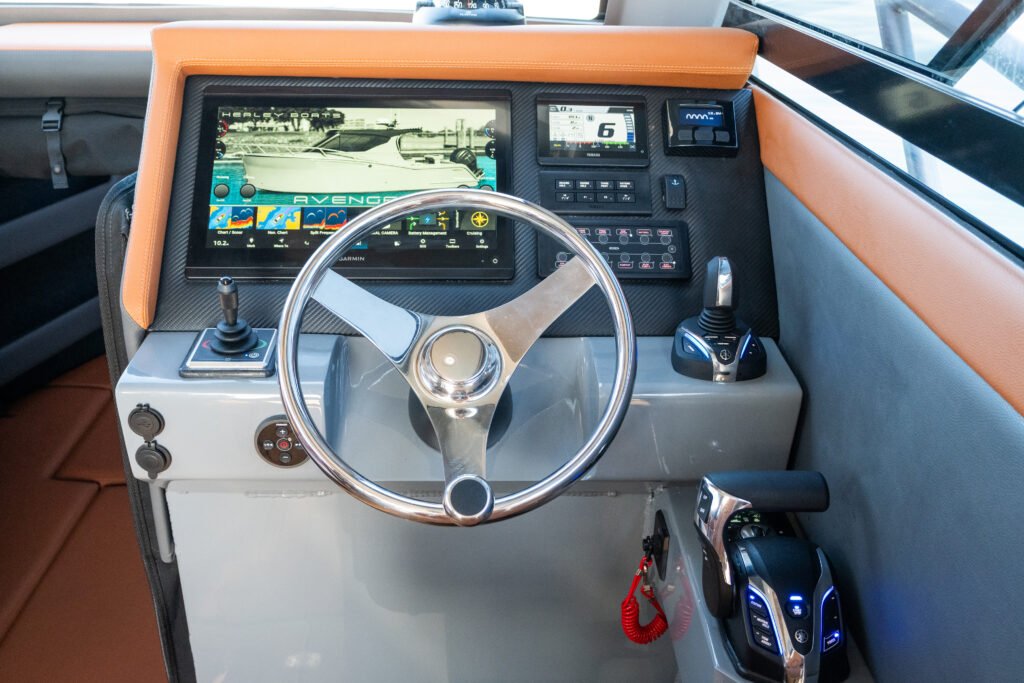
The adjustable helm seat, mounted on gas risers with a flip-up bolster, is comfortable whether sitting or standing. Visibility through the curved one-piece windscreen is excellent, aided by the large opening side windows. A footrest improves comfort underway, while a Fridgetech Isotherm fridge is tucked neatly beneath the helm seat.
Everything at the helm falls easily to hand, and the instrumentation is clear and logical.
The curved panoramic windscreen is one of the cabin’s defining features. Combined with the large side windows, it provides outstanding visibility. I asked Nick why there wasn’t a windscreen wiper.
“This is an extremely dry boat,” he replied. “With the rake of the glass and the Clear Shield treatment, we didn’t think it was necessary, but it is available as an option”.
Other thoughtful touches include sliding side windows, twin solar roof ventilators, elevated grab handles, offset full-length overhead grab rails, vinyl-lined cabin panels, cup holders, twin USB charging ports, a Plastimo Offshore 115 compass, Garmin 116i VHF, Hella LED downlights, generous storage lockers and a roll-down privacy screen for the forward cabin.
FORWARD CABIN
The forward cabin is accessed via a central two-step companionway with a sturdy grab rail to port.
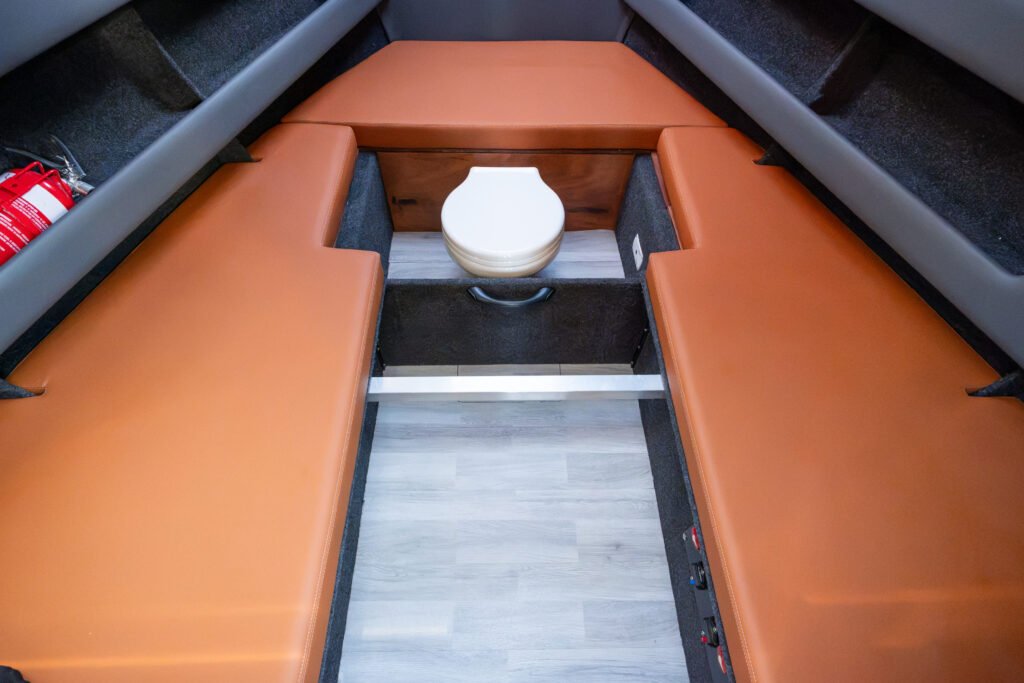
Matching tan upholstery continues throughout. Storage beneath the bunks accommodates up to six fishing rods per side, while full-length overhead lockers maximise usable space.
The starboard bunk measures 1950mm, while the port bunk stretches to an impressive 2400mm. Both double as lounges with backrests, and the removable infill converts the area into a generous double berth. An electric macerator toilet is concealed beneath the forward squab, with Hella lighting and a zip-down privacy curtain completing the package.
The plumb bow really comes into its own here. By pushing the anchor locker further forward, Herley has created a noticeably larger forward cabin than you’d expect in a conventional 8-metre boat.
EXTERIOR
The foredeck can be reached either through the forward hatch or via the side decks.
Up to this point I’d found very little to criticise, so indulge me one small grizzle. While the bow rails look sleek and complement the boat’s lines, I’d like to see them slightly higher, extending further aft with an additional stanchion. I believe it would improve security moving forward without compromising the styling.
Once on the foredeck, however, everything is clean, uncluttered and easy to access. Even the X-Fold cleats disappear flush into the deck when not in use.
Beneath the anchor hatch sits a generous chain locker housing a Lone Star GX2 drum winch with 90 metres of 8mm rope, 10 metres of 7mm galvanised chain and a 10kg stainless Maxwell anchor on a robust bowsprit assembly.
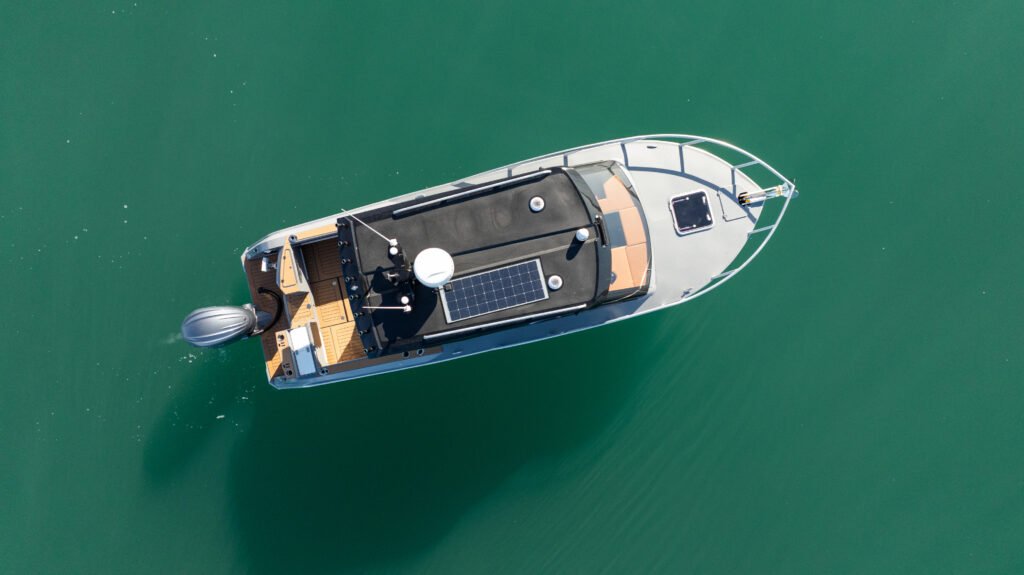
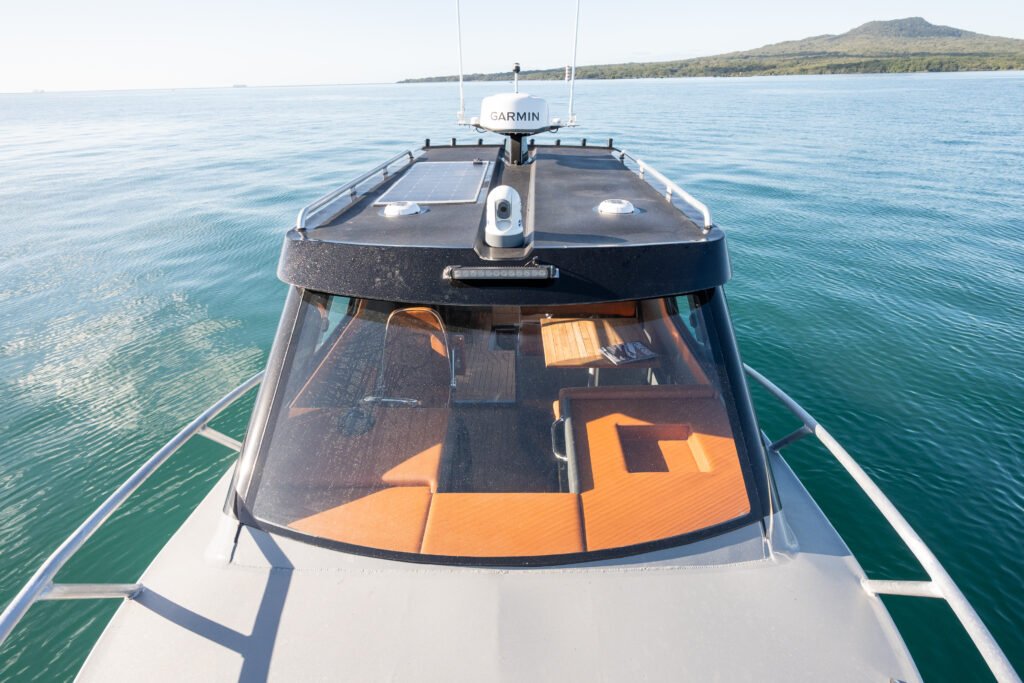
The cabin roof is equally well equipped with a Garmin GMR xHD radar, FLIR night-vision camera, GPS, Starlink system, VHF and AM/FM aerials, solar panel, twin solar ventilators, foredeck light bar, navigation mast, eight rod holders and fulllength handrails.
PERFORMANCE
The calm conditions on the Hauraki Gulf weren’t ideal for evaluating rough-water performance, but they did allow us to gather accurate performance data while filming. Then opportunity arrived.
A fast ferry left behind a sizeable wake, so we headed straight for it. One particular series of steep waves looked certain to deliver a spine-jarring impact. Instead, the Elite 8 simply rode through the troughs and sliced cleanly into the next wave. We threw plenty of spray, but remarkably little found its way aboard.
That brief encounter told me more about this hull than an hour of running in flat water ever could. I came away convinced the Elite 8 would handle virtually any conditions sensible boaties are likely to encounter. With good seamanship, it strikes me as the sort of boat that will look after its crew when the weather turns against you.
PROPULSION OPTIONS
Our test boat was powered by a single 300hp Yamaha fourstroke with electric steering and throttle, joystick control and joystick-to-thruster integration.
Alternative options include twin 200hp Yamahas with hydraulic steering or a Steyr 285 Hp inboard diesel driving a Bravo stern leg.
SUMMARY
The Herley Elite 8 is a premium aluminium powerboat designed for serious offshore conditions while offering extensive scope for owner customisation.
Its plumb bow and high sheer create a fine entry and extend the waterline, giving the boat the ride of something closer to nine metres. The design reduces pitching and slamming, improves interior volume and creates a remarkably spacious forward cabin, while the relatively shallow deadrise aft provides reassuring stability at rest.
A forward collision bulkhead, a sealed, self-draining cockpit, and fuel-tank options capable of delivering more than 375 nautical miles of range make the Elite 8 an outstanding long-range fishing and diving platform. Performance of up to 40 knots, a Vetus BowPro 36kgf variable-speed bow thruster and twin Hella APELO blue/white underwater lights complete an exceptionally capable package.
The Elite 8 isn’t simply different for its own sake. Every design decision serves a purpose, and after a day aboard, it’s clear that purpose has been well executed.
SPECIFICATIONS
LOA 8.19m
Beam 2.5m
Fuel 425L
Water 70L
Draft (Hull) 0.35m (approx)
Displacement (Dry) 2.8 tonnes (approx)
HP Options O/board or Sterndrive 300-400hp
PERFORMANCE DATA
RPM KNOTS L/PH RANGE
1000 4.3 5 366
2000 7.1 12.5 241
3000 10.5 22.6 197
4000 21.5 38 240
5000 29 65.3 189
5900 35 102.4 145
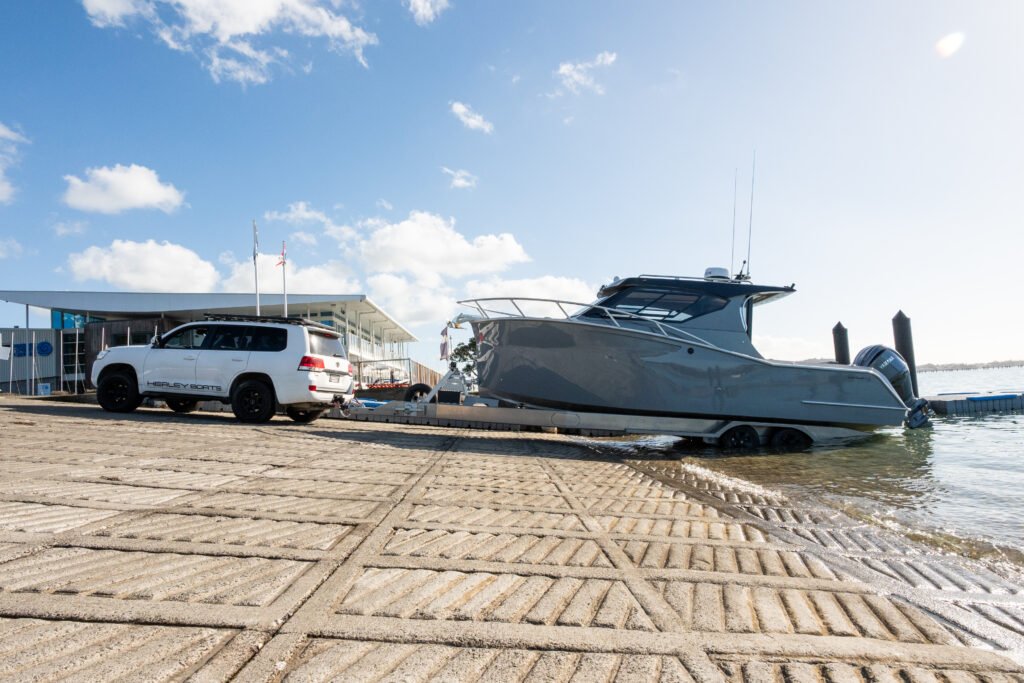
TRAILING ARM BOAT TRAILER SUSPENSION SYSTEM:
The TrailFlex boat trailer, developed and designed by the folks at Herley and marketed under the TrailFlex brand, utilises a trailing arm suspension system designed to remove one of the biggest worries of towing large, high-value boats: trailer suspension failure. Standard systems can suffer from broken springs, worn bushes and harsh road shock, especially under heavy loads and longdistance towing. The TrailFlex system uses heavy-duty trailing arms, available in galvanised steel or full 316 stainless steel, with loads absorbed through a progressive urethane bush. As the wheel travels, the load is absorbed through the bush, which is designed to progressively load rather than simply hitting hard against a fixed spring point. The result is a stronger, more controlled suspension platform designed to protect both the trailer and the boat.