
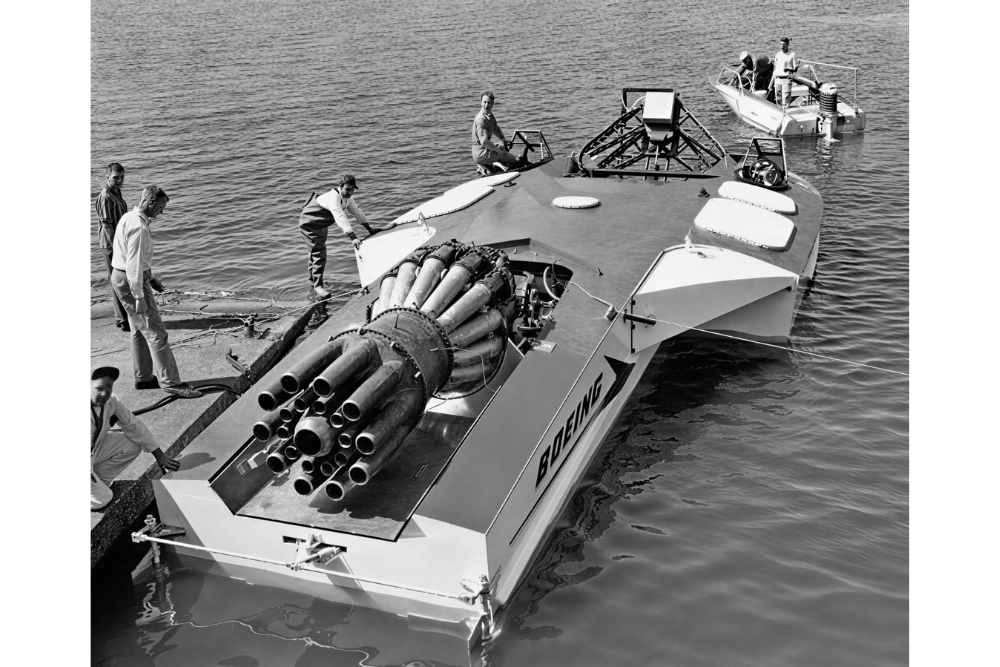

These remarkable images capture the Boeing Aqua-Jet, one of the most unusual and ambitious marine engineering projects of the early 1960s. Developed by Boeing Marine Systems during a period of intense technological experimentation, the Aqua-Jet was created to explore the potential of jet-powered marine transportation and high-speed watercraft.
At the time, Boeing was already at the forefront of aerospace development, and the company wanted to explore how aviation technology could be adapted for use beyond the skies. The Aqua-Jet became a striking example of that thinking, combining futuristic styling with a propulsion system more commonly associated with military aircraft than pleasure craft.
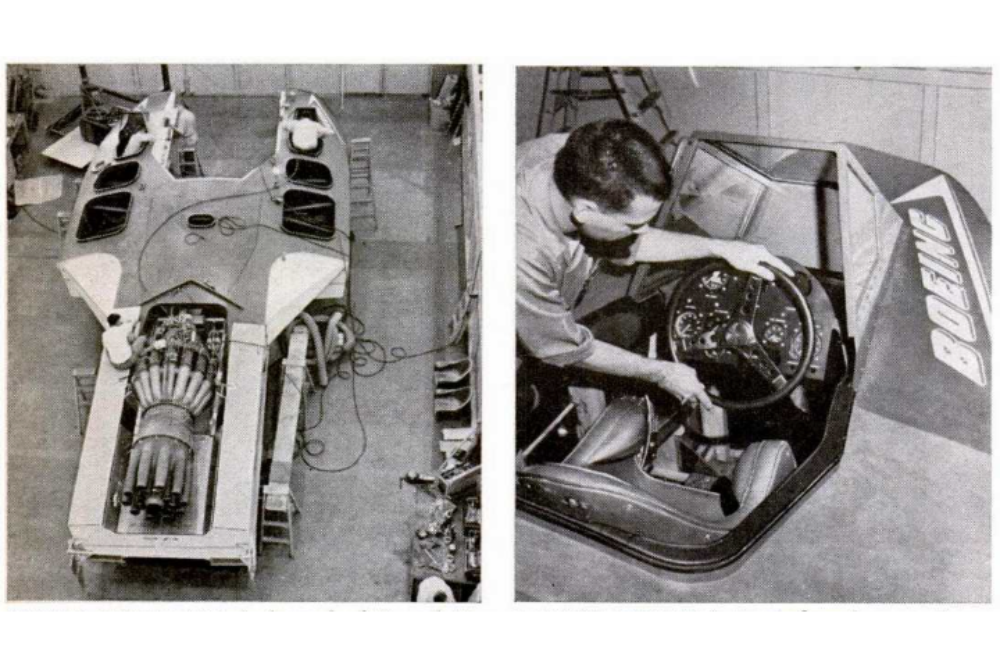
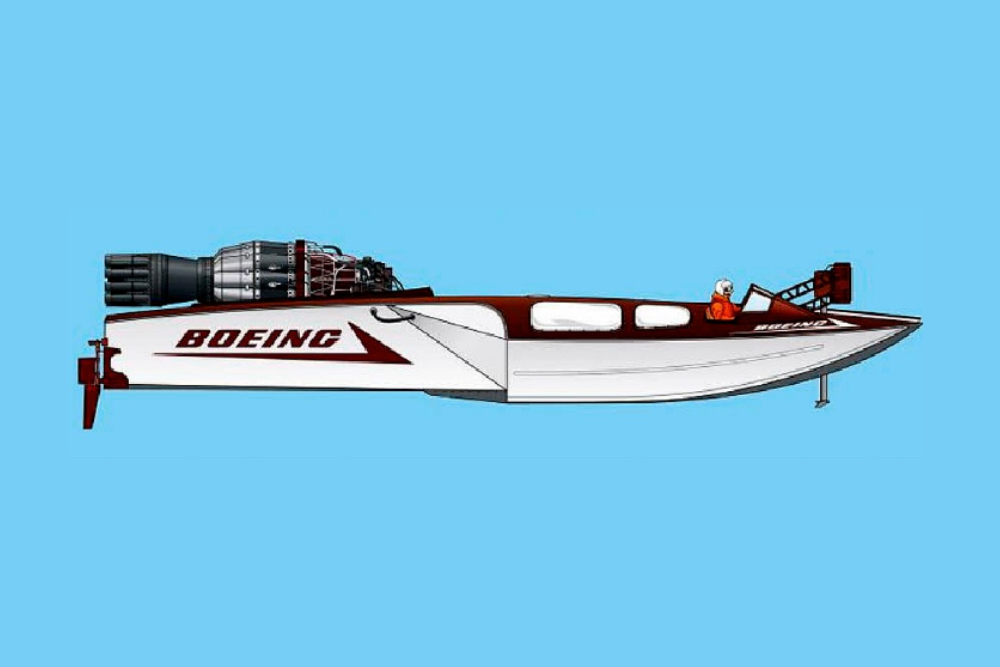
Measuring about 38 feet long, the experimental vessel was powered by an Allison J33 turbojet engine, a powerplant with origins in military aviation. Rather than using conventional marine engines, shafts, and propellers, Boeing engineers adapted jet propulsion technology to drive the craft across the water at extraordinary speeds.
During testing on Lake Washington around 1961, the Aqua-Jet reportedly reached speeds approaching 100 knots, or around 115mph. That performance placed it among the fastest experimental watercraft of its era and highlighted the extraordinary possibilities engineers were exploring at the dawn of the Space Age.
Its sleek profile, enclosed cockpit, and aircraft-inspired engineering gave the Aqua-Jet a look more science fiction than conventional boating. It reflected the optimism of an era when designers and engineers believed new forms of propulsion could dramatically reshape the future of transportation.
The project was also part of a much broader movement. Throughout the 1950s and 1960s, aerospace companies, defence contractors, and marine engineers experimented with everything from hydrofoils and gas turbines to jet propulsion and high-speed passenger craft. A growing belief held that technology developed for aircraft and military applications could be successfully transferred to commercial and recreational marine use.
Although the Aqua-Jet never progressed into series production, it was far from a pointless exercise. Experimental craft like this allowed engineers to better understand the challenges of stability, control, hull design, and high-speed operation on water. Knowledge gained from projects like the Aqua-Jet contributed to a broader understanding of advanced marine design and propulsion systems.
Ultimately, practical limitations meant turbojet-powered boats were unlikely to become a realistic replacement for conventional marine propulsion. Fuel consumption, noise, operating costs and the complexities of handling such immense power all counted against the concept.
Even so, the Aqua-Jet remains a fascinating piece of Boeing history and a memorable example of Space Age engineering ambition. It represents a time when engineers actively challenged the boundaries between aviation and marine technology, and when they were willing to explore ideas that seemed almost limitless.
More than six decades later, the Boeing Aqua-Jet still looks remarkably futuristic, a jet-powered reminder of an era when the question was not necessarily whether something was practical, but simply whether it could be done.
“Powered by a turbojet and born from the Space Age, the Aqua-Jet brought aviation technology to the water.”