ELEGANCE UNLEASHED
Against the backdrop of the early March afternoon, one boat stood out to me. Tucked quietly to a corner of the show was a nearly 17-year-old Palm Beach 55, presented in a condition that suggested not just caring ownership, but a level of timeless build quality that has endured. I recognised this particular Palm Beach 55 from when it was first delivered, originally customised for an Australian-based owner, who is now on his fourth Palm Beach.
When trying to categorise Palm Beach Motor Yachts within the context of this show, it was apparent that the company sits slightly outside of the usual production or even custom categories. While the company’s state-of-the-art facilities, build processes, and customer support infrastructure reflect those of a large-scale builder, founder and CEO Mark Richards maintains that the company’s core approach remains rooted in customisation.
“We started as a custom builder in 1995, and this remains our focus 31 years later,” says Richards. “We have the high-tech factory and processes of a production builder, but these allow us to deliver a custom yacht experience on time, on budget, and with the support our owners expect.” When speaking about the company’s past, and its recent 30 year old milestone, a defining nuance permeates within the conversation. Although he’ll refer to model nomenclature, this is often followed by referencing a particular owner and how they were able to build precisely what this owner wanted in their new yacht.
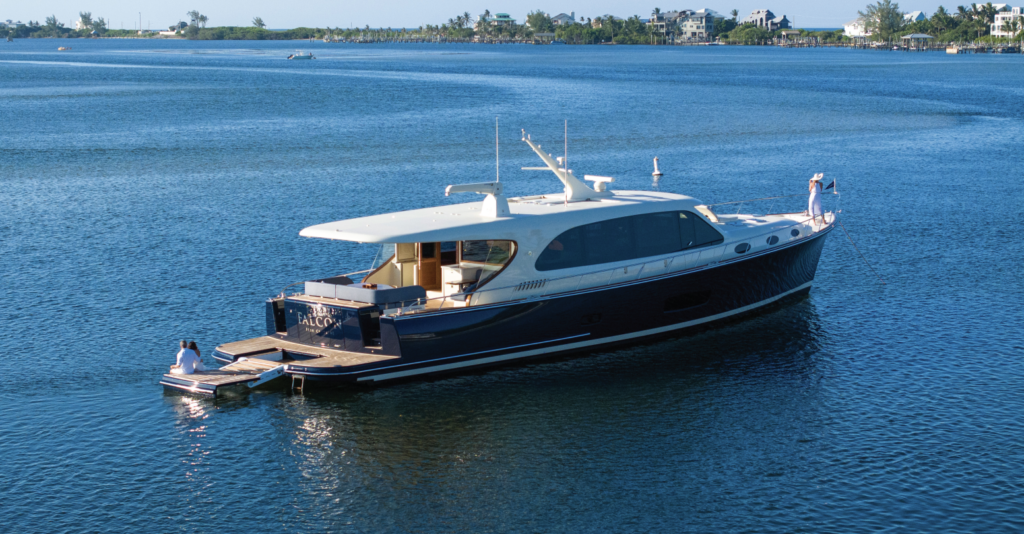
The Palm Beach 85, currently the largest model in the range until the 107 arrives in 2027, exemplifies this customer-first approach. Our test PB85 was delivered to a U.S. owner who began his Palm Beach journey with a PB50. He then moved to a PB52, followed by a custom PB70. Today he is enjoying his new 85, and, as this went to press, has already ordered a second 85, refining a few changes he’d like to incorporate for a planned Mediterranean cruising adventure.
Walking through the first Palm Beach 85 it became evident that this yacht was just as much of a reflection of the owner, as it was Richards’ experience and guiding hand. Despite sharing a proven hull platform, none of the first PB85s are identical. Skylounge, flybridge, and sedan configurations all exist, each reflecting an owner’s priorities and cruising style.
Accommodations
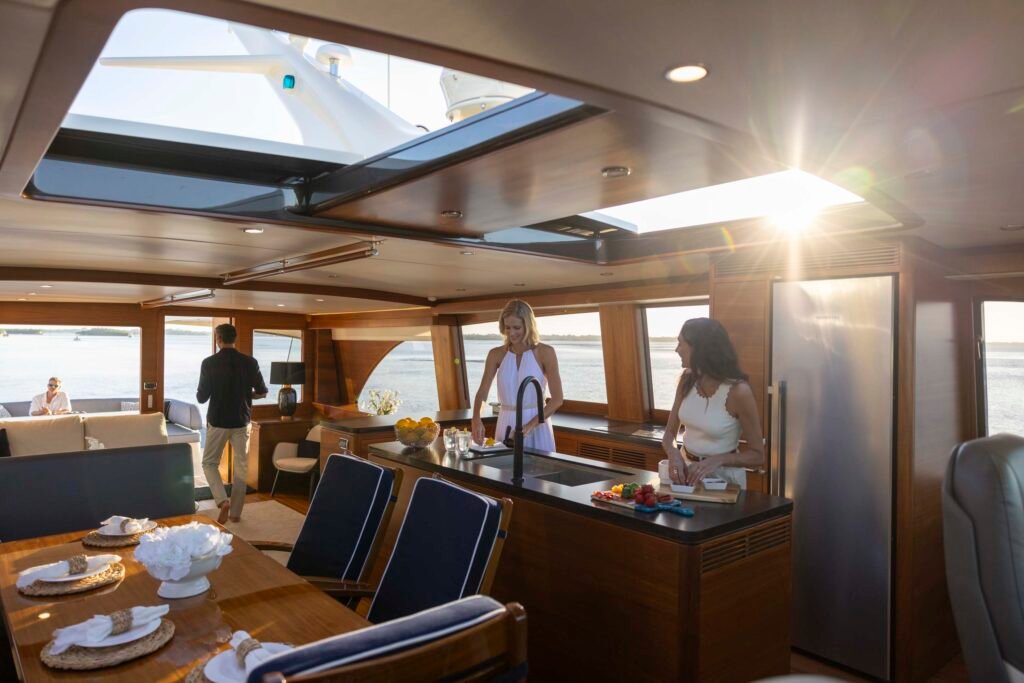
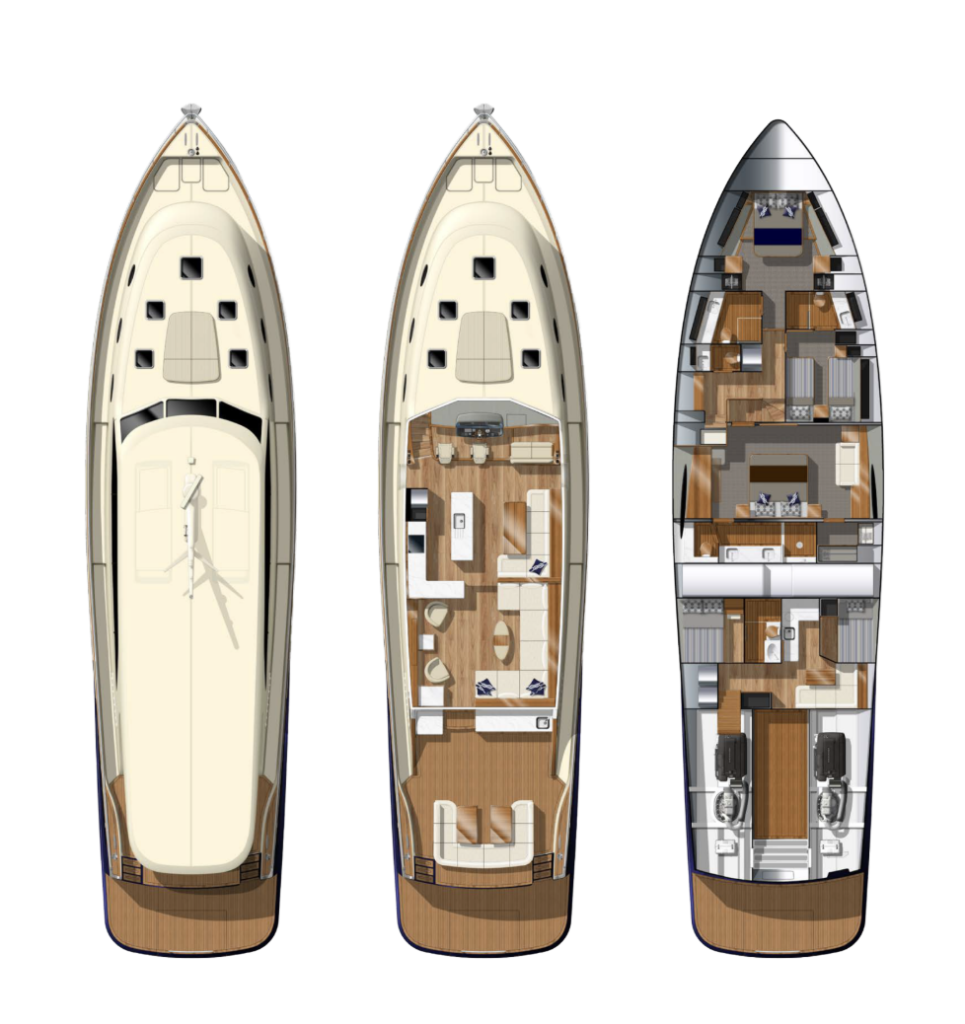
The PB85 Sedan we tested features a single-level main deck running from the helm through to the cockpit, creating a vast living space and giving the interior a cohesive feel with the outdoors. Perfectly matched teak presents an aesthetic that, like the Palm Beach 55 on display at the Auckland Boat Show, will look just as elegant decades from now. Large side windows with opening sections to allow fresh breezes along with overhead hatches bring in natural light and airflow, while sliding doors aft connect the saloon and cockpit seamlessly. It’s a layout that prioritises functional luxury and elegance.
The Skylounge version pushes the galley forward abaft the windscreen, giving the cook one of the best views on the water, and introduces a beautifully crafted staircase that connects the salon to the upper helm and lounge area. Essentially this layout provides another salon area in the Skylounge and can be fitted with a dayhead for long offshore runs.
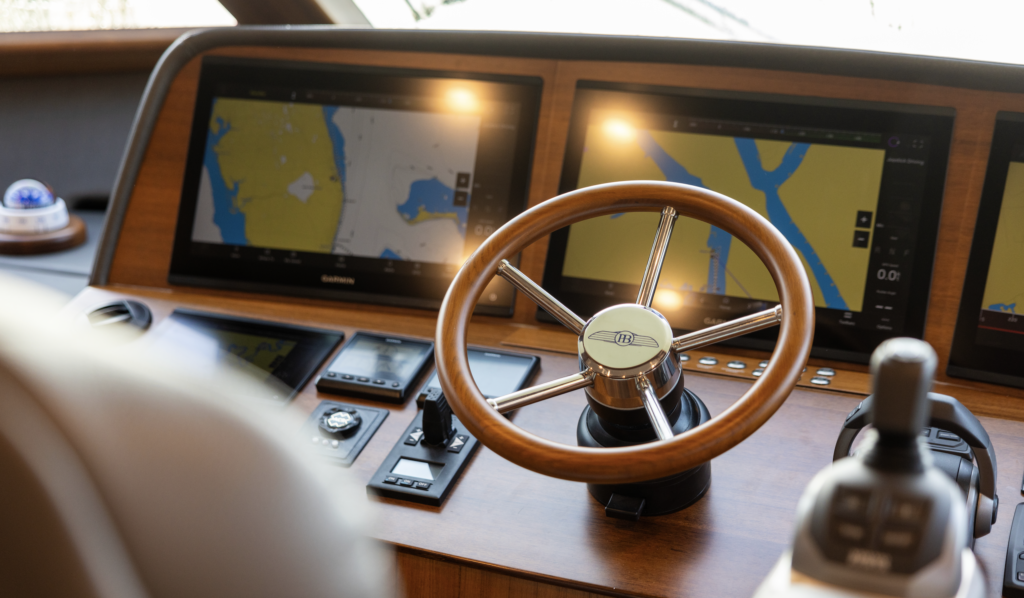
On our Sedan version test boat, the helm featured two pedestal Stidd seats, with a companion settee outboard to starboard, allowing four people to sit at the helm while underway. It’s a tested Palm Beach arrangement, though always tailored to the owner’s preferences. Two side doors in the salon feature adjacent wing stations just inside the door to allow for easier close quarters maneuvering. A joystick control is also fitted into the armrest of the captain’s helm seat.
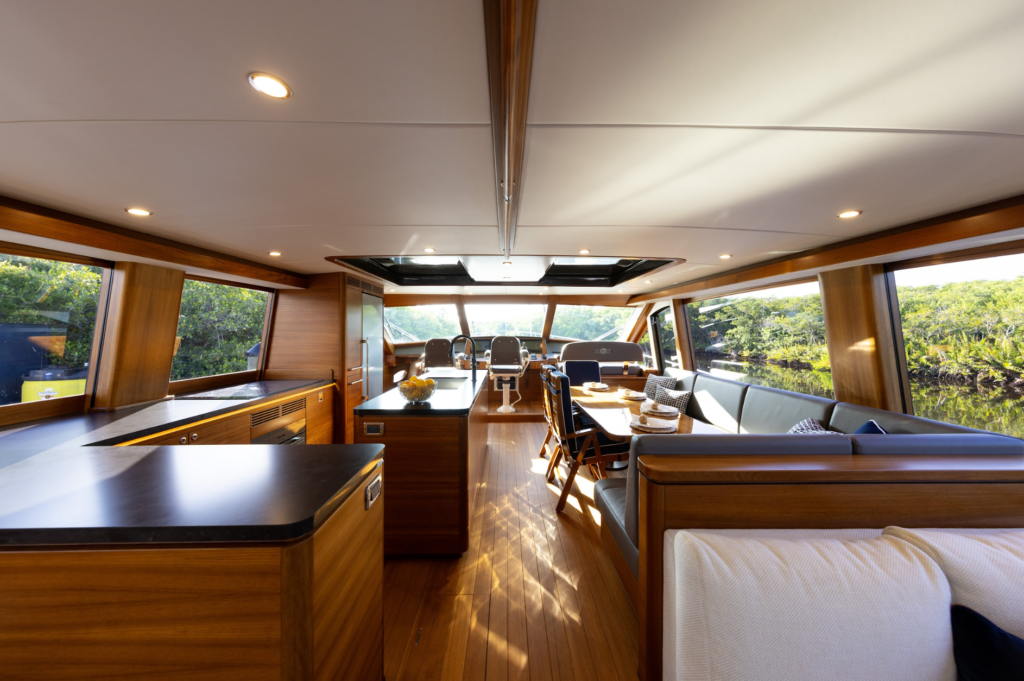
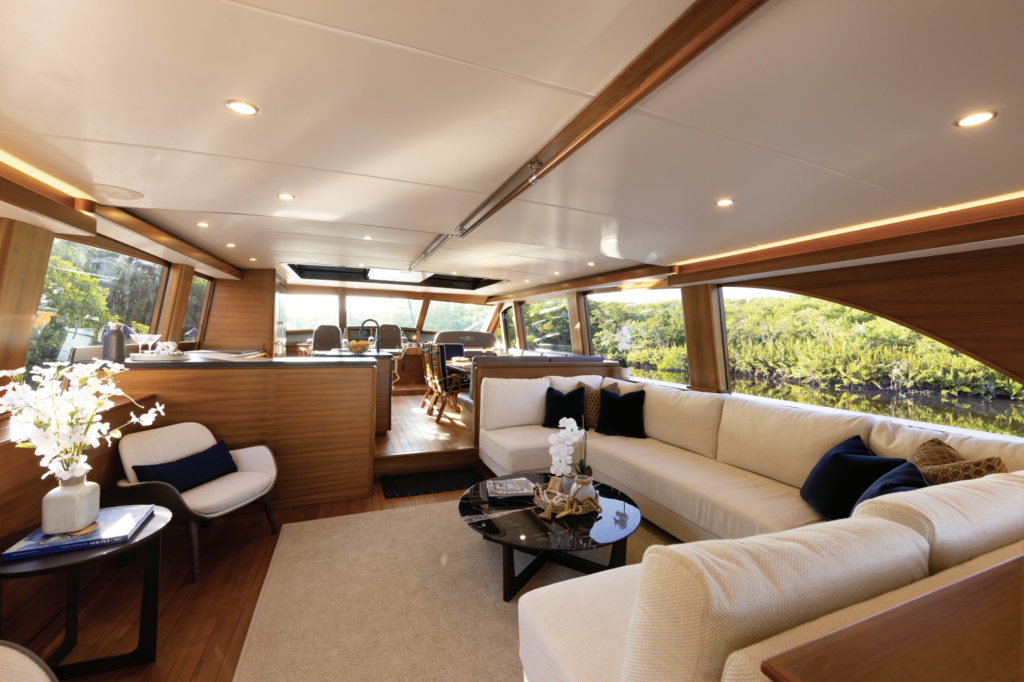
The dining area sits amidships, seating up to eight, with a lounge positioned further aft to create distinct social zones. The galley, located to port, remains open to the main space and is equipped with residential-grade appliances, generous bench space and loads of stowage to ensure the 85 is stocked and ready to go no matter where your adventures lead. This entire area is bathed in natural lights from the forward and side windows.
Further aft, the cockpit becomes a natural hub set up for informal dining with easy access to the swim platform. With a grill, refrigeration, and an icemaker, the cockpit is equally suited to entertaining at anchor or relaxing with a favourite book while underway. Palm Beach works with the owners in this area as well, and have built full bars with seating, additional lounge seating, extra freezers, and room for water toys. A huge lazarette runs between the split engine rooms to either side, and can be accessed from the swim platform or through the crew quarters. Here there is easy to access storage for lines, supplies, fishing gear or even SCUBA tanks if preferred.
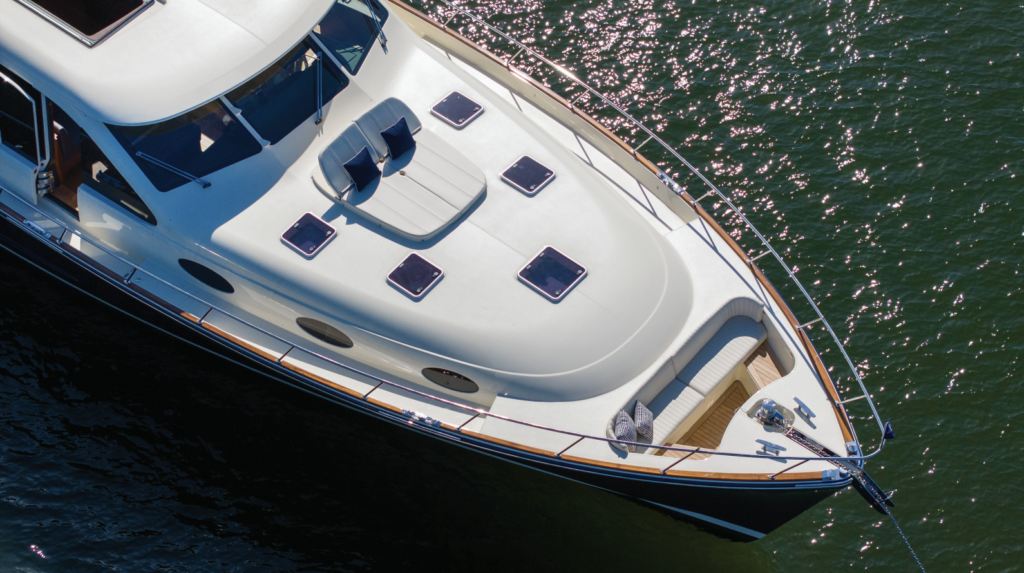
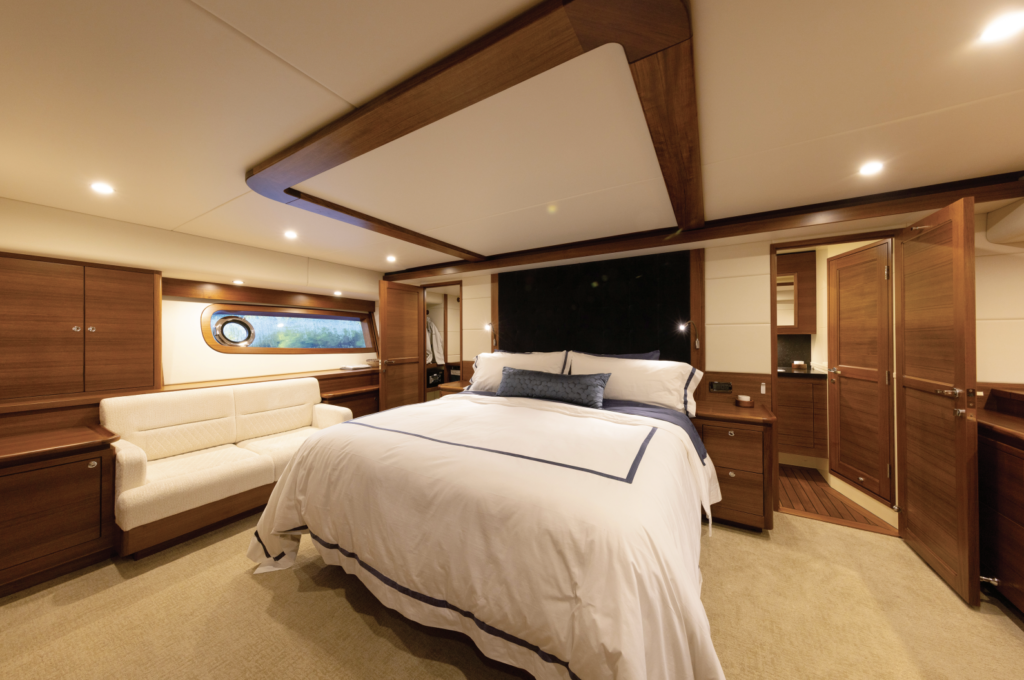
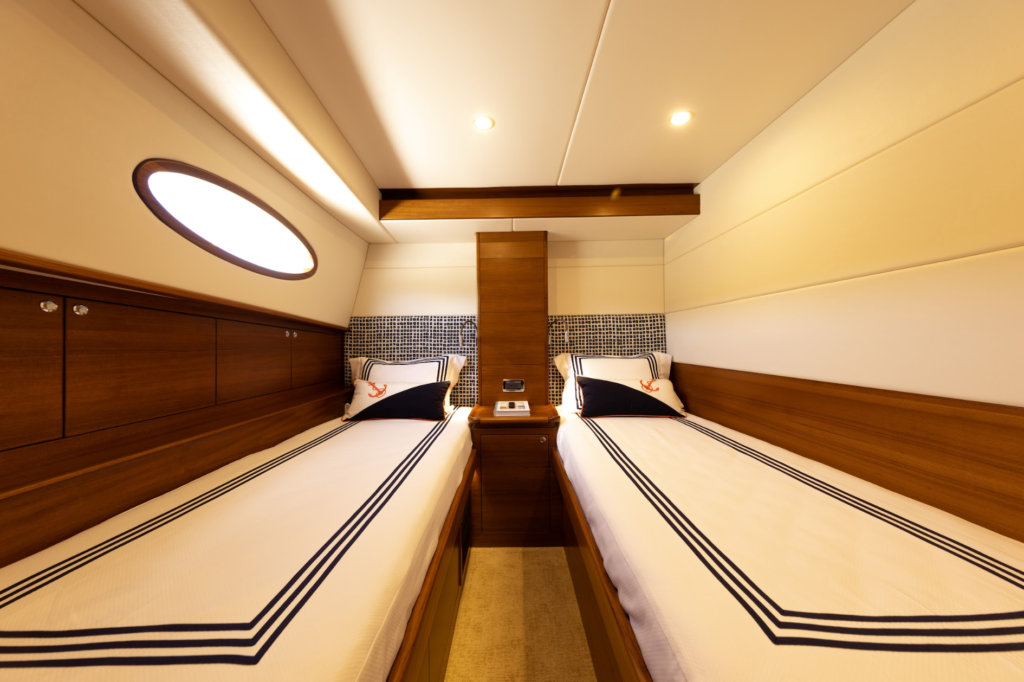
Forward, an optional bow cockpit seating area, available across the range from the PB55 upwards—adds another highly usable and very appealing space. Underway, it’s often the preferred spot onboard, and some owners have even opted to integrate a hot tub into this area. An added bonus in my opinion is that it actually makes working the foredeck lines or anchor easier as you’re nestled and secure while handling lines. Palm Beach can also incorporate shade units to allow an extra element of protection from the sun when anchored. Below deck, accommodation can be configured with three or four cabins, each with its own en suite. Crew quarters with two staterooms, additional laundry facilities, and a galley are accessed from the cockpit and can also offer additional accommodations for larger families who will not cruise with a crew. The interior is another area where owners bring their own experience to the brief. On our test boat, the full-beam master was amidships, taking full advantage of the available volume, with hull windows and again substantial storage suited to extended cruising. Interior finishes reflect a high level of craftsmanship, with a focus on detail and consistency throughout and a reminder that Palm Beach crafts everything in house from the handstitched upholstery to the stainless-steel details.
Performance
The PB85 is built around Palm Beach’s V-Warp® Technology, combining hull form design with lightweight composite construction. The structure integrates E-glass fabrics with carbon fibre reinforcement, bonded into a single framework that includes bulkheads, deck, and superstructure. The result is a relatively light, strong platform and very much influenced by Richards’ offshore sailing background. That strength is immediately noticeable underway, particularly in the absence of secondary noise or movement. Furniture and structural elements are bonded into the hull, becoming part of the boat rather than being built outside of the hull and then tabbed into place.
Power comes from twin 1,000-horsepower Volvo Penta IPS 1350s, delivering a top speed of around 27 knots and a cruising speed in the low 20-knot range. At approximately 21 knots, fuel consumption is a reported 58 gallons per hour combined, an area where Richards has long focused his efforts. Optional 1,300-horsepower MAN V8 diesels with straight shafts are offered as an option.
The review of the Palm Beach 85 brought back memories of my first sea trial with Mark Richards, nearly two decades ago after the Sanctuary Cove Boat Show, aboard a Palm Beach 50. I arrived with what I thought was a thorough boat testing kit. A stopwatch, inclinometer, and decibel meter. I laid everything out and got ready to measure the boat’s time to plane and running angles, and general “hole shot.”
As I fumbled with my kit, Richards just smirked seated next to me. He was going to let me discover the Palm Beach running characteristics on my own.
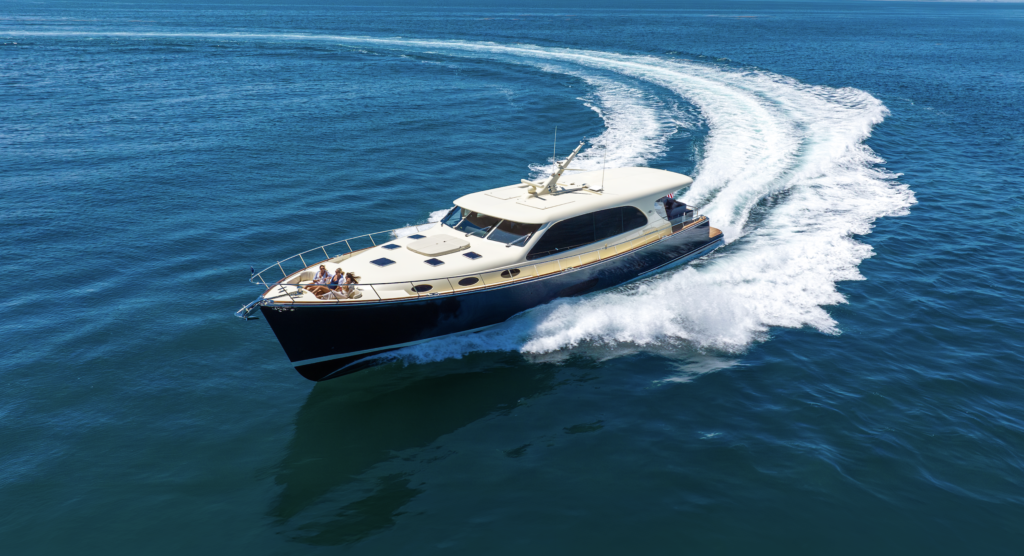
Looking back, I realise I brought a bunch of unnecessary tools to that morning boat ride down the Broadwater. I now appreciate a Palm Beach isn’t designed to behave like a traditional deep-V. In fact, there’s no dramatic transition onto the plane, no significant bow rise, and you don’t need to reach for the trim tabs to push the bow down mechanically to get the boat to plane. Instead, the hull is designed to run flat, maximising waterline length and efficiency, with no outside mechanical appendages necessary.
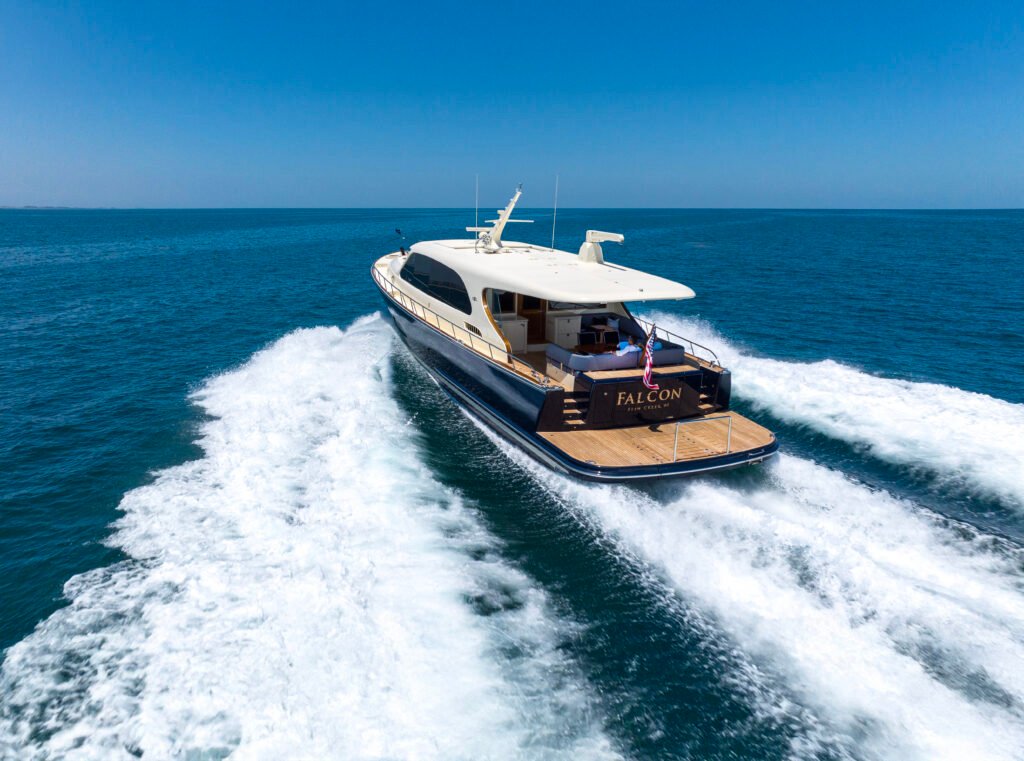
Similarly, the PB85 maintains a consistent running attitude, around five degrees, across the speed curve. In practice, driving a Palm Beach feels more like accelerating a performance car: add throttle, gain speed, without the boat noticeably changing its posture or shuddering in protest.
For Richards, during these tests the stern wake communicates much of the story. He’s quick to point out the relatively clean, minimal wake behind a Palm Beach. “It’s just wasted energy,” he says, gesturing at the larger wakes produced by other designs as they push through water versus gliding on top.
Additionally, the fine bow entry works effectively in head seas, while flatter sections aft reduce drag and increases efficiency. The transition between the two is gradual, giving the boat a predictable, composed feel across varying conditions. A small centreline keel assists with tracking.
At the helm, response is immediate without being overly sharp. The IPS system simplifies close-quarters maneuvering, and visibility from the lower helm is excellent. In fact, the owner of our test boat often runs his 85 short-handed, typically with just one other person onboard.
Build and Engineering
Where the PB85 stands apart is less about any single feature and more about how its elements all work together. For example, the construction process focuses on achieving an optimal resin-to-fibre ratio through infusion, using unidirectional and multi-axial fabrics throughout. These are bonded directly to a carbon fibre structure, creating a unified assembly rather than a collection of separate components.
In a typical Palm Beach, more than 50 percent of the boat employs carbon fibre, from bulkheads to deck and superstructure. The result is reduced weight, increased strength, and a lower centre of gravity, all of which contribute to efficiency and handling.
It’s an approach clearly informed by Richards’ sail racing background, where weight and structural integrity are closely linked. On the PB85, those principles are applied with a focus on consistency, efficiency and durability.
Systems
Over time, what stands out most is how the PB85 prioritises usability and to me reflects the results achieved when you have a shipwright like Richards building and designing boats. I’ve walked into engine rooms on boats half the size of this 85 and spend an inordinate amount of time trying to determine how to operate the boat. The engine space on the PB85 is comprised of two spaces, port and starboard, and as mentioned previously, both spaces are split by the lazarette. From the lazarette, two doors drop down allowing very easy access to the inboard side of both of the Volvo engines. The spaces are finished with the same level of detail as the entire boat, and all components are laid out neatly and easily serviced by an owner-operator. That is not an easy feat on a 27-metre boat.
Conclusion
After my review, I realised the Palm Beach 85 doesn’t try to redefine a category. Instead, it sidesteps it altogether. In doing so, the latest launch highlights what has long set Mark Richards’ approach apart: a focus on efficiency, innovation, and real-world usability, delivered through a platform that can be tailored to the individual.
Each PB85 begins with the same underlying principles, but the end result is always shaped by the owner. That bespoke element isn’t superficial; it influences layout, systems, and ultimately how the boat is used.
Richards’ influence is evident throughout. His background in performance sailing continues to inform how these boats are built and how they perform, but it’s tempered by a pragmatic understanding of what owners actually need from a cruising yacht.
The PB85 is, in many respects, a snapshot of that thinking today, refined, efficient, and beautiful. And if history is any guide, the next evolution of Palm Beach Motor Yachts is already underway.

SPECIFICATIONS
LOA 27.55m
Beam 6.76m
Top Speed 26 knots
Cruising Speed 23 knots
Range 700 Nm
Fuel Capacity 10,000L
Water Capacity 1,500L