



SEAFORCE’S GRP PONTOON BOAT FINALLY COMES OF AGE
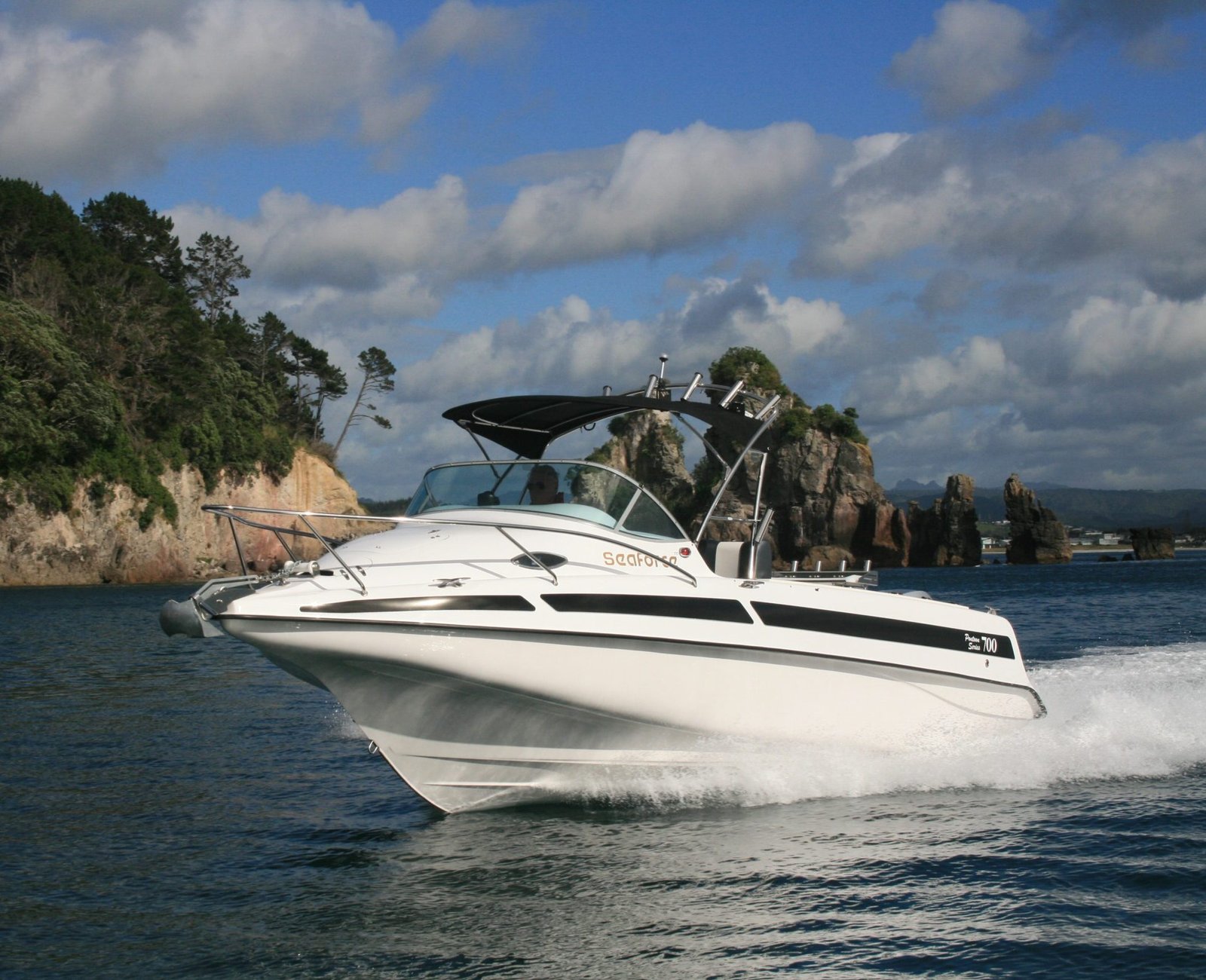
Ric Lawrence’s new Seaforce 700, is a real coming of age for a breakthrough innovation first unveiled some 21 years ago.
Seaforce Marine’s new flagship 700, launched just prior to Xmas 2025, had its genesis all the way back at the 2004 Hutchwilco New Zealand Boat Show. There, to much acclaim, an article in the NZ Herald and a coveted Boat of the Show Award (one of 8 for the small Hamilton yard), designer and boatbuilder Ric Lawrence proudly displayed his latest innovation: the Seaforce 530 Mate. Billed as the first of the company’s new Pontoon Series, it was a 5.3m cabin boat with an integral pontoon on each side.
It was not the pontoons that were the novelty; aluminium- and inflatable-pontooned vessels were becoming increasingly common. It was the fact that a) these pontoons were not “add-ons”, they were an integral part of the design, and b) they, like the rest of the boat, were moulded GRP.
When questioned about the thinking behind the innovative design, Ric referenced the old 90/10 rule: “90% of the time on the water is spent at rest.”
The integral GRP pontoons certainly gave great stability at rest. Just as importantly, the boat performed really well while underway, especially at higher speeds and the concept quickly proved popular. Variations (the open 530 Ute and the centre console 530 Skipa) soon followed; plans were underway for larger models and, seemingly quite suddenly, there were an impressive 44 Seaforce 530s gracing Kiwi waters. And then the GFC hit.
“We suddenly went from counting boats per month to months per boat,” Ric remembers. From a successful production GRP boatbuilder with a full order book, good brand recognition and an increasingly popular, innovative range of models, Seaforce Marine almost overnight became a mere shadow of its former self: building boats solely to order and literally waiting for the phone to ring.
However, it is a well-known truism that innovative people don’t stop innovating just because challenges arise. Having proved the GRP inflatable hull concept with the 530, Ric began focusing on a 7m version – and, some 14 years later, that concept has become a reality.
FULLY FISHING FOCUSED
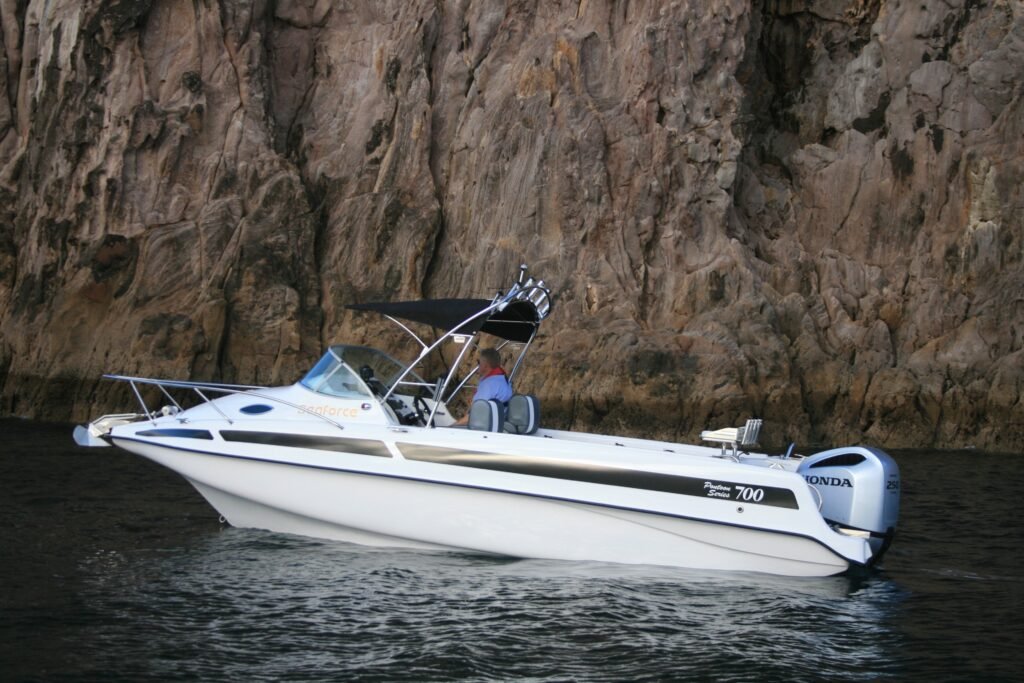
The new Seaforce 700 is unashamedly aimed at those who like to fish, with many of its features informed by the feedback from clients over more than 40-years.
“I initially designed it for the West Coast,” says Ric. “Not many people overnight out there so there really wasn’t a need for a top.” That said, the modern desire to escape the increasingly harsh sun has seen him add a rather stylish bimini (which just happens to come with some 8 additional rod holders, a brace of handy floodlights and a great spot to mount the centre white nav light).
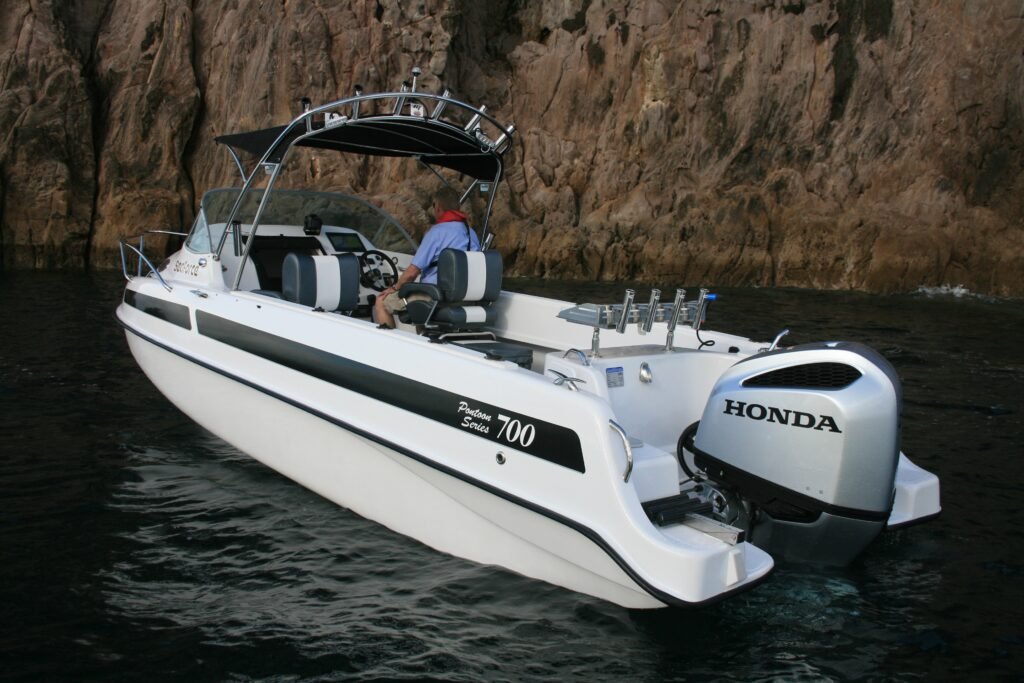
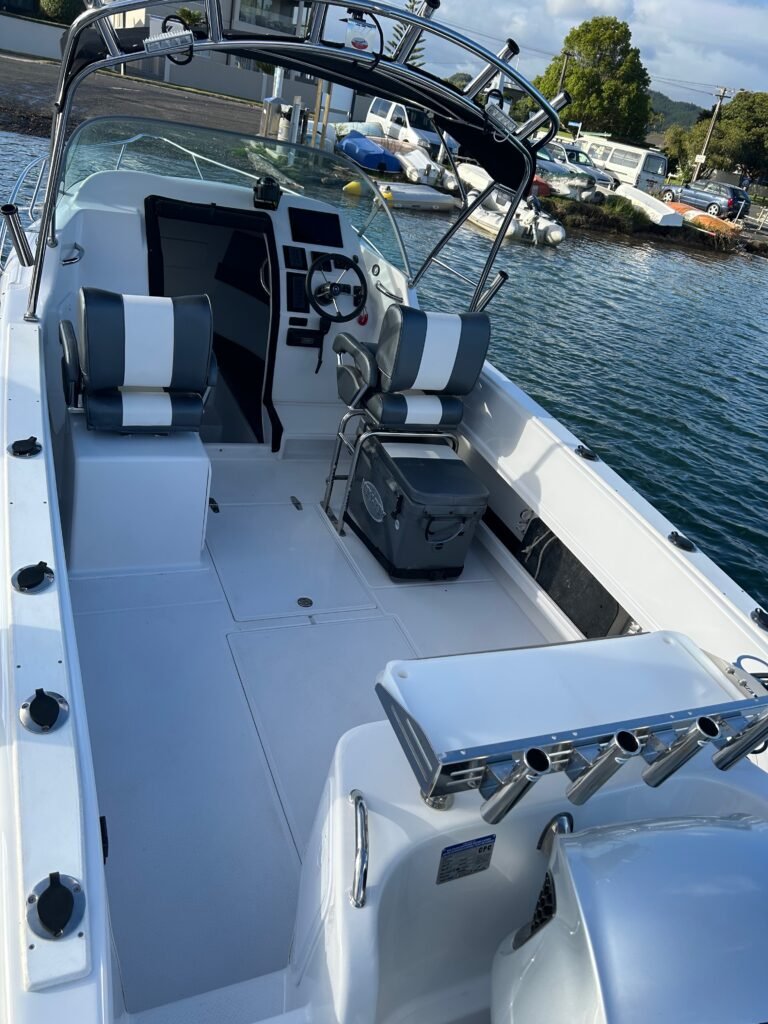
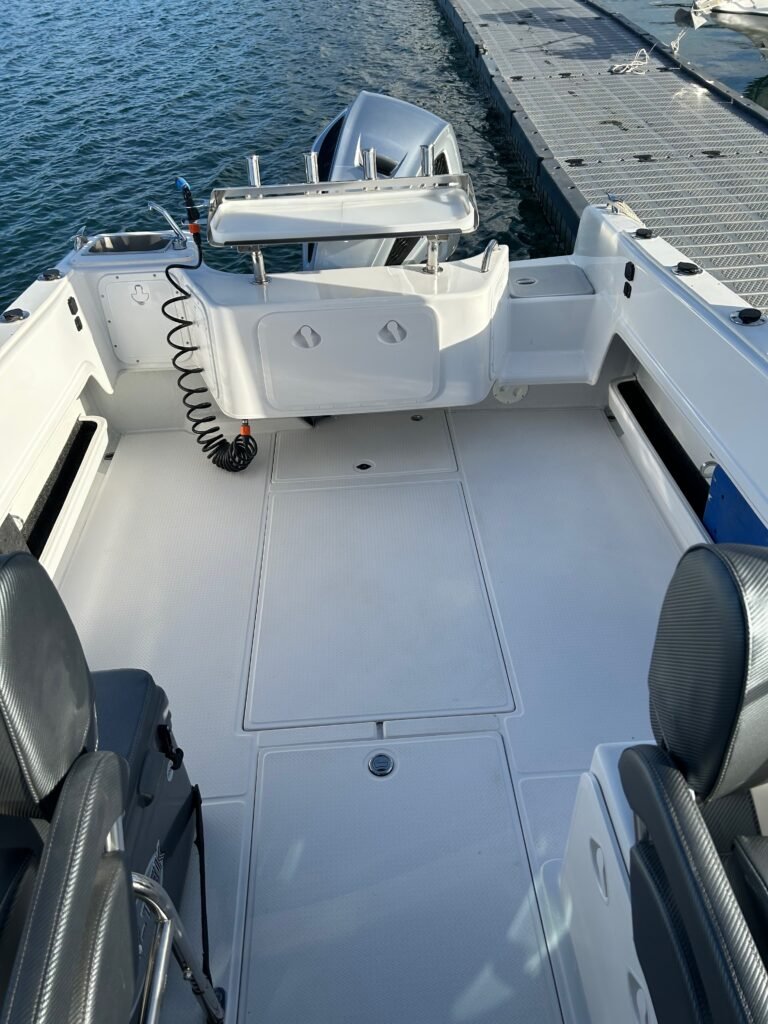
With the emphasis firmly on serious fishing, Ric has resisted any temptation to clutter his cockpit with additional seats or any other unnecessary fittings. Apart from the two bolster seats for’ard, there is nothing but delightfully free space all the way aft to the transom.
For this enthusiast, that is absolutely as it should be. While Ric stresses that four can fish easily from the 700, to my mind, any more than two just get in the way (family fishing trips aside).
In addition to those up on the bimini, there are another 4 rod holders per side with the gelcoat cockpit tops protected by a thick hard plastic liner. Small electrical panels with traditional 12v and 50amp DC outlets have been handily positioned near the transom on each side of the cockpit, ideal for powering everything from electric reels, downriggers and craypot haulers to spotlights and the like.
The generous side shelves provide storage for three rods and incorporate under-gunwale lighting. There is a fully-plumbed livebait tank under the access step to port and a sink, serviced by a salt water faucet and complemented by a sturdy spiral washdown hose, on the starboard side of the transom. Between them, a modified Manta baitboard has pride of place, complete with additional rod holders and an extra thick hard plastic inset.
The Seaforce 700 has been built to both survey and NZ Marine’s CPC standards. It is not surprising, therefore, that the electrics and the water have deliberately been kept well apart. The latter are all housed on starboard, the isolating switches and DC circuits are in their own locker on port and the twin batteries live in their own sealed locker in the centre, high above the deck. Access to the fuel filter, automatic bilge pumps and the like is under the transom.
The 700 comes with a range of fuel tank options. There are the standard 180-litre short range and 300-litre long range versions as well as the option to replace the large underfloor storage locker with another 250-litre tank.
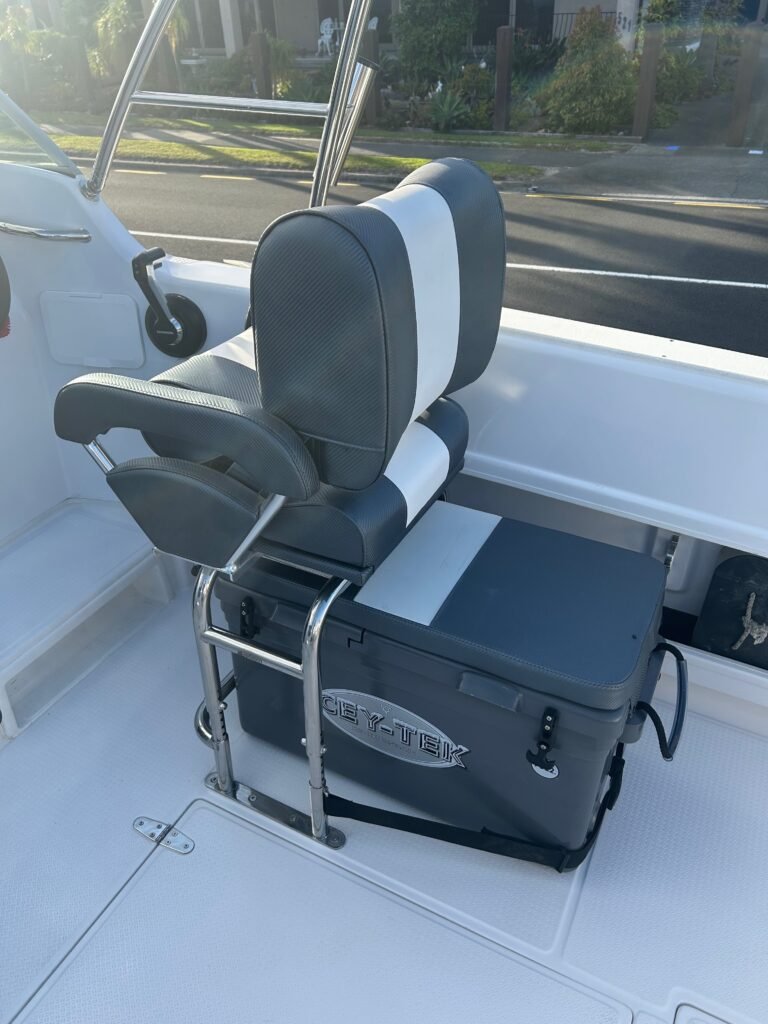
Although Ric has kept the seating to a minimum, he has certainly not stinted on what is there. Imported specially from Australia, the Relaxn bolster seats are smart, versatile and look extremely durable. The bolsters can be up for those preferring to stand, down for sitting and, depending on the position of the back rest, facing either forward or aft.
The starboard seat is on a stainless steel tube base so it can accommodate a large Icey-Tek bin while the port one sits on a GRP moulding suitable for lifejackets, dry bags and the like. It could also, says Ric, house a chemical toilet, keeping it, its smells and privacy issues out of the cabin. In the front is a horizontal bracket for a fire extinguisher.
Ric says he is also more than happy to accommodate a variety of different seating options for owners who would prefer a less fishing-oriented layout. Small, enclosed lockers for items like keys, phones, sunglasses, etc have been thoughtfully installed on both the skipper’s and passenger’s side, and there is another aft, back on the starboard side of the transom.
KEEPING IT SIMPLE
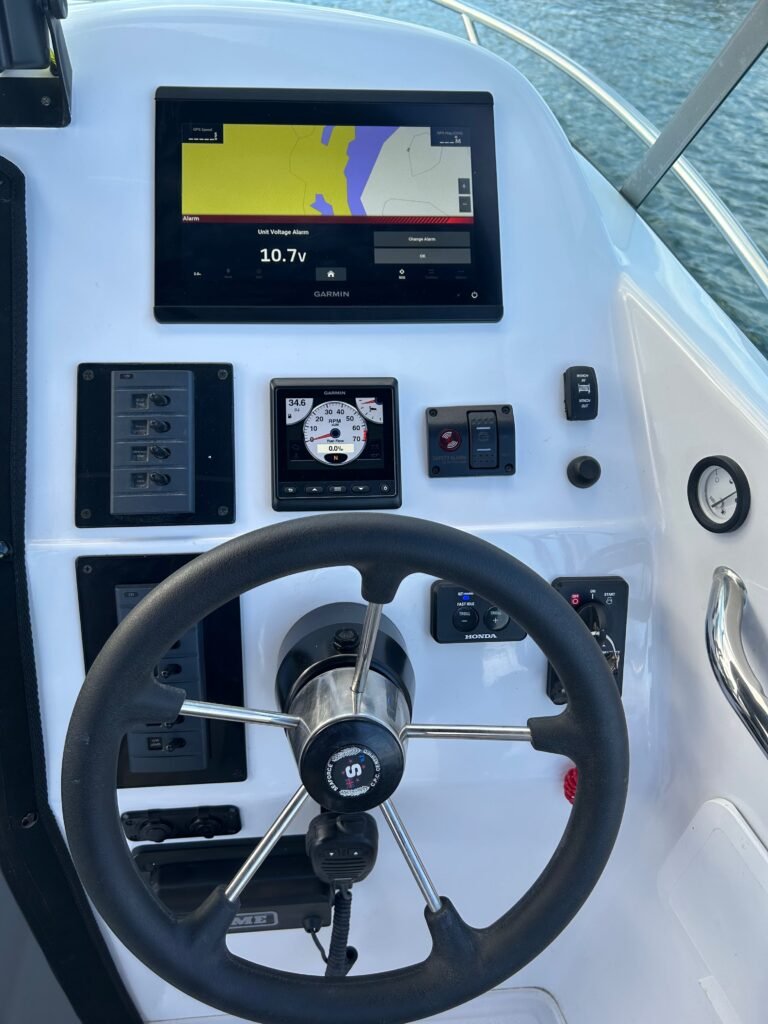
Like many modern trailer boat manufacturers, Ric has gone for the simple approach at the helm. The 12” Garmin MFD does most of the heavy lifting, leaving huge amounts of space for the few extras required: the Garmin engine and drum winch controls and the GME VHF. Off to the side are the fuel gauge and, this being a surveyed boat, an EPIRB in its own housing. (There are also a range of different transducer options, depending on the type of fishing the owner will be doing.)
Simple, however, definitely doesn’t mean unsophisticated. Quite the opposite. All the engine controls are fly-by-wire and hydraulic side shift tube steering has been installed, meaning there are no exposed rams. Ric has also made the most of the vessel’s full width transom to set it up to accommodate either single or twin outboards.
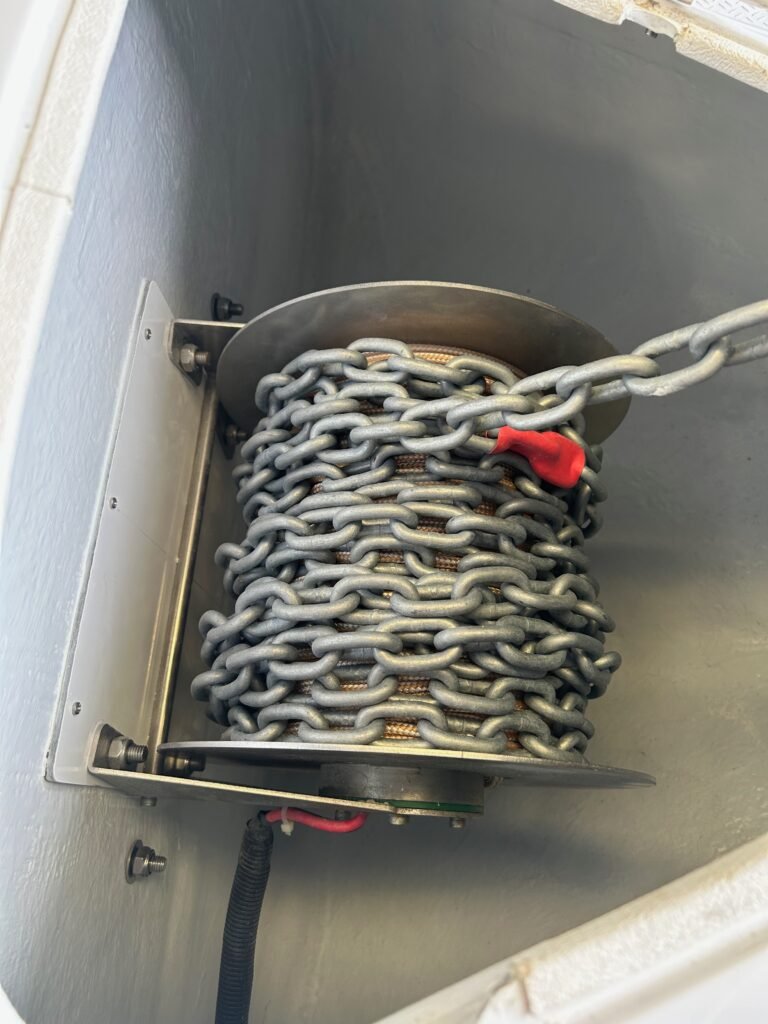
At the other end of the 700, the choice of windlass is just as noteworthy. The Smarter drum winch, designed and built nearby in Hamilton has its motor inside the drum. With no additional motor off to the side, the winch is both lighter and more compact than is usually the case, leaving lots of space for a grapnel should one be required. (A capstan windlass with the motor contained with the capstan housing is also available). The winch houses 10m of chain and 150m of rope connected to a Savwinch anchor.
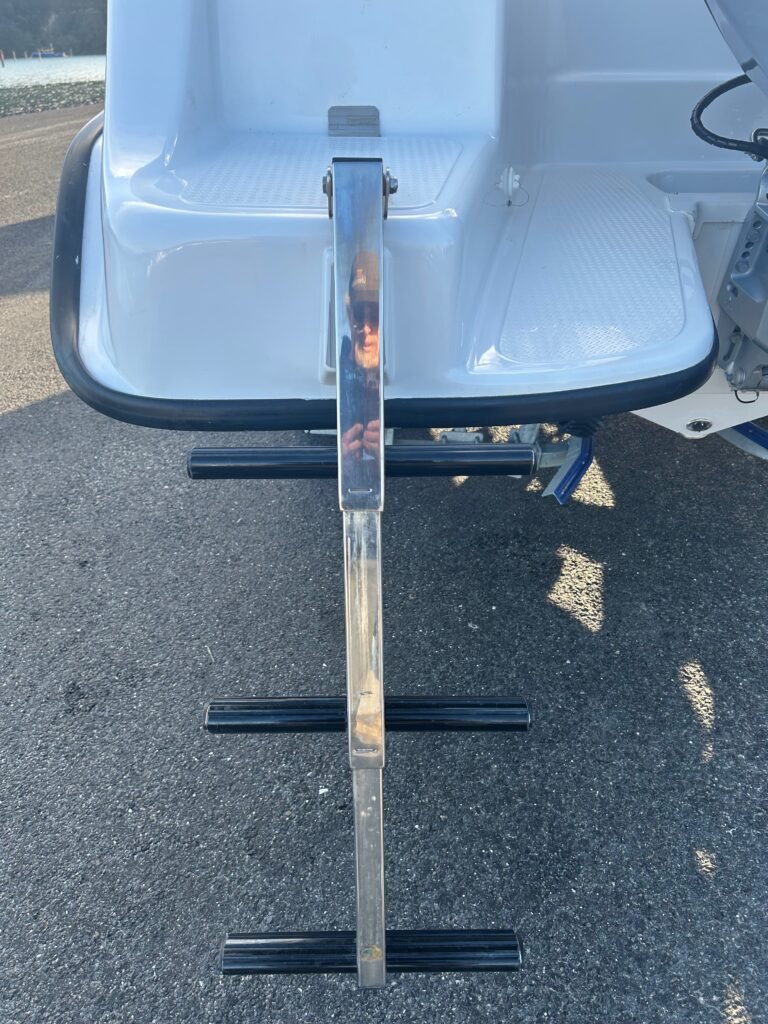
For those heading forward, there is anti-skid moulded into the gelcoat and all the stainless steel hardware (hand rails, cleats, the 3-step retractable stern ladder) are all specially imported by Ric.
Although it doesn’t appear so from the outside, the 700’s cabin is a spacious one. With squabs purposely designed to match those on the bolster seats, including twin inserts, it boasts 2m-long berths, lots of open stowage in big side lockers, a large foredeck hatch and a locker in the port bulkhead that has deliberately been designed to house a trolling motor display should one be fitted sometime in the future. (Ric already has a foredeck moulding for the motor ready to install.)
In another nice touch, GRP mouldings, rather than the more common carpet, have been used to line the cabin. This first 700 also comes with underwater lights and soon-to-be fitted outriggers and a radar.
UNDERWAY
The 700 comes on an Australian-made Seatrail doubleaxle trailer and, for a reasonably large craft, is relatively easy to launch.
The “fly-by-wire” connections give effortless control over the 250hp outboard both at low speed through the 5-knot area and out at sea.
The pontoons, although based on those used in the 530 design, are proportionally larger, to help carry the extra weight and, as Ric explains, they force air under the hull when underway. They also compress and hold it there, creating additional lift, effortless planing, better fuel economy and a softer ride, especially at higher speeds.
As with a traditional inflatable, the pontoons are carried well aft. This helps support the weight of the engine(s), keeps the stern stable and reduces the need for trim tabs.
The hull also handles any turns (especially those at high speed) with what feels like joyous abandon, performing more like a jetboat than a traditional monohull.
The combination of the pontoons and Ric’s hull design delivers a very soft and smooth ride, even in the sometimes nasty chop we encountered out of Whangamata. The boat planes easily and clearly uses its power efficiently; so much so that the 250 horses on the back are almost too much. Without experiencing it, it is hard to be sure but one suspects a single 150hp outboard would be all that is required unless regularly carrying large numbers of passengers and a lot of extra weight.
That said, this current set-up certainly eats up the miles. Heading back in we sat nicely on top of the chop, doing a more than respectable 27 knots and in absolute comfort.

CONCLUSION
Producing a new GRP model of trailer boat, especially one of this size, is not a quick, easy or inexpensive process, even for a larger well-established manufacturer. For a relatively small yard, with much smaller resources, it is a massive undertaking.
Although it has taken a while, it has obviously been worth it. Ric has (at the time of writing) two potential buyers jostling for possession of the first 700, another already sold for the next out of the mould, due for launch within the month, with serious interest from a couple more in the New Year. It seems the wait has been worth it.
SPECIFICATIONS
LOA 7.25m
Beam 2.48m
Deadrise 24 Degrees
Height on trailer 3.4m
Power options 150-250hp
Fuel capacity 180-280L
Engine Honda 250hp 4-stroke outboard
PERFORMANCE DATA
RPM KNOTS LPH
1000 3.5 2.8
2000 6.5 7.4
3000 11.3 24
4000 27 41
5000 33.5 54.7
6000 42.7 84

